
Livraison le jour même ou le lendemain

Qualité garantie

Débloquez vos offres de bienvenue: Livraison GRATUITE | Jusqu'à -80 % | 30 jours d'essai gratuits à JoyPlus
Téléchargez l'application
Equipping your kitchen with a new cookware set for all hobs, including induction, can quickly become a headache. Between marketing promises of revolutionary coatings and tempting designs, it's easy to end up with a set of pots and pans that loses its appeal after just a few months. As home equipment experts, our mission is to decipher the technical specifications for you, helping you make an informed, durable choice that's genuinely suited to your daily life. Let's break down the pitfalls to avoid and the criteria that truly matter.
The market is flooded with options, but not all are created equal. Here are three classic mistakes that lead to purchases you'll soon regret.
To make the right choice, here are the three technical points to inspect closely before confirming your purchase.
For a utensil to work efficiently on an induction hob, its base must be ferromagnetic. This is what allows the creation of the magnetic field needed for heating.
The choice of material has a direct impact on cooking performance, maintenance, and the durability of your cookware.
Everyday comfort comes down to details that are anything but.
Keeping these criteria in mind, here are a few products that stand out and meet specific needs.
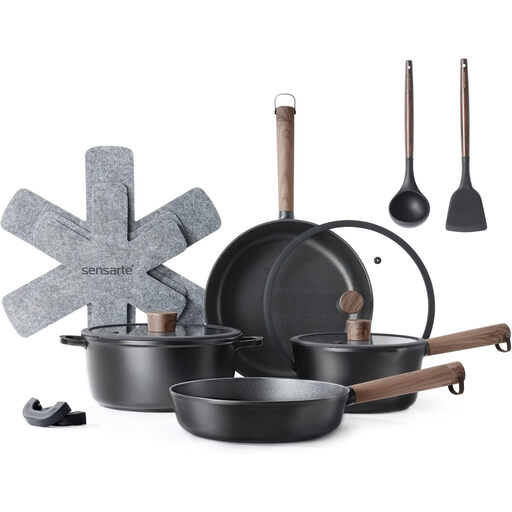
Why we love it: This complete cookware set meets most of a family's needs. With its frying pans, saucepan, and stockpot, it allows for preparing a wide variety of dishes, from the simplest to the most elaborate.
Its non-stick coating is guaranteed PFOA/PFOS-free, and its composite base ensures fast, even heating on induction, thus preventing hot spots.
A very comprehensive set including lids, utensils, and pan protectors. Oven-safe up to 287 °C (550 °F) (without handles), offering great versatility.
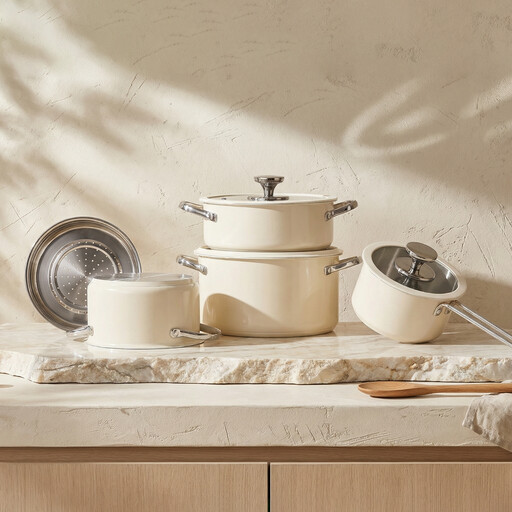
Why we love it: Perfect for those who make healthy and durable materials an absolute priority. The 304 stainless steel interior is a benchmark for healthy cooking, with no risk of particle migration and ultra-resistant to corrosion.
This set bypasses non-stick coatings and their wear-and-tear by opting for a stainless steel cooking surface, renowned for its longevity and neutrality in contact with food.
Versatility is key, with a stockpot, Dutch oven, saucepan, and steamer basket included. The ceramic exterior coating makes cleanup much easier.
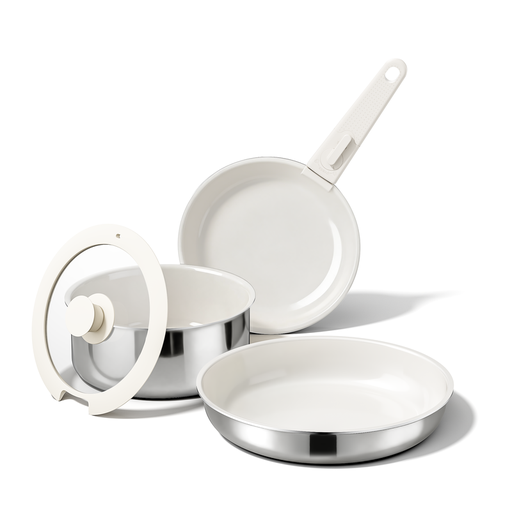
Why we love it: The perfect solution for studios, small apartments, or even camper vans. The removable handle allows the items to be stacked for maximum space-saving, without compromising on cooking quality.
It puts an end to the storage headache. The detachable handle system is secure and stable during use, then removes for storage or for use in the oven.
Total versatility: the pieces go from the hob to the oven (up to 250 °C / 480 °F), then to the table as a serving dish, and finally to the fridge to store leftovers. The ceramic-titanium coating is guaranteed PFOA-free.
We have selected a full range of products that meet our quality criteria and current safety standards.
The magnet test is the simplest and most reliable method. Take a magnet (a simple fridge magnet will do) and place it on the bottom of your pot or pan. If it sticks firmly, the cookware is compatible. You can also look for the coil symbol (a series of loops) on the packaging or underneath the product.
Its lifespan will always depend on the quality of the coating and your maintenance. A good quality coating, used over moderate heat and cleaned with non-abrasive sponges, can retain its properties for several years. Absolutely avoid metal utensils, which can scratch and damage it prematurely.
Each material has its advantages. Stainless steel is considered one of the most stable and neutral materials, ideal for all types of cooking, especially stews. Ceramic is a good PTFE-free alternative for cooking with little fat. A non-stick coating, provided it is certified PFOA-free and free of other controversial substances, remains very practical for delicate foods like eggs or fish. Ultimately, the choice will depend on your priorities: durability, ease of use, or the type of dishes you prepare most often.