
Livraison le jour même ou le lendemain

Qualité garantie

Débloquez vos offres de bienvenue: Livraison GRATUITE | Jusqu'à -80 % | 30 jours d'essai gratuits à JoyPlus
Téléchargez l'application
Whether you live in a cramped city apartment or a well-organised family home, optimising space is a constant challenge. In response, cookware with a detachable handle has emerged as the miracle solution for decluttering our cupboards. But be warned: behind the promise of perfect storage lie pitfalls that can quickly turn a good investment into a costly disappointment.
Before you splurge on your next stackable pot and pan set, it's best to know the three most common traps:
This guide is here to help you avoid these pitfalls and choose a kitchen set with a removable handle that delivers on all its promises: practicality, durability, and versatility.
To avoid unpleasant surprises, here are the technical points that make all the difference.
The most critical component of space-saving cookware is its handle system. A good mechanism must ensure a firm lock, with no wobble whatsoever, even after hundreds of uses. Favour systems that confirm attachment with an audible "click" and are designed to support a weight far greater than that of a full pot. The ability to attach and detach it with one hand is a real everyday bonus.
The choice of materials directly impacts the longevity of your cookware and the quality of your cooking.
The real strength of a removable set is its ability to juggle between uses. Systematically check the following points:
Because every household has different needs, here is a selection of options that cater to distinct user profiles, always keeping our criteria of quality and practicality in mind.
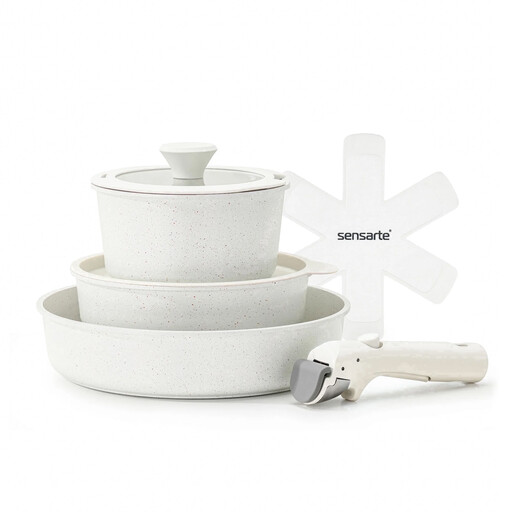
Why we chose it: This set is designed for maximum space optimisation. It includes not only cooking utensils but also storage lids and pan protectors. An all-in-one solution for cooking, storing, and organising without the clutter.
The handle, designed to support up to 10 kg (22 lbs), addresses the stability problem. The included pan protectors prevent scratches on the coating during stacking.
An ultra-complete set with its protection and storage accessories, perfect for a first kitchen or small spaces.
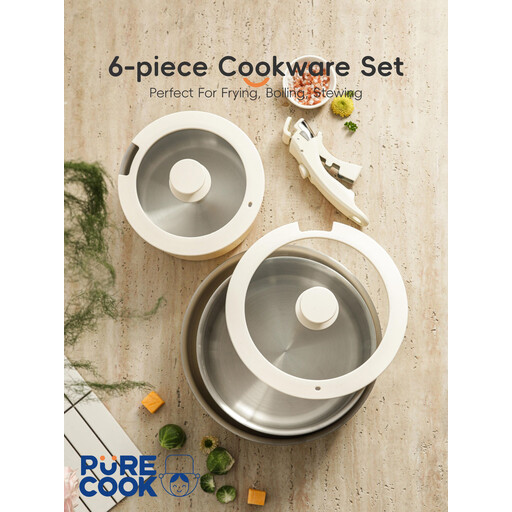
Why we chose it: For anyone who prioritises durability and material safety. The 304 stainless steel interior is a guarantee of food-grade quality, while the ceramic exterior makes cleaning easy. A choice firmly focused on longevity and peace of mind.
By opting for an uncoated stainless steel interior, it eliminates the risk of a degrading non-stick surface. The exterior ceramic coating is designed to withstand temperatures of 200 to 300°C (392 to 572°F).
Food-grade 304 stainless steel interior, durable and healthy, combined with an easy-to-clean ceramic exterior. PTFE and PFOA-free.
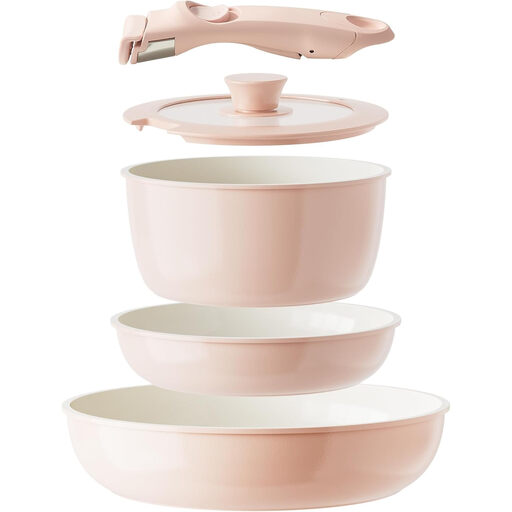
Why we chose it: This set is for those looking for a true all-in-one system. Its very high-temperature oven compatibility (up to 450°C / 840°F according to the manufacturer) makes it suitable for all recipes, from the stovetop to the grill, as well as for serving at the table and storing in the fridge.
It sidesteps the "false versatility" trap by boasting very high-temperature oven compatibility. A rare asset that confirms its suitability for demanding cooking methods, including grilling.
A seamless transition between all cooking modes (including high-temp oven) and serving. Ceramic coating guaranteed free of PFAS, PTFE, and PFOA.
Discover our complete and updated selection of products that meet our strict selection criteria and current safety regulations.
Its longevity depends on the quality of the mechanism and your care. A robust metal system that is well-maintained (cleaned regularly, not put in the dishwasher if not recommended) can last for many years. We advise you to periodically check for any looseness and always follow the manufacturer's instructions.
Yes, but only if you take a few precautions. Using felt liners or pan protectors (sometimes included) is essential. These inserts create a physical barrier that prevents direct contact between surfaces, thus preventing scratches and premature wear of the coating.
Absolutely not. Performance on an induction hob depends directly on the quality and size of the ferromagnetic base. A thick, wide base ensures efficient energy transfer, rapid heating, and even heat distribution. Conversely, a poor-quality base will result in slow, uneven heating and higher energy consumption.