
Livraison le jour même ou le lendemain

Qualité garantie

Débloquez vos offres de bienvenue: Livraison GRATUITE | Jusqu'à -80 % | 30 jours d'essai gratuits à JoyPlus
Téléchargez l'application
By Joybuy, our product expert – Published on August 27, 2026
Choosing a cookware set with a detachable handle is a game-changer for anyone looking to optimise their kitchen space. Whether you live in a studio, a small city apartment, or are outfitting an RV, the promise is alluring: perfectly stackable pots and pans for maximum space-saving, complete versatility from stovetop to oven, and finally, simplified storage.
However, behind this ingenious concept lie several marketing traps that can turn a good investment into a costly disappointment. Before you make a decision, it's best to know how to decipher the labels to distinguish false promises from genuine benefits.
The market is flooded with options, but they are far from equal. Here are the most common traps and our advice on how to avoid them.
To navigate the offers with confidence, focus on these three technical parameters that make all the difference.
The non-stick coating is at the heart of your cooking experience.
Modularity is the core purpose of these sets.
For kitchen tools in a small kitchen, every square centimetre counts.
We have analysed several models based on criteria of practicality, material safety, and versatility. Here are options that meet specific needs.
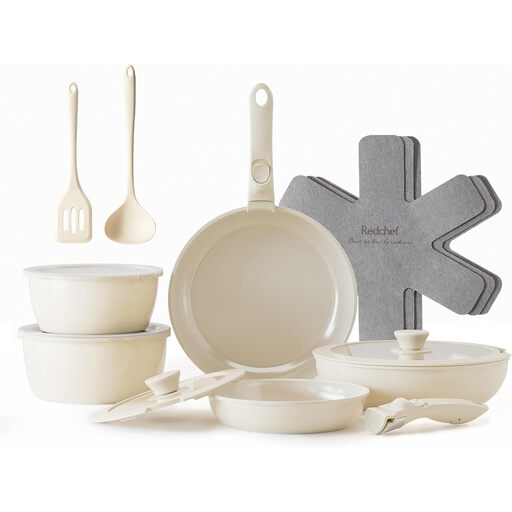
Why this model stands out: Perfect for those who are seriously short on space (studio, camper van). This ultra-complete set checks all the boxes: cooking, oven use, serving at the table, and storing in the fridge.
It counters the false versatility trap by boasting oven compatibility up to a very high temperature (advertised at 450°C) and a design that truly facilitates transitions between uses, not just storage.
The 16-piece set covers almost all needs. The ceramic coating is advertised as being free of PFAS, PTFE, and PFOA.
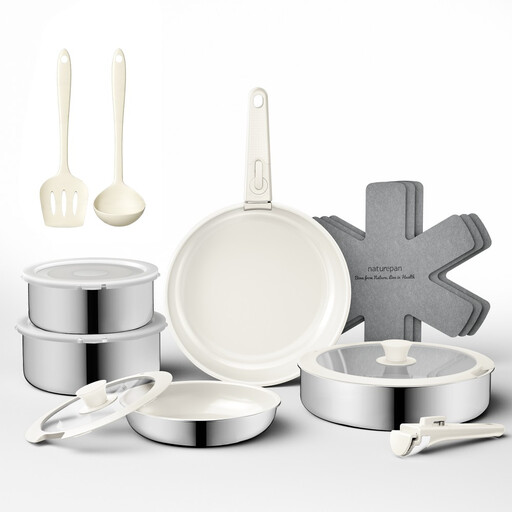
Why this model stands out: This set goes all-in on durability and food safety with a stainless steel body and a reinforced ceramic coating, advertised as PFOA-free.
It tackles the trap of a "healthy" but fragile coating by combining a robust triple-ply stainless steel base with a reinforced ceramic coating (diamond-titanium, according to the brand), promising better longevity.
The stainless steel construction ensures excellent heat distribution and great durability, while the reinforced coating is designed for intensive daily use.
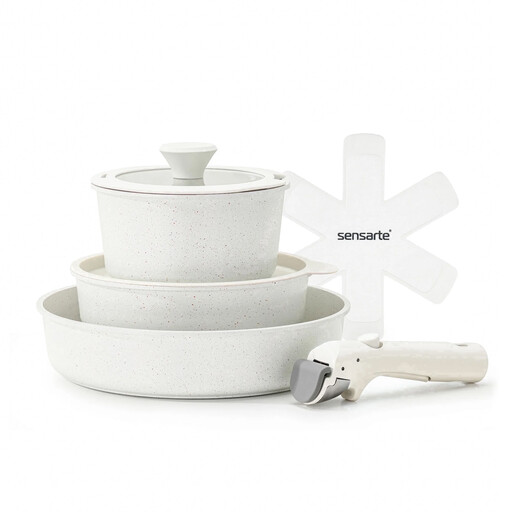
Why this model stands out: An excellent starting point. This 8-piece set gets straight to the essentials (two pans, one pot) and adds clever accessories like storage lids for the refrigerator.
It tackles the "poorly designed space-saving" trap by offering a coherent system: the cookware stacks and the silicone lids transform the pots into airtight containers, optimising space even in the fridge.
The anti-oxidation coating on the entire body is designed to prevent exterior blackening, a common problem that ruins the aesthetics of cookware over the long term.
We have compiled a complete and updated list of products that meet our strict selection criteria and current safety regulations.
This is a legitimate concern. Modern locking systems are designed to be very robust. Look for models where the handle can support a high weight (often indicated by the manufacturer, e.g., up to 10 kg) and that have a multi-point locking mechanism. The best practice: always check that the handle is securely locked before lifting a full pot.
The longevity of a ceramic coating depends on its quality and, most importantly, its care. On average, with proper use and maintenance, it will remain effective for several years. To preserve it, avoid thermal shock (going from hot to cold abruptly), prefer hand washing with a soft sponge, and only use wooden, silicone, or nylon utensils.
The answer is a categorical no. It is strongly advised not to use metal utensils on any type of non-stick coating, including ceramic. Even the most resistant coatings will eventually scratch, which will destroy their non-stick properties and reduce their lifespan. Always opt for spatulas, spoons, and whisks made of soft materials.