For dinner with friends, plain rice that’s ready to heat lets you choose the accompaniments separately. First, compare the energy per 100 g, then consider how much you plan to serve. Among the products listed by Auchan and Carrefour, values range from 134 kcal per 100 g for Ben’s Original long-grain rice to 164 kcal per 100 g for its Mediterranean-style recipe. Also check the number of portions, the ingredients and the storage instructions: a pouch of rice to serve as a side and a complete dish to share won’t meet the same needs.
Who is this choice for?
Anyone comparing the energy content of side dishes
If rice is just one part of dinner, compare the nutritional values per 100 g of products that are already cooked, then take the serving size into account. A lower value than another product’s doesn’t make it a “low-calorie” food.
Anyone preparing a meal at the last minute
An express pouch can make preparation easier, as long as you work out how many you’ll need for your guests and follow the heating instructions. Formats and recipes vary from product to product.
Groups keeping an eye on certain ingredients
If any of your guests avoid pork, eggs or milk, you can’t automatically swap one rice recipe for another. Read the ingredients list and allergen information for the product you choose before planning your menu.
What should you look for?
First decide whether the rice will be a side dish you can customise or a prepared dish to share. Then compare the values per 100 g for products in the same state, before checking portions and ingredients.
Plain express rice
Choose this if: you’d like to add the other elements of dinner separately.
Remember to: season it and work out how many pouches you’ll need for the group.
Seasoned express rice
Choose this if: you’d prefer a prepared recipe that’s quick to serve.
Check: the ingredients in each variety, as these may be harder to adapt to your guests’ needs.
Prepared rice dish to share
Choose this if: you’re looking for a sharing format rather than a base to add to.
Remember to: check the storage requirements and make sure the recipe suits everyone at the table.
| Criterion | What to check | Who is it for? |
|---|
| Energy per serving |
Compare the kcal per 100 g of rice that’s ready to eat, then consider how much you plan to serve on each plate. |
If rice is served with other dishes, you’ll want to know the energy content of the portion you’re serving. Around 33% of consumers would prioritise this comparison. |
| Meal format |
Check the net weight, the stated number of portions and whether it’s a side dish or a complete meal. |
When you’re having several friends round for dinner, you’ll need to choose an amount that suits the menu, rather than assuming one pouch will feed everyone. Around 27% of consumers would make this their priority. |
| Preparation |
Check the heating instructions and how many containers you’ll need to prepare. |
If you’re organising dinner at the last minute, you’ll want to serve the rice without having to prepare lots of separate portions. Around 20% of consumers would put this need first. |
| Ingredients |
Read the ingredients, allergen information and salt content for the exact recipe. |
If your guests avoid certain ingredients, you’ll need to choose a recipe that suits them before serving it. Around 20% of consumers would put this check first. |
Mistakes to avoid
-
Calling the lowest-energy rice in a selection “low-calorie”
A relative comparison isn’t a nutrition claim. Regulation (EC) No 1924/2006 sets a maximum of 40 kcal per 100 g for the claim “low energy” on solid foods; the express rice pouches mentioned here contain more than that.
Instead, refer to the value per 100 g and the planned serving size, without applying this claim to the products you’re comparing.
-
Comparing dry rice directly with rice that’s already cooked
Their values per 100 g refer to different states of the product. The DGCCRF says that nutrition information per 100 g makes comparisons easier, but you also need to consider the state in which the rice will be eaten.
When choosing between the options for this dinner, compare products that are ready to heat separately.
-
Treating seasoned rice like plain rice
The ingredients could affect what works for everyone in the group: Auchan’s listing for Ben’s Original paella-style rice mentions pork chorizo, while its Cantonese rice contains egg, ham and milk, among other ingredients.
Check the packaging of the product you buy and prepare a separate option if your guests have different dietary requirements.
-
Leaving cooked rice out during the evening
According to Anses, Bacillus cereus can multiply in food between 4 °C and 55 °C. Heating it later is no substitute for storing it properly.
Follow the product instructions and put any leftovers in the fridge promptly instead of leaving them on the table.
Rice brands to consider
Ben’s Original
A range of express rice pouches, both plain and seasoned, that can be served as a side dish prepared at dinner time.
- For the products mentioned, Auchan and Carrefour list 134 kcal per 100 g for long-grain rice, 142 for basmati, 157 for paella-style rice and 164 for the Mediterranean-style recipe.
- Ingredients vary by recipe; the paella-style version contains pork chorizo.
Carrefour Classic
An express basmati rice option to compare with other sides that are ready to heat.
- Carrefour’s listing shows a 250 g pouch and gives a value of 149 kcal per 100 g.
- Check how much you’ll need for your meal before comparing this pouch with 220 g formats.
Auchan
Its Cantonese rice is an example of a prepared dish for sharing, rather than a pouch of plain rice.
- Auchan lists this product in a 1 kg format, stated to serve five, with 198 kcal per 100 g.
- It contains egg, ham and milk, among other ingredients; also check its chilled storage instructions.
E.Leclerc / Marque Repère
The 250 g Comptoir du Grain plain express rice is another option to consider as a side dish.
- E.Leclerc’s listing gives the product’s 250 g format.
- Check the nutrition information and ingredients on the exact pack before comparing it with other rice products.
ALDI / Asia Green Garden
Asia Green Garden Cantonese rice is an option to consider if you’re looking at a prepared recipe.
- ALDI lists this product as Cantonese rice.
- To decide whether it’s right for dinner, check the ingredients, nutrition information and storage instructions on the packaging.
Plain rice bowls on Joybuy
These two 210 g bowls of plain cooked rice can be used as a base, with other ingredients added to suit your guests. Work out how many bowls you’ll need and follow the preparation instructions for each product.
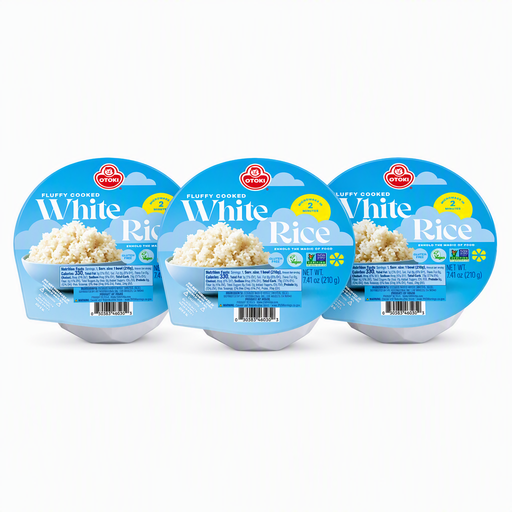 Image unavailable
Ottogi Cooked Rice, 210 g, pack of 3
This pack of cooked rice is ideal if you want to serve individual bowls and add the other ingredients separately.
Three 210 g bowls; adjust the number of bowls to suit your menu and check the preparation instructions on the packaging.
View on Joybuy
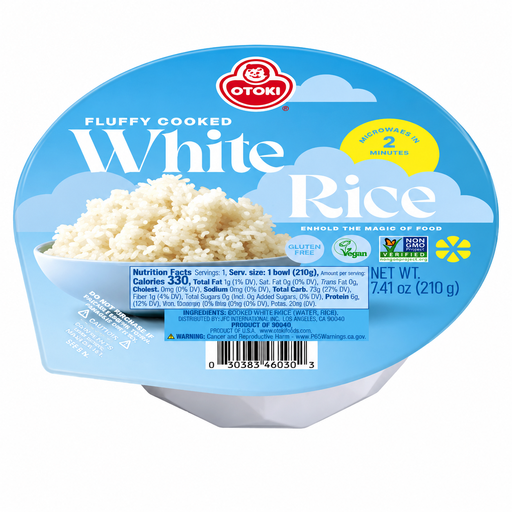 Image unavailable
OTOKI Cooked Rice Cup, 210 g
This bowl of cooked rice can be served with a meal whose other elements you prepare separately.
One 210 g bowl; work out how much you need based on the number of guests and check the preparation instructions.
View on Joybuy
Frequently asked questions
Can these rice products be described as “low-calorie”?
Not the express products mentioned here: their listings give values of 134 to 164 kcal per 100 g. Regulation (EC) No 1924/2006 reserves the claim “low energy” for solid foods that contain no more than 40 kcal per 100 g. You can compare these rice products with one another without using that claim.
How should you account for the portion you serve?
Start with the nutrition value per 100 g for rice that’s already cooked, then calculate it based on the amount you plan to serve on each plate. Compare products in the same state: the value per 100 g for dry rice isn’t directly comparable with that of a pouch that’s ready to heat.
Is one express pouch enough when you’re having several friends round?
Not necessarily: it depends on how many guests you’re having and how much rice is part of the menu. The Ben’s Original long-grain and Mediterranean-style pouches listed by Auchan each weigh 220 g; check how much you’ll need in total before buying.
What should you check if your guests avoid certain ingredients?
Read the ingredients for the exact recipe before serving it. The Ben’s Original paella-style rice listed by Auchan contains pork chorizo, while its Cantonese rice contains egg, ham and milk, among other ingredients. Plain rice and prepared rice dishes aren’t interchangeable for everyone.
How should you store leftover cooked rice?
Follow the instructions on the packaging and refrigerate leftover cooked rice promptly. Anses says Bacillus cereus can multiply in food between 4 °C and 55 °C, so don’t leave the dish at room temperature and rely on reheating it later.


