
Livraison le jour même ou le lendemain

Qualité garantie

Débloquez vos offres de bienvenue: Livraison GRATUITE | Jusqu'à -80 % | 30 jours d'essai gratuits à JoyPlus
Téléchargez l'application
A cooking pot must first and foremost meet very practical needs: making soup for the whole family, cooking pasta, simmering a stew or organising a Chinese hotpot without making a mess everywhere. Yet the purchase can quickly turn into disappointment if you rely solely on the stated capacity or vague promises about materials.
Before you decide, be sure to check compatibility with your hob, the truly usable volume and the care instructions. Here are the criteria that allow you to compare models on solid grounds.
The label all hob pan does not guarantee that the vessel can be used directly on an induction hob. A borosilicate glass pot, for example, may work on gas and electric hobs, yet require an adapter disc for induction. The same issue arises with certain non-magnetic ceramic pots.
So look for the explicit mention "induction" on the product page. If an adapter is needed, also factor in its price and the space it will take up in your cupboards.
A large capacity pot is ideal for a family or a meal with friends, but its weight quickly increases once filled with liquid. A 6.5 L stockpot allows you to prepare a large quantity of soup or a Chinese hotpot, but may prove cumbersome for one or two people.
Also bear in mind that the stated capacity corresponds to the maximum volume. To avoid spillovers, always leave a little room when boiling soup, pasta or a hotpot broth.
A non-stick pan certainly makes cleaning easier, but its coating demands more attention than a stainless steel pot. Metal utensils, abrasive sponges and heating when empty can accelerate wear. If the coating begins to peel or shows visible damage, it is best to stop using the vessel.
For an induction-compatible pot, the base must incorporate a suitable magnetic layer. Its diameter also matters: a very wide vessel placed on a small cooking zone may heat less evenly.
Stainless steel pots often have a capsule or composite base, which promotes better heat diffusion. Aluminium heats up quickly, while borosilicate glass lets you monitor cooking at a glance, though with particular limits regarding temperature and thermal shock.
For one person or a couple, a capacity of 1.5 to 2.5 L is generally enough for preparing soup, a sauce or pasta. For three to five people, look instead at a model of 3 to 5 L. Beyond that, a stockpot with a lid of 6 L or more will be better suited to group meals and Chinese hotpot.
A straight-sided shape optimises the available space, while a pouring lip makes serving broth easier and reduces splashes.
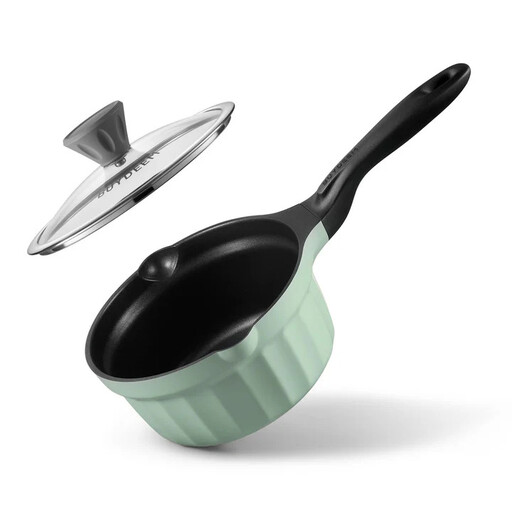
Why this choice suits this profile: With its 1.9 QT, this model is suitable for meals for one or two people and makes a versatile first pan for sauces, noodles or small soups.
The capacity is clearly stated and the pouring lip makes serving easier. The product page also specifies the coating limits and advises against heating when empty.
Cast aluminium, rapid heat-up, non-stick coating free from PFOS and PFOA according to the description, and compatibility stated with all hob types.
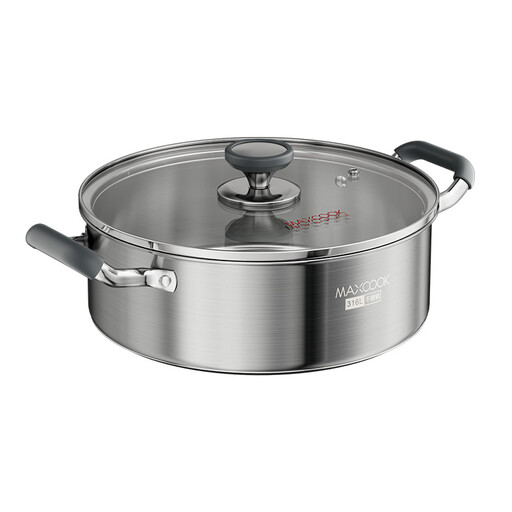
Why this choice suits this profile: Its large capacity is aimed at families and fans of broths, stewed dishes or Chinese hotpots prepared regularly.
Compatibility is detailed for gas, induction, electric, ceramic and halogen hobs. The absence of a non-stick coating also means you don't have to be careful with it.
Stated 316L stainless steel, composite base, glass lid and silicone handles. Hand washing is recommended.
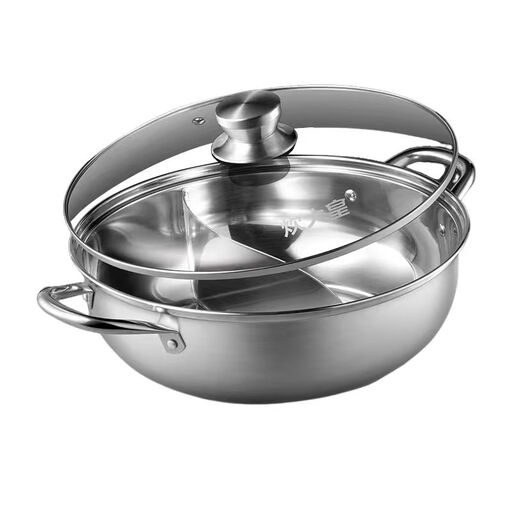
Why this choice suits this profile: The divider allows you to prepare two broths or adjust the seasoning differently in a single pot – an ideal setup for a sociable Chinese hotpot.
The product page states direct compatibility with gas, electric and induction hobs: no need to plan for a separate adapter.
304 stainless steel, 30 cm diameter and two-compartment design for group meals.
We have gathered a comprehensive selection, updated in real time, of products that meet these demanding criteria and European safety regulations.
The choice of pot also depends on the broth you plan to prepare. For a Chinese hotpot base, check the recommended water quantity as well as the allergens mentioned on the packaging.
Follow the preparation instructions, storage conditions and allergen information stated on the packaging.
A pot of 4 to 6 L generally leaves enough room for soups, pasta, vegetables and stewed dishes. For a Chinese hotpot, also allow space for the broth and ingredients added as you go.
Not necessarily. Some models can be used directly on gas and electric hobs, but require an adapter disc on induction. Avoid thermal shock, direct flames when not recommended, and any temperature above the stated limit.
Avoid heating it when empty, use wooden or silicone utensils, and let it cool down before washing. Steer clear of abrasive products and replace it if the coating chips or deteriorates.