People who make recipes with several steps
You regularly make soups, sauces or casseroles and want to move from preparation to cooking with less transferring between containers.


A cooking food processor is ideal for recipes that involve chopping, mixing or blending and cooking: you won’t need to keep switching between appliances. If you’re happy with your existing cooking appliances, a food processor can handle the preparation separately; if your ingredients are already prepared, a multicooker may be all you need for cooking. In each case, compare the accessories, usable capacity, cleaning requirements and space needed with the recipes you make regularly.
You regularly make soups, sauces or casseroles and want to move from preparation to cooking with less transferring between containers.
Before choosing a capacity, compare the genuinely usable volume, the space available for steaming and the overall size of the appliance.
You have a hob, oven or another cooking appliance and mainly want to chop, blend, grate or knead, without adding a cooking function you’re unlikely to use much.
Your choice depends first on which tasks you want to combine, then on the practicalities of quantity, cleaning and storage.
Consider one : if you regularly make soups, sauces or casseroles that involve preparing the ingredients and then cooking them in the same appliance.
Bear in mind : you’ll need space to store and clean the appliance and its accessories, even though the cooking steps are combined.
Consider one : if you’re happy with your current cooking equipment and are mainly looking for food preparation functions.
Bear in mind : you’ll need to transfer the ingredients to a cooking vessel. Que Choisir makes this distinction between a food processor and a cooking food processor.
Consider one : for cooking ingredients that have already been prepared, particularly for slow-cooked recipes.
Bear in mind : you’ll need to prepare the ingredients separately; according to Que Choisir, multicookers generally don’t stir food.
| Consideration | What to check | Who is this for? |
|---|---|---|
| Combining preparation and cooking | Check which accessories are included for chopping, mixing and blending, as well as the cooking functions you need for your recipes. | For soup or sauce, I want to prepare the ingredients and then cook them without using lots of different containers. Around 36% of consumers prioritise this uninterrupted process. |
| Cleaning and storage | Check which parts are dishwasher-safe and how much space you’ll need for the appliance and its accessories. | If I cook often, the food processor needs to be easy to reach and its parts should be easy to clean. This is a priority for around 29% of consumers. |
| Quantities prepared | Compare the usable capacity, maximum fill levels and, if needed, the space available for steaming. | When serving several portions, I want to avoid having to cook another batch because the bowl is too small. Around 21% of consumers prioritise usable capacity. |
| Functions you’ll actually use | Identify the tasks you do often in your recipes and take into account any cooking appliances you already own. | If my ingredients are often ready to cook, or I already have cooking appliances, I’d rather avoid built-in functions I won’t use much. Around 14% of consumers make this their top consideration. |
A multicooker can handle the cooking, but may not chop or blend ingredients as needed to make some dishes from start to finish. Que Choisir also points out that multicookers generally don’t stir food.
Make a note of the tasks involved in a few recipes you make often. If built-in preparation is an important part of them, check the functions of the cooking food processor you’re considering rather than relying on the number of cooking programmes alone.
The amount you can prepare depends on the recipe and its maximum fill level. Que Choisir notes in particular that a multicooker’s stated capacity isn’t always fully usable.
Compare the usable capacity and any limits that apply to your recipes with the portions you usually make. For steaming, check the space available in the basket too.
An appliance can be awkward to use every day if its parts are difficult to store or clean, even if its base fits on your worktop.
Measure the space needed with the bowl and lid in place. Check where you’ll store the accessories and which parts of the specific model are dishwasher-safe.
Guided recipes help you with preparation, but they don’t make up for a missing accessory. Que Choisir says they aren’t essential for using a cooking food processor, and access to them varies by offer.
Choose the hardware functions you need first, then check which recipes are available on the model you’re considering and whether access depends on a subscription.
These ranges show different ways to combine preparation, cooking and recipe guidance. Always check the exact model number.
The Companion XL range combines food preparation and cooking for home recipes with several steps.
The Cook Expert is aimed in particular at people who want to combine cooking, chopping and other food preparation in their kitchen appliance.
The Thermomix TM7 focuses on its screen and the guided recipes available through Cookidoo.
These two cooking food processors are suited to anyone looking for one appliance that combines preparation and cooking. Compare their advertised functions with the steps in your recipes, then check which accessories are included and whether the electrical specifications are compatible with your setup in France.
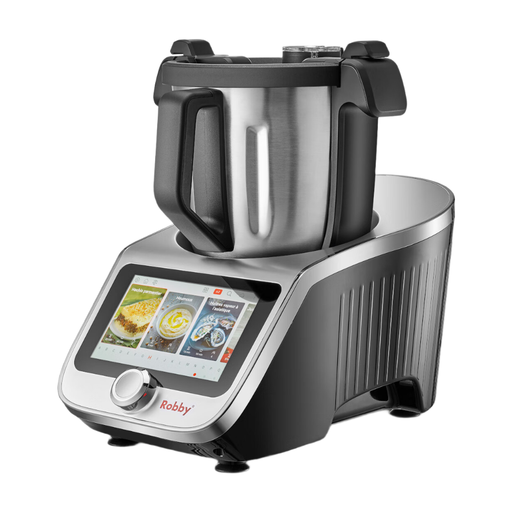 Image unavailable
Worth considering if you want to combine several preparation and cooking steps in one cooking food processor. This version is described as having an XL bowl, built-in scales and a large touchscreen. Check the usable capacity, included accessories and electrical specifications before choosing it; the information about the number of recipes is inconsistent.
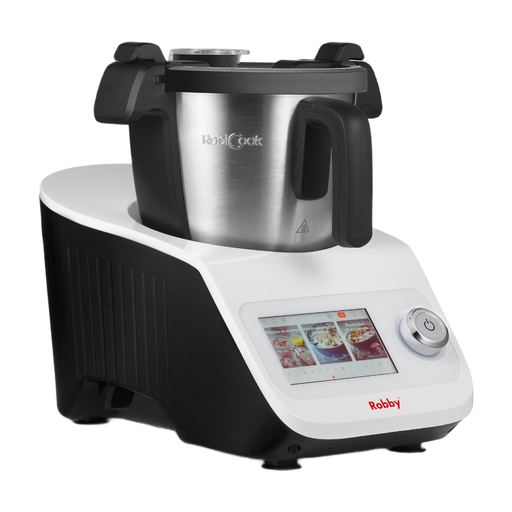 Image unavailable
Worth considering if you’re looking for a cooking food processor with built-in scales and a touchscreen to guide you through your recipes. The name of this version states that it includes 680 recipes. Before choosing it, check the usable capacity, included accessories, how easy the parts are to clean and whether it’s electrically compatible with your setup.
Check that the accessories match the tasks in your recipes: a blade or knife for chopping and blending, a whisk or mixer depending on what you’re making, and a basket if you plan to steam. Check they’re included with the exact model rather than assuming they come with it because it’s described as ‘multifunctional’.
A multicooker may suit your needs if you prepare the ingredients separately and mainly want help with cooking them. It won’t directly replace a cooking food processor if you also want built-in chopping, blending and mixing: Que Choisir says that multicookers generally don’t stir food.
Check the information for the specific model to see which parts can be removed and are dishwasher-safe, then look into spare parts and repair terms. Don’t assume that a commitment announced for a range applies in the same way to every model.
For a cooking food processor sold to a consumer in France, the statutory legal guarantee of conformity is covered by Articles L217-3 to L217-20 of the French Consumer Code, published on Légifrance. A commercial warranty offered by a brand is separate. Keep your proof of purchase and check the terms to see what additional cover it provides.