What should you look for before buying?
For cookies, start by thinking about how you want the chocolate to work in your recipe, then check the quantity and ingredients of the specific product.
| What to consider |
What to check |
Who is it for? |
| Piece format |
Look for the description “chips”, “chunks” or “baking bar”. Choose according to whether or not you want to chop the chocolate. |
If I want to add the chocolate straight to the dough, I’d choose pieces that are already cut. Around 40% of consumers put this kind of ready-to-use preparation first. |
| Quantity |
Compare the net weight with the amount your recipe calls for and work out how many packs you’ll need. |
If I’m making several batches, I need to make sure I have enough chocolate without confusing the weight of the bag with the weight of the chocolate. Quantity comes first for around 30% of consumers. |
| Ingredients |
Check the ingredients and allergen information for the product you’ve chosen. Compare the sugar and fat per 100 g if these values matter to you. |
If a recipe needs to take certain ingredients or allergens into account, I check each product before using it. Around 20% of consumers check the ingredients first. |
| Sharing and baking |
For a product intended for sharing, check its inclusions and decide whether you’ll need to chop it before adding it to the dough. |
If I want to serve some of the chocolate and use the rest in biscuits, it needs to work for both purposes in the same recipe. Around 10% of consumers prioritise this dual use. |
A Joybuy option for a crunchy recipe
This crunchy mix may be worth considering for a recipe that calls for this type of ingredient. It isn’t a direct substitute for milk chocolate chips in a cookie recipe.
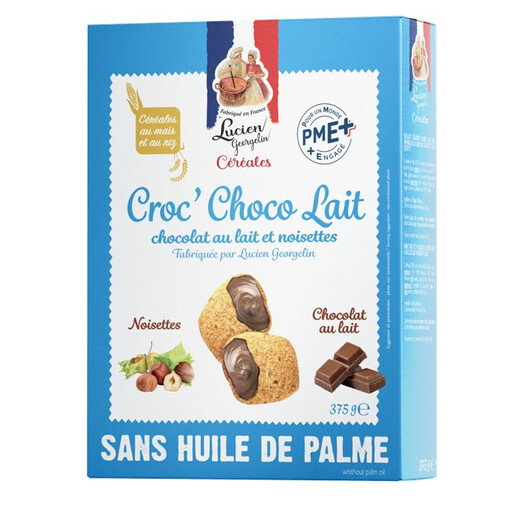 Image unavailable
Lucien Georgelin Milk Chocolate Crunch, 375 g
If your recipe calls for a crunchy mix rather than chocolate chips, this 375 g bag is an option to consider. Its description mentions baking, but doesn’t specify how it will turn out in cookie dough.
The mix contains milk, hazelnuts and cereal ingredients, among other things, so the 375 g isn’t all pure chocolate. Check the ingredients and allergen information on the pack before adding it to your recipe.
View on Joybuy
Frequently asked questions
Is Nutri-Score compulsory on milk chocolate in France?
No. The Directorate-General for Enterprise says that displaying it is voluntary in France. The DGCCRF, however, explains that nutrition information is mandatory for the prepacked foods covered by the rules. To compare two products, check their nutritional values per 100 g.
Does the rule mentioned for fizzy drinks apply to solid chocolate?
The regulations cited by the French Ministry of Agriculture describe fizzy drinks as non-alcoholic carbonated drinks. This definition doesn’t mean the rule mentioned for these drinks applies to solid chocolate. To find out how much sugar chocolate contains, check its nutrition information per 100 g.
Which allergens should you check in milk chocolate for cookies?
Check for milk and any other allergens listed for the product you’ve chosen. Some of the products reviewed also list soya, hazelnuts or wheat, or say they may contain other nuts. Check the information on the pack before use.
How should you store chocolate before making biscuits?
Follow the storage instructions printed on the pack. The instruction to store a bar in a cool, dry place away from heat applies to the Milka product reviewed here and shouldn’t automatically be assumed to apply to every variety.


