For an open-plan kitchen, first choose the option your home can actually accommodate: an extractor hood if the ducting, air supply and installation requirements have been confirmed, or a recirculating hood designed for the necessary filters and accessories. Then check that the style suits your hob, cabinetry or island, and compare extraction rates and noise levels in the same mode and at the same speed. Figures quoted for different modes are not directly comparable.
Who is this choice for?
Homes without usable external ducting
If there is no compatible ducting you can use in your home, look for a hood specifically designed for recirculation. Check the references for the kit and filters, as well as their maintenance requirements: Elica confirms that not all its hoods can switch between modes.
Households concerned about noise in the living area
If the living area is in use while you’re cooking, compare noise levels in the same mode and at the same speed. UFC-Que Choisir’s test protocol distinguishes between measurements taken in extraction and recirculation modes.
Projects with an island or existing wall units
The position of your hob will determine which styles to consider. For a wall unit or island, check the dimensions, fixing method and installation clearances in the instructions for your chosen model. Novy and Electrolux product information sets out requirements for individual models.
Which criteria should you prioritise?
UFC-Que Choisir points out that your home’s layout may determine whether you need extraction or recirculation. Decide this first, then choose a style and compare the features that matter in your living area.
External extraction
Consider this: if a suitable connection to the outside and an adequate air supply can be confirmed for your home.
Please note: installation depends on the ducting and the instructions, as well as any relevant permissions for the work involved. The presence of ducting alone does not mean you’re allowed to use it.
Recirculation
Consider this: when external extraction isn’t possible and the hood is designed to operate in recirculation mode.
Please note: according to Elica, filtered air is returned to the kitchen, so you’ll need to get compatible filters and maintain them as instructed.
| Criteria |
What to check before buying |
Who this matters to |
| Installation mode |
The mode allowed by the instructions; ducting and air supply for extraction, or a compatible kit and filters for recirculation. |
If I can’t use the ducting in my home, I need to choose a mode that works with my installation. Around 33% of consumers put this compatibility first. |
| Extraction and noise |
Extraction rate and noise level in comparable modes and at comparable speeds; consistent test results where available. |
When I cook near a living area that’s in use, I want to keep noise to a minimum without relying on a single sound figure. This is the top priority for around 27% of consumers. |
| Dimensions and position |
Width of the hob and hood, cabinet dimensions or island fixing, and model-specific installation clearances. |
With a hob beneath a wall unit or on an island, I need an appliance that fits the available space and can be secured correctly. This is the first consideration for around 20% of consumers. |
| Filter maintenance |
Reference for the charcoal filters, replacement or regeneration instructions, and grease filter maintenance. |
If I choose recirculation, I want to be able to follow the maintenance instructions for my hood’s filters. Around 20% of consumers prioritise this practical consideration. |
Pitfalls to avoid before buying
-
Assuming any recirculation filter will fit your hood
Elica says that not all its hoods can be converted, while Bosch requires a specific accessory for some models used in recirculation mode.
Before ordering, check the exact reference for the hood, the required kit and the compatible filter in the instructions.
Depending on the model, a recirculation kit and charcoal filters are additional to routine maintenance.
-
Comparing noise measurements taken in different modes
UFC-Que Choisir’s test protocol measures the extraction rate with a charcoal filter in recirculation mode, and without this filter in extraction mode. So a figure from each mode does not give you a like-for-like comparison.
Compare the same mode and speed, and use a consistent testing protocol where tests for the models you’re considering are available.
-
Assuming visible ducting is ready to use
You’ll need to confirm where it leads, how it connects and whether it meets the requirements for your home. In France, ANIL also points out that some work in rented homes or shared buildings requires permission, depending on its nature.
Before choosing an extractor hood, get the ducting checked and find out what permissions apply to the specific work you’re planning.
-
Choosing a style before measuring the space
Integrated, wall-mounted and island hoods each have their own dimensions and installation clearances. The dimensions of a different model won’t confirm that your chosen hood can be installed.
Measure the hob, cabinet and available height, then check these measurements against the product details and instructions for your chosen model.
If the dimensions don’t match, alterations or refitting may add to the cost of your project.
Brands to consider, depending on the model
Elica
Depending on the model, Elica offers hoods for extraction or recirculation, along with compatible charcoal filters.
- The brand provides maintenance guidance for specific disposable and regenerable filters.
- Check whether your chosen hood and filter can be used in different modes, and how often they need maintaining.
Novy
The Novy Fusion Pro 8710 for wall units and Mood 7552 for islands are examples of two different installation styles.
- Their product information lets you check the dimensions and operating modes for each model.
- Their installation and filtration requirements don’t apply to other Novy hoods.
Electrolux
Electrolux provides information on models including the LFG615X integrated hood and the EFF90563OX wall-mounted hood.
- The product information for these models includes useful details for checking installation and operating requirements.
- Before comparing their quoted figures, check which mode and speed they refer to, as well as any accessories required.
Bosch
Bosch offers recirculation kits and modules, with the right option depending on your hood model.
- The accessory information explains when a kit is required for a recirculation installation.
- Check compatibility with your exact model: the details for one kit don’t cover every Bosch hood.
Cooker hoods for open-plan kitchens on Joybuy
This selection includes under-cabinet models, a wall-mounted hood and a 90 cm angled hood. First choose a style to suit the position of your hob, then check the instructions for each model’s operating mode and installation requirements.
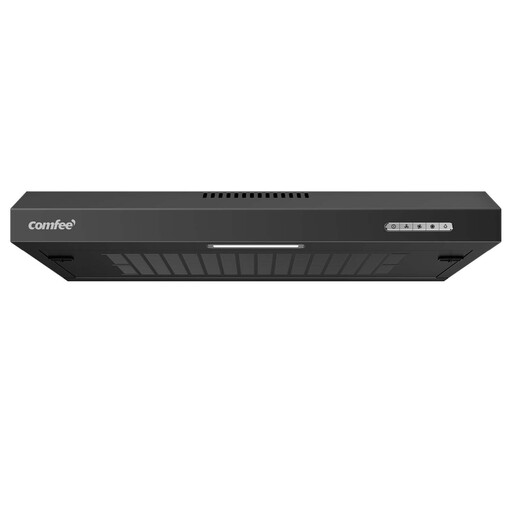 Image unavailable
COMFEE' KWH-SLIF17B-60, 60 cm, stainless steel
This under-cabinet style may suit you if the space above your hob meets the installation dimensions in the instructions.
The product name specifies a width of 60 cm and a top air outlet. If you’re planning to use recirculation, check which filter is compatible and confirm the model’s installation requirements.
View on Joybuy
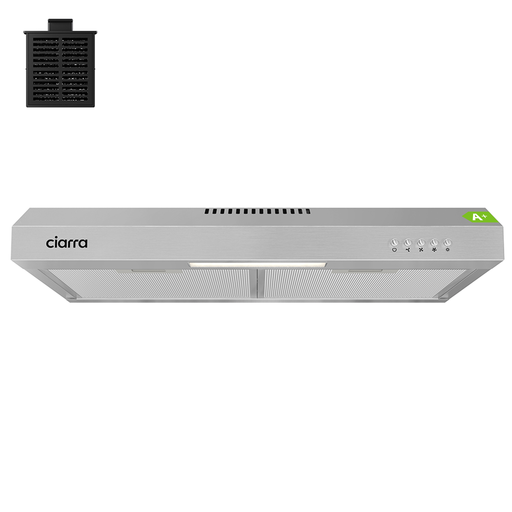 Image unavailable
Ciarra Slimline 60 cm, stainless steel
This hood fits beneath a cabinet and is designed for kitchens where the hob sits below a compatible unit.
The product name specifies a width of 60 cm and two ventilation options. For recirculation, check the instructions for the CBCF009 charcoal filter listed for this model, along with any other required accessories.
View on Joybuy
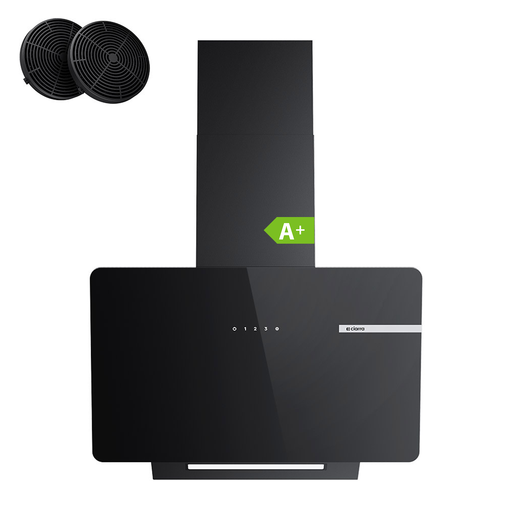 Image unavailable
Ciarra 60 cm wall-mounted hood, black glass
Consider this wall-mounted hood if your hob is against a wall and the fixing method is suitable for the space.
The product name specifies a width of 60 cm and a black glass panel. Check the installation clearances and, if you plan to use recirculation, the compatible filters in the instructions.
View on Joybuy
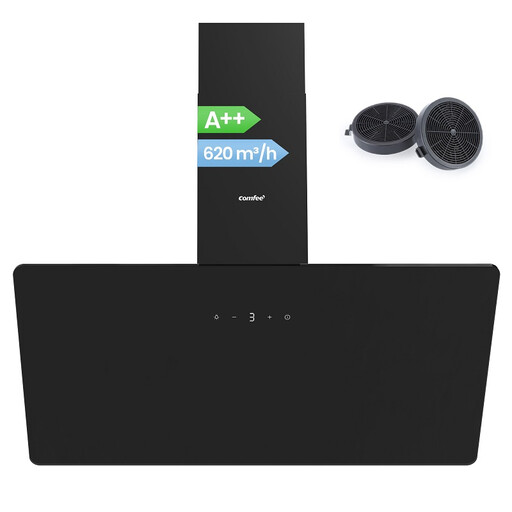 Image unavailable
Comfee' CH90J64ET4A2B2-EU, 90 cm, black
Consider this angled hood if the space above your hob can accommodate a 90 cm appliance.
The product name lists four speeds, extraction and recirculation modes, and a maximum extraction rate of 620 m³/h. This figure alone won’t tell you how noisy it will be in your living area. Check the fixing method, installation clearances and the filter required for recirculation.
View on Joybuy
Frequently asked questions
Should you choose an extractor hood for an open-plan kitchen?
Consider an extractor hood if the ducting to the outside, air supply and installation requirements in the instructions are suitable for your home. If extraction isn’t an option, look for a model designed for recirculation, with compatible filters and accessories. Visible ducting alone isn’t enough to decide.
How often should you change a charcoal filter?
Follow the replacement schedule for the filter compatible with your hood, as it varies by model. Elica recommends changing its CFC0038668 disposable filter every 3 to 4 months, and replacing its regenerable CFC0166361 filter after 2 years. These guidelines don’t apply to all its filters.
How do you compare the noise levels of two cooker hoods?
Compare their noise levels in the same mode and at the same speed. UFC-Que Choisir’s test protocol distinguishes between recirculation measurements taken with a charcoal filter and extraction measurements taken without one. A quoted noise level without these details won’t help you compare models for your living area.
What should you check before planning extraction in a rented home?
Before choosing a hood, check that you can use the ducting and confirm the work you’re planning. For rented homes in France, ANIL points out that alterations to the property require the landlord’s written consent. If the work affects communal areas or the exterior of a shared building, the permissions you need will also depend on the specific project.


