If your kitchen already has a dedicated, usable outlet to the outside, a ducted cooker hood expels steam and odours outdoors. UFC-Que Choisir says this mode is generally quieter than recirculation. If there’s no suitable outlet, choose a hood designed for recirculation and check which charcoal filter fits the exact model. In either case, compare noise levels and performance in the mode you’ll actually use, then choose a shape that suits the space available.
Which set-up is right for you?
Homes with an existing external outlet
If there’s a dedicated outlet near the hob that can be used for the cooker hood, consider models that can be set up for ducted extraction. Cooking air is expelled outdoors, so no charcoal filter is needed in this mode.
Homes without a suitable external outlet
A recirculating cooker hood filters the air before returning it to the kitchen. Check that you can obtain the charcoal filter specified for your exact hood model, and that you can maintain it as directed in the instructions.
Open-plan kitchens or noise-sensitive homes
If you cook near a living area, compare noise levels at the speeds you expect to use and in your chosen installation mode. A single maximum figure doesn’t tell you how noisy the hood will be at every speed.
What should you check before choosing?
First, find out whether a dedicated external outlet is available and can be used. Then compare cooker hoods in ducted mode or, if that’s not an option, in recirculation mode with the charcoal filter fitted.
Ducted extraction
Choose this when: there’s already a suitable, dedicated external outlet near the cooking area.
The trade-off: air is expelled outdoors, but this option depends on whether the outlet can genuinely be used. UFC-Que Choisir says ducted extraction is generally quieter than recirculation.
Recirculation
Choose this when: there’s no suitable external outlet that can be used for the cooker hood.
The trade-off: filtered air is returned to the room. The charcoal filter helps tackle odours, but doesn’t expel steam outdoors, and needs to be maintained according to its specific reference.
| Priority |
What to check |
What you need |
| Installation mode |
Look for a dedicated, usable external outlet. If there isn’t one, check that the cooker hood and its kit are designed for recirculation. |
I want to choose a mode that works with the ventilation already in my kitchen before deciding on the shape of the cooker hood. |
| Steam and odours |
Compare performance in the intended mode. UFC-Que Choisir’s test protocol measures airflow with the charcoal filter fitted in recirculation mode, and without it in ducted mode. |
For steam, I’m looking for extraction to the outside if there’s a suitable outlet. If I need to recirculate the air, I’ll check how well it filters odours without mistaking this for moisture extraction. |
| Noise |
Check the dB(A) levels at each speed and, where available, for each installation mode. Also check the noise level in intensive mode. |
In an open-plan kitchen, I want to be able to use a speed that suits the cooking without relying solely on the maximum noise level. |
| Filters |
For recirculation, check the compatible reference, what’s included and how the filter should be replaced or regenerated. Also check how to maintain the grease filter. |
I’d rather know what maintenance is needed before choosing a cooker hood I’ll use regularly. |
| Positioning |
Measure the available space under a cabinet, on the wall or around an island. Check the installation dimensions for the exact model. |
The shape needs to suit my cooking area, without leading me to choose a ventilation mode that I can’t use at home. |
A cooker hood advertised for both modes gives you a choice of installation, but its figures aren’t necessarily comparable from one mode to the other. For recirculation, look for data measured with the charcoal filter fitted rather than relying on an airflow figure with no mode specified.
What mistakes should you avoid?
-
Choosing the shape before the ventilation mode
A wall-mounted, built-in or island design doesn’t, by itself, tell you whether the cooker hood will suit your existing installation. The mode you choose also affects how noise and performance figures should be compared.
First identify a usable external outlet, or choose a set-up explicitly designed for recirculation. Then check the dimensions and shape.
-
Comparing figures from different modes
In recirculation mode, the charcoal filter is part of the set-up. UFC-Que Choisir’s test protocol distinguishes between measurements taken with this filter fitted and those taken in ducted mode without a charcoal filter.
For each model, check which mode the stated airflow, noise level and filtration results relate to.
-
Forgetting to check the charcoal filter reference
Replacement intervals and regeneration methods vary between filters. A filter listed for a particular brand won’t necessarily fit all of its cooker hoods.
Check the exact filter reference that’s compatible with your cooker hood, see what’s included and follow the care instructions.
-
Neglecting the grease filter
Electrolux says that a build-up of grease can reduce extraction and increase noise. So even a washable filter needs to be cleaned regularly.
Check your model’s instructions for the approved cleaning method and frequency.
Which brands and filter references should you consider?
The details below relate to specific accessories or models, so always check that they’re compatible with the cooker hood you’re considering.
Bosch
Worth considering for recirculation if you want to identify exactly which charcoal filter you’ll need.
- Bosch states that its standard 00353121 filter lasts 6 to 12 months.
- The brand advises checking the filter’s compatibility with your appliance reference before choosing it.
Electrolux
Filter options to compare if you’re deciding between a replacement filter and one that can be cleaned for recirculation.
- Electrolux states that the OdourClean Standard ECFB01ST lasts 4 to 6 months, while the OdourClean Plus MCFE11PL lasts 2 to 3 years and is described as dishwasher-safe.
- These lifespans apply to these specific filters. Check they’re compatible with your cooker hood and follow their care instructions.
Elica
Worth considering if a regenerable charcoal filter suits your recirculation set-up.
- Elica describes its Long Life KIT0166444 filter as dishwasher-regenerable, with a recommended lifespan of 2 years.
- Check that this reference is suitable for your chosen cooker hood and follow the regeneration instructions.
Franke
Specifications for individual models let you check their shape, installation mode and published noise levels.
- Franke says that the Smart FSMS F42 island cooker hood works in recirculation mode only. Charcoal filters are included, and the maximum noise level is 66 dB(A).
- These details don’t apply to other Franke cooker hoods. Check the specifications for the model that suits your kitchen layout.
Joybuy cooker hoods for under-cabinet or wall-mounted installation
This selection includes an under-cabinet cooker hood and wall-mounted models. All offer ducted extraction and recirculation. First choose the mode that works in your kitchen, then check which accessories you’ll need to set it up.
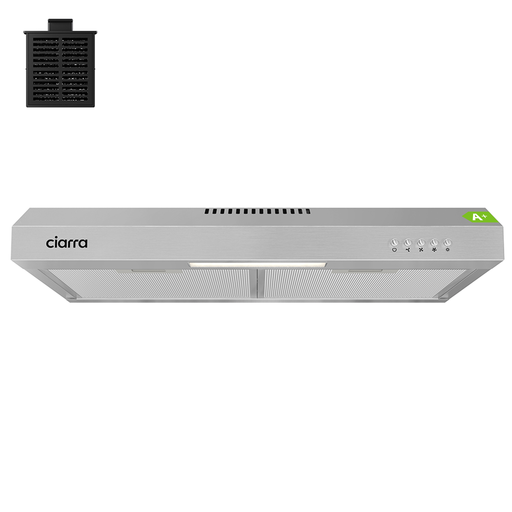 Image unavailable
Ciarra Slimline 60 cm under-cabinet cooker hood
Its under-cabinet design suits kitchens with space for this type of installation. The hood offers ducted extraction and recirculation. For recirculation, check that the CBCF009 filter is compatible and whether it’s included. Compare the stated airflow with the installation mode you’ll use.
View on Joybuy
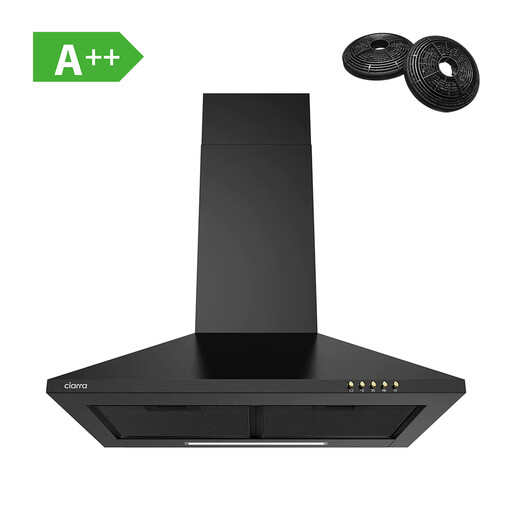 Image unavailable
Ciarra CBCB6201-B 60 cm wall-mounted cooker hood
This wall-mounted cooker hood offers both modes and a stated airflow of 370 m³/h. If you install it for recirculation, check that the CBCF002X2 filter is compatible and included in the box. Assess the airflow and noise in your chosen mode.
View on Joybuy
 Image unavailable
Ciarra CBCS6765B 60 cm angled cooker hood
Its angled design is made for wall-mounted installation, so check the space around your cooking area. It offers ducted extraction and recirculation, and a stated airflow of 580 m³/h, though the mode isn’t specified. For recirculation, check the CBCF055 reference and what’s included in the box.
View on Joybuy
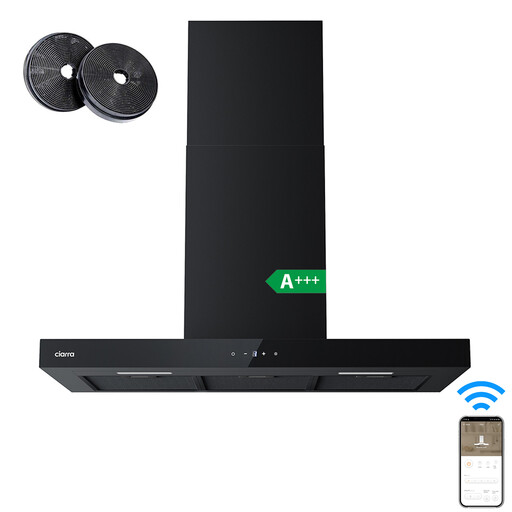 Image unavailable
Ciarra 90 cm wall-mounted cooker hood with Wi-Fi
Check that you have enough wall space for this 90 cm design. The hood offers four speeds, including a booster mode, and both ducted extraction and recirculation. For recirculation, check that the CBCF003 filters are compatible and included in the box. The stated airflow of 650 m³/h doesn’t specify the configuration used.
View on Joybuy
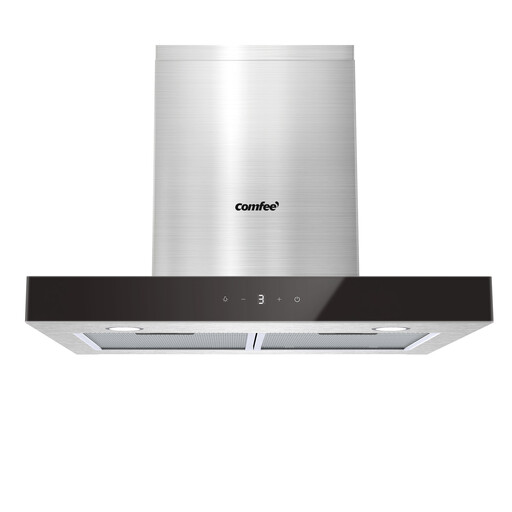 Image unavailable
Comfee TSHM77SS-60 60 cm T-shaped wall-mounted cooker hood
This T-shaped design suits a wall-mounted installation where there’s enough room for it. The model offers ducted extraction and recirculation, with a stated airflow of 650 m³/h. Before choosing recirculation, ask which charcoal filter reference is compatible and check the performance figures for this mode.
View on Joybuy
Frequently asked questions
Can I connect a ducted cooker hood to a mechanical ventilation system or chimney?
No. UFC-Que Choisir says a cooker hood’s exhaust duct must be dedicated to that purpose and advises against connecting it to a mechanical ventilation system or chimney. Ask a suitably qualified professional to check your existing installation before choosing a ducted model.
Does a recirculating cooker hood expel cooking moisture outdoors?
No. It filters the air and returns it to the kitchen. Its charcoal filter is designed to tackle odours, not to extract steam outdoors. UFC-Que Choisir’s tests distinguish between odour reduction in recirculation mode and steam extraction in ducted mode.
Does the charcoal filter always need replacing?
It depends on the filter reference. Some filters need replacing, while others are designed to be cleaned or regenerated. Check which filter is compatible with your cooker hood and follow its instructions rather than applying the same maintenance schedule to every model.


