People who cook near the living room
If smells, grease and steam could spread into your living space, start by finding out whether you can install an external duct. Then compare extraction performance and noise in the mode you’ll actually use.


In an open-plan kitchen, first choose the extraction method your home allows. According to UFC-Que Choisir, a ducted cooker hood is generally more effective than a recirculating one, but it needs a suitable outlet. If ducting isn’t possible, check that the hood is compatible with recirculation and its filters. Then choose a size and style that suit your hob’s position and the available space.
The proximity of your living room, installation options and hob position mean that different households will need different cooker hoods.
If smells, grease and steam could spread into your living space, start by finding out whether you can install an external duct. Then compare extraction performance and noise in the mode you’ll actually use.
An existing ventilation vent doesn’t necessarily mean you can connect a cooker hood to it. Before planning an external outlet or any building work, ask someone to check the duct and any restrictions specific to your home. Recirculation is an option to consider if ducting isn’t possible.
For an island hob, check the ceiling fixing and whether a duct can be routed through. Against a wall, compare a wall-mounted hood with a model built into a unit, and check the dimensions needed for installation.
First decide between ducted extraction and recirculation based on your home, then check the hood’s size, noise level and maintenance needs.
Consider this if: a dedicated outlet can be used or created for the cooker hood.
The trade-off: UFC-Que Choisir considers this option generally more effective than recirculation, but it requires a suitable installation and may involve building work.
Consider this if: a suitable external duct can’t be installed.
The trade-off: filtered air is returned to the room, and the maintenance needs of charcoal filters vary by model.
| Consideration | What to check | What I need |
|---|---|---|
| Smells and steam | Check whether a dedicated external outlet is possible. For recirculation, identify a compatible charcoal filter. Compare extraction performance in the intended installation mode, rather than relying on the stated airflow rate alone. | I cook near the living room and want to limit what spreads into the space. Recirculation returns filtered air indoors; it doesn’t vent steam outside. |
| Noise | Compare noise levels at different speeds and in the mode you’ll use. For ducted extraction, also check the route of the duct: Roblin recommends keeping it as short and straight as possible. | People chat near the kitchen, so the noise level at the speed I’ll use every day matters more to me than a single minimum figure. |
| Installation and size | Have the duct and any building work requirements confirmed before choosing ducted extraction. Compare the hob’s position, the hood’s width and fixings, and, for an integrated model, the dimensions of the unit. | My hob is against a wall, under a unit or on an island. I need a hood that fits there and can be installed using the method allowed by my home. |
| Maintenance | Identify the kit and charcoal filters required for your chosen model, then check their care instructions. Also check that the grease filter is easy to access and follow its cleaning instructions. | If I choose recirculation, I want to be able to find compatible filters and plan for their maintenance after installation. |
A wall-mounted, island or integrated hood might look right but still not be suitable for the intended installation method. UFC-Que Choisir points out that your home may dictate whether you need ducted extraction or recirculation.
First check which outlet is possible, then consider the hob’s position and the dimensions, and choose the finish last.
UFC-Que Choisir advises against connecting a cooker hood to a mechanical ventilation system (VMC) or chimney flue. An unsuitable connection can be dangerous and may disrupt the ventilation system.
Ask a professional to confirm that an outlet is dedicated to the cooker hood. If not, look at a model that’s compatible with recirculation.
Bosch says that some of its models require an initial installation kit. Don’t assume that a filter or kit designed for a different model will be compatible.
Note down the cooker hood’s full model number and check which accessories you need, along with the care instructions for the corresponding filter.
An initial kit and replacement filters may need to be bought separately from the cooker hood.
These two figures relate to different operating conditions. For example, the product specifications for the Roblin OSMOSE 900 island hood list 44 dB(A) at minimum, 59 dB(A) at maximum and 66 dB(A) in intensive mode. These figures apply to this model only.
Compare noise levels and performance at the speeds you expect to use, using the same installation mode.
Their ranges include a variety of styles, but you’ll need to check the installation method, accessories and specifications for each model.
Bosch offers cooker hoods and accessories for both ducted extraction and recirculation.
Roblin, part of the Franke Group, offers island and wall-mounted hoods, as well as hoods designed to fit into units.
Miele France’s catalogue includes wall-mounted, island, downdraft and integrated cooker hoods.
This selection includes wall-mounted hoods and a model designed to fit under a unit. Compare each hood’s width with your hob, and check that its installation method is suitable for your home before choosing.
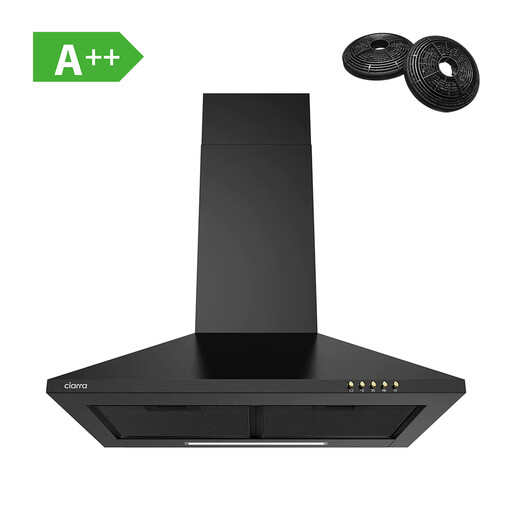 Image unavailable
Worth considering for a hob positioned against a wall. The product name gives an airflow rate of 370 m³/h, but this figure alone doesn’t show how well it will extract in your kitchen. Check the width of your hob and, if you plan to use recirculation, make sure the filter is compatible.
 Image unavailable
This style is designed for a hob positioned against a wall. The product name lists three speeds, ducted extraction and recirculation, and a stated airflow rate of 580 m³/h. Also compare the noise levels at the speeds you’ll use and check which accessories are compatible with your chosen mode.
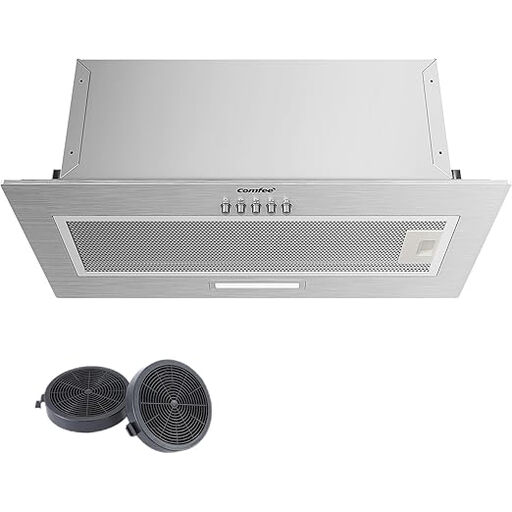 Image unavailable
Worth considering if you’re still deciding between ducted extraction and recirculation: the product name lists both modes, three speeds and an included charcoal filter. The stated airflow rate is 400 m³/h. Check the installation dimensions and noise level in your planned set-up, especially if the hood is near the living room.
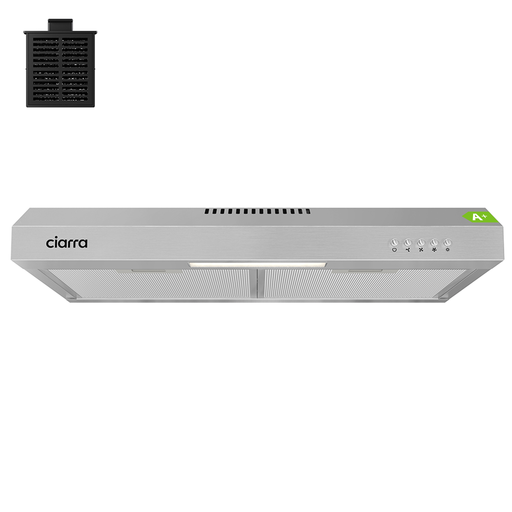 Image unavailable
This under-cabinet model is worth considering if your hob is against a wall and you want the hood to blend into your kitchen units. The product name lists two ventilation modes and push-button controls. Check the installation space, the width of your hob and which accessories you’ll need for recirculation.
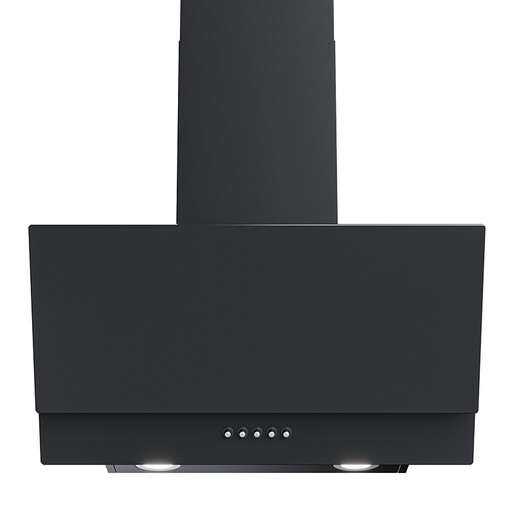 Image unavailable
This angled hood is designed for a hob positioned against a wall. Its product name lists an airflow rate of 300 m³/h, ducted extraction and recirculation, as well as an included charcoal filter. Before choosing it for an open-plan kitchen, compare noise levels at different speeds and check the installation dimensions.
Don’t plan to make this connection: UFC-Que Choisir says it’s prohibited and warns of the risks it can pose. Ask someone to confirm that the outlet is dedicated to the cooker hood. A cooker hood also doesn’t replace your home’s general ventilation system.
Check what the work involves and get your landlord’s written permission before making any alterations to the property. ANIL highlights this requirement for alterations carried out by tenants. Also ask someone to assess the planned duct route before choosing a hood with ducted extraction.
Check the building’s co-ownership rules and speak to the building manager before commissioning any work. According to ANIL, work affecting communal areas or the building’s structure needs approval from the co-owners’ general meeting. You’ll need to establish whether your planned work falls into this category.
Follow the instructions for the filter that’s compatible with your cooker hood. Replacement frequency depends on the filter technology and how often you use it. For example, Elica recommends a 3 to 6-month replacement cycle for some of its standard filters; this timeframe won’t automatically apply to a different model.
Compare the actual widths before buying. Bosch recommends in its FAQ choosing a hood that’s at least as wide as the hob. If you’re considering an under-cabinet or integrated model, also check the dimensions needed for installation.