
Livraison le jour même ou le lendemain

Qualité garantie

Débloquez vos offres de bienvenue: Livraison GRATUITE | Jusqu'à -80 % | 30 jours d'essai gratuits à JoyPlus
Téléchargez l'application
A cooker hood isn't something you should pick based on looks or price alone. In a small kitchen, a rented flat or an open-plan living space, the wrong model can quickly become noisy, awkward to maintain or difficult to install.
Before you place your order, three common pitfalls keep cropping up:
Start by measuring the width of your hob, the available depth and the height between the hob and the hood. A wall-mounted hood in 60 cm, particularly in a stainless steel finish, works for most standard setups. For a large hob or multiple cooking zones, a 90 cm model will give you better coverage.
In a fitted kitchen, an integrated hood or an under-cabinet hood helps you keep maximum storage space. However, do check the internal dimensions of the cabinet, the diameter of the air outlet and the fixing system. The manufacturer's instructions should also state the minimum distance between the hood and the hob, which can vary depending on the type of hob.
Measured in m³/h, the airflow tells you how much air the hood moves. This figure alone isn't enough to judge how comfortable it will be to use. Look at the values for each speed and compare them with the noise level, which is given in decibels.
As a rough guide, the models featured here range from around 184 m³/h for a compact hood to 650 m³/h for some models designed for more intensive cooking. A quiet hood isn't necessarily the one with the highest maximum airflow: the smart move is to compare the noise level at the speed you'll actually use.
In an open-plan kitchen, go for product specs that clearly break down the noise levels. Depending on the model, the Ciarra and Comfee hoods we offer have a maximum noise level between 58 and 64 dB. The small portable Ciarra unit, meanwhile, claims less than 65 dB at its highest power.
An externally ducted hood pushes air outside your home through a duct. This setup can work well in a house or during a renovation, but it needs a compatible installation and enough space for the ductwork.
If no duct is available, choose a recirculation hood. The air passes through a grease filter and then, depending on the model, a charcoal filter before being released back into the room. Check which type of filter is compatible and how much replacements cost before you buy.
A washable aluminium filter cuts down on consumables, but it doesn't mean you can skip regular maintenance. The general recommendation is to clean it every two to four weeks, depending on how often you cook. Make sure the filter is completely dry before putting it back. For stainless steel, glass or black finishes, use a soft cloth and avoid abrasive products.
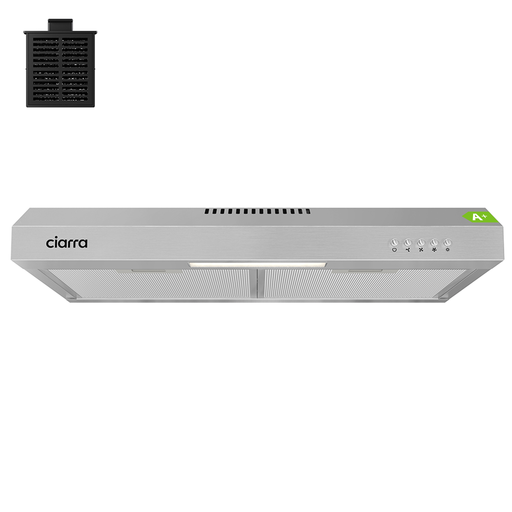
Why this suits this profile: At 596 mm wide, this model fits neatly into a compact kitchen and can work in either extraction or recirculation mode.
Its washable metal filter cuts down on replacements, and its two ventilation modes mean you won't end up with an incompatible installation.
Maximum airflow of 370 m³/h, LED lighting, A++ energy rating and a maximum noise level of 61 dB.
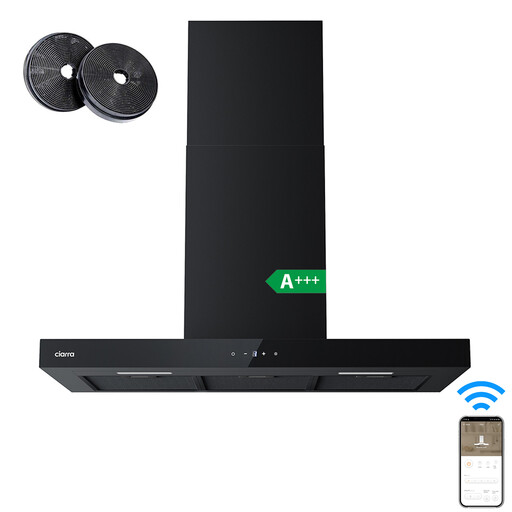
Why this suits this profile: This 90 cm black hood combines touch control, a Wi-Fi app and wall-mounted installation to complement larger hobs.
The spec sheet details the airflow, noise level, annual energy consumption and included filters, rather than relying solely on the promise of connectivity.
Airflow of 650 m³/h, A+++ energy rating, maximum noise level of 59 dB, washable aluminium filters and app control.
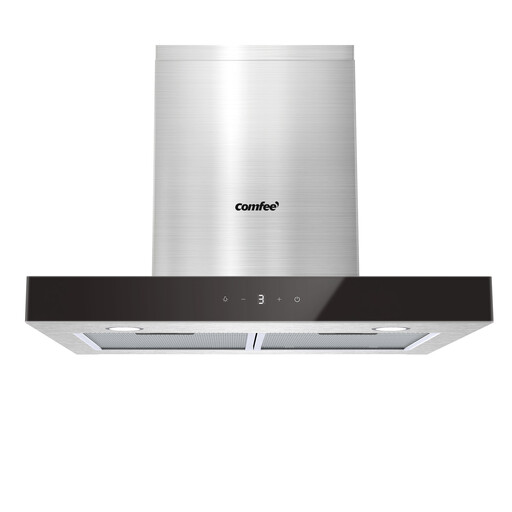
Why this suits this profile: Its four speeds and 650 m³/h airflow are built for frequent cooking, especially in an open-plan kitchen.
The five-layer aluminium filter is removable and, according to the product sheet, dishwasher-safe, making everyday maintenance much easier.
Touch and gesture controls, LED lighting, A+++ energy rating and a maximum noise level of 59 dB.
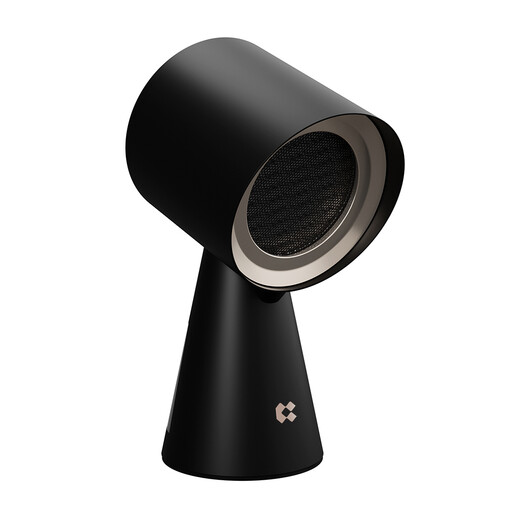
Why this suits this profile: This self-contained solution works without drilling into the wall, making it ideal for a studio flat, rental property, campervan or near an electric hob.
It works in recirculation mode and needs neither a wall duct nor any changes to your existing setup. The downside is that the tray and filters need cleaning after each use.
Two speeds, 24 W power, compact size and airflows of 77.8 and 108 m³/h.
We've put together a full, real-time selection of products that meet these exacting standards, all while complying with European safety regulations.
It fits many standard hobs, but always measure the actual width of your cooking area and the available space. The hood needs to be properly centred and installed according to the instructions in the manual.
Yes, as long as the model offers this mode and compatible charcoal filters are available. Recirculation doesn't replace the general ventilation in your home, and it does require regular maintenance of both the grease and charcoal filters.
The running cost depends on the power, energy rating, how long you use it and the speed you select. Compare the annual energy consumption shown on the product sheet, then add the potential cost of charcoal filters. A washable filter can reduce ongoing purchases, but it doesn't mean you can skip the cleaning routine.