If you have an outside duct
If you cook often, first check that the duct can be used with the cooker hood you’re considering, and that its use or any work needed is permitted. Choose a model only once you’ve confirmed this.


Choose extraction if there’s a usable duct to the outside and the installation is permitted. Otherwise, consider a cooker hood that supports recirculation, checking that you have the right kit and filters. Extraction sends the air drawn in outside, while recirculation filters it and returns it to the kitchen. In both cases, the hood supplements your home’s ventilation; it doesn’t replace the mechanical ventilation system, which should remain switched on, according to ADEME.
If you cook often, first check that the duct can be used with the cooker hood you’re considering, and that its use or any work needed is permitted. Choose a model only once you’ve confirmed this.
Recirculation lets you use a cooker hood without a duct to the outside. Check that the model supports this mode, then find the kit and filters that are compatible with its full model reference.
In an open-plan kitchen, noise can matter as much as the installation method. Compare the stated noise levels at the speed and in the configuration you plan to use, rather than relying on a general promise of quiet operation.
Whether extraction is possible is the first thing to consider when choosing between the two types of cooker hood. Your existing ventilation is there to complement it: ADEME advises you not to switch off your mechanical ventilation system and says a high ventilation rate in the kitchen may be needed while cooking or when steam is being produced.
Consider this: if there’s a usable duct to carry the extracted air outside.
Check first: confirm the duct route and whether any permissions are needed for the work before you buy.
Consider this: if extraction to the outside isn’t available or permitted, and you have a hood designed for recirculation.
Bear in mind: filtered air is returned to the kitchen, and compatible filters need regular maintenance.
| Factor | What to check | Who should consider it? |
|---|---|---|
| Installation | For extraction, check the duct and the model’s connection dimensions. If work is planned, check which permissions apply to your home. | I want to avoid choosing a cooker hood that won’t work with my kitchen’s installation options; around 31% of shoppers put compatibility first. |
| Steam and odours | Check whether the air will be extracted outside or filtered and returned to the kitchen, along with the stated specifications for your chosen mode. | If I cook often and find steam and odours bothersome, I first look for effective extraction above the cooking area. This is the top priority for around 31% of shoppers. |
| Noise | Compare the stated noise levels for the specific models, at similar speeds and in comparable installation modes. | In an open-plan living space, I want to cook without the cooker hood drowning out conversation; around 19% of shoppers prioritise quiet operation. |
| Filter maintenance | For recirculation, find the reference for the compatible kit and filters, then check the maintenance interval in the manual. | If I use my cooker hood regularly, I want to know which filters to replace and be able to find the right references; for around 19% of shoppers, maintenance is the main concern. |
Recirculation returns filtered air to the kitchen; on its own, it doesn’t ventilate your home.
Keep your mechanical ventilation system switched on, as ADEME recommends, and use the cooker hood to extract air above the cooking area.
Extraction to the outside requires a suitable route for the duct. In a block of flats, work affecting shared areas or the building’s exterior may also require permission.
Check the duct, any restrictions that apply to your home and the permissions you need before planning to drill through a wall or choosing this installation method.
Kits and filters are selected according to the cooker hood’s model reference. Bosch notes, for example, that its initial-installation kits for recirculation aren’t universal.
Make a note of the model’s full reference and check it against the compatibility lists for the kit and replacement filters.
A single noise figure doesn’t tell you what speed the cooker hood will run at or which mode it’ll use in your home.
Use the acoustic data for the exact model to compare the configuration and speeds that match how you’ll use it.
Bosch offers cooker hoods and accessories for extraction and recirculation, with model-specific compatibility information for some kits.
Elica filters and accessories may be worth considering for a cooker hood used in recirculation, particularly if you want to plan ahead for maintenance.
Falmec offers cooker hoods in several sizes; installation options and features should be checked for each model.
These cooker hoods are listed with extraction and recirculation options. To choose between them, first check what can be installed in your home, then look at the accessories and specifications for the model you’ve selected.
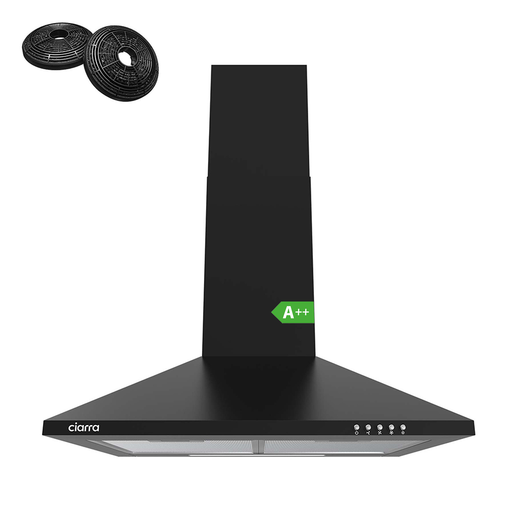 Image unavailable
Consider this if a 60 cm wall-mounted installation suits your kitchen and you want to choose between extraction and recirculation.
The product name lists both modes and push-button controls. Check that the connection is suitable; for recirculation, check which filters are compatible.
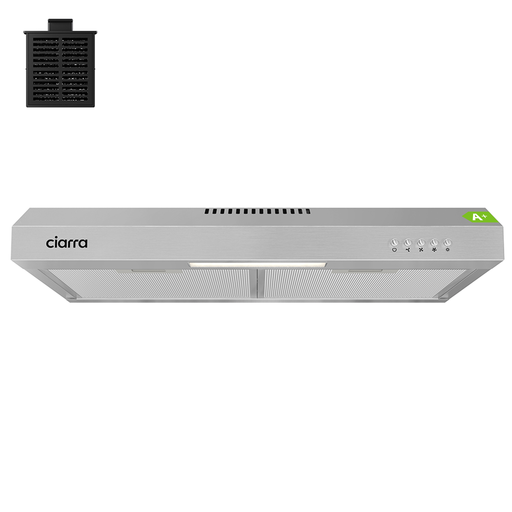 Image unavailable
Worth considering if the space under a kitchen cabinet points you towards a compact design.
The product name lists a 60 cm width, two ventilation modes and push-button controls. Check the cabinet’s installation dimensions and, for recirculation, whether the CBCF009 filter is compatible.
 Image unavailable
Consider this if an angled wall-mounted design suits your cooking area and you need to choose between extraction and recirculation.
The product name lists an extraction rate of 580 m³/h and three-speed touch controls. For recirculation, check which accessories are required and whether the CBCF055 carbon filter is compatible; compare the noise level for the mode you’ll be using.
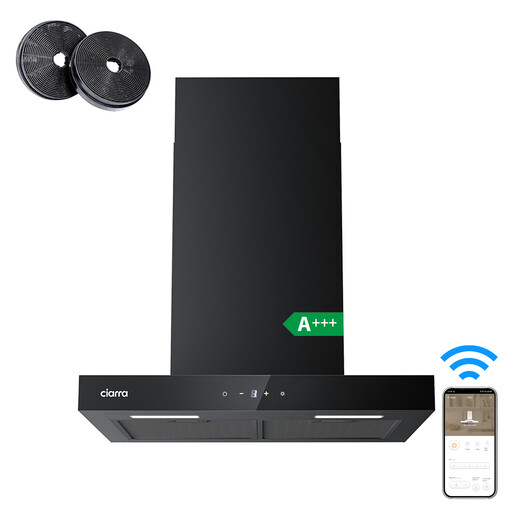 Image unavailable
Worth considering if you’re looking for a wall-mounted cooker hood with touch controls and app control, provided it can be installed in your kitchen.
The product name lists an extraction rate of 650 m³/h, a booster function, and extraction and recirculation modes. Check the number of speeds and the reference for the filters that suit your chosen mode.
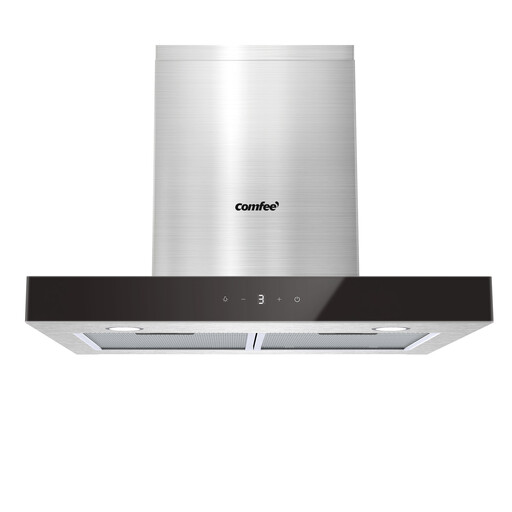 Image unavailable
Consider this if a 60 cm T-shaped cooker hood fits your available space and you’re comparing extraction with recirculation.
The product name lists an extraction rate of 650 m³/h, gesture and touch controls, and both modes. Before installing it for recirculation, check which carbon filter and kit are required for this model.
No. A recirculating cooker hood returns filtered air to the kitchen, while the mechanical ventilation system helps ventilate the whole home. ADEME advises you never to switch off the mechanical ventilation system; use the cooker hood to extract air above the cooking area.
Don’t assume that work affecting shared areas or the building’s exterior is permitted. For relevant work by a flat owner, Article 25 of the law of 10 July 1965, published by Légifrance, requires approval from the general meeting. Check the duct route and any permissions needed before drilling.
It depends on the model. Bosch says that its cooker hoods installed for recirculation need a compatible initial-installation kit. Check the manual for your chosen hood to find out which accessories you need; don’t assume one kit fits every model.
Follow the replacement interval for the specific filter and cooker hood model. For example, Elica recommends replacing its CFC0140055 filter every 3 to 4 months; this guidance doesn’t automatically apply to other filters.