
Livraison le jour même ou le lendemain

Qualité garantie

Débloquez vos offres de bienvenue: Livraison GRATUITE | Jusqu'à -80 % | 30 jours d'essai gratuits à JoyPlus
Téléchargez l'application
Choosing a cooker hood might seem simple, but this purchase will define your kitchen's comfort for years to come. Between marketing jargon and a technical maze, it's easy to make a mistake. The result: a kitchen filled with lingering odours, a deafening racket, or unexpected installation costs.
Our mission: to help you see things more clearly and find the model that truly fits your needs. Let's review the pitfalls to avoid and the essential criteria to check.
The market is flooded with models boasting tempting features. However, two common mistakes are a fast track to buyer's remorse.
1. Focusing only on the maximum extraction rate (m?/h) A high number looks promising, but an overpowered hood is often synonymous with noise. In daily use, a hood that forces you to raise your voice or turn up the radio quickly becomes unbearable. The secret is balance: an extraction rate sufficient for your needs, without turning your kitchen into an airport runway. A quiet hood with a moderate airflow is often far more pleasant day-to-day than a power-hungry monster.
2. Ignoring your home's limitations (external ventilation) This is the classic—and most costly—trap. You've found the perfect hood, only to realise too late that it requires an external ventilation duct... which is impossible to install in your flat. You're left with an unusable appliance or facing significant modification costs. It is therefore crucial to check before any purchase whether you can install a ducted hood or if you must opt for a ductless hood (recirculation).
To make an informed choice, focus on these three fundamental parameters.
Your kitchen's layout dictates the hood's format.
Also, consider the width. Rule of thumb: for optimal efficiency, the hood should be at least as wide as your hob. A 60?cm cooker hood is standard for most hobs, but 90?cm models are recommended for wider range cookers.
This is THE technical point to confirm before you pull out your credit card.
These two data points are inseparable.
Here are a few models that cater to different user profiles, taking into account the criteria we've just discussed.
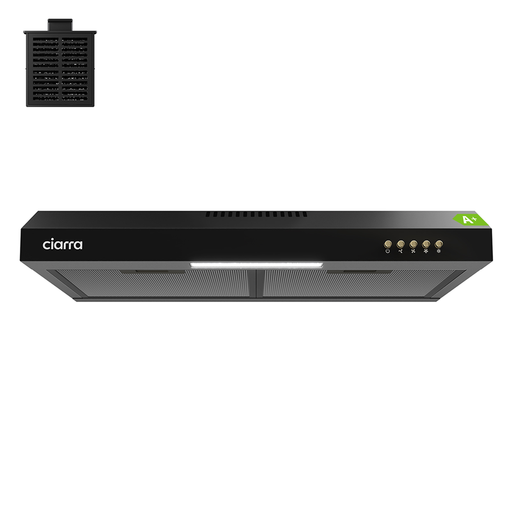
Why it stands out: Perfect for compact kitchens or studios where every square centimetre is precious. Its integrated hood format conceals it under a wall unit, freeing up visual space while remaining functional. It's the ultimate pragmatic solution for a first-time installation or a budget-conscious renovation.
This model is compatible with both installation modes (ducted or recirculation), which eliminates any risk of incompatibility with your home. No nasty surprises upon delivery.
Compact format: Ideal for kitchens where space is at a premium. Simple controls: Reliable push buttons for direct, no-fuss operation.
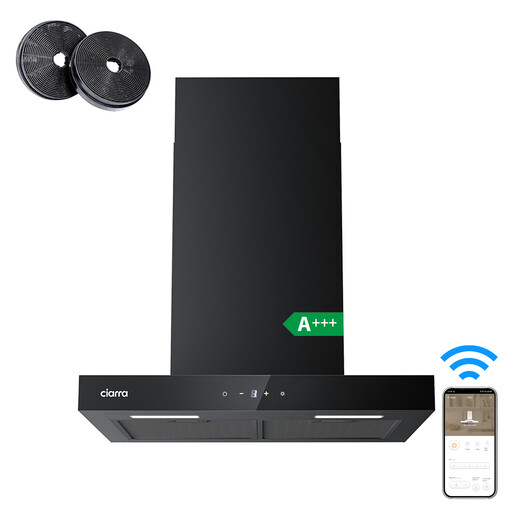
Why it stands out: For those who see their kitchen as a true living space—modern and connected. This black designer hood combines a sleek aesthetic with advanced features like app control, while delivering high extraction performance for intensive cooking.
With an airflow rate of 650 m?/h and a contained noise level of 59 dB, this model offers an excellent compromise. It delivers considerable power for frying or grilling without reaching the deafening noise levels of some competitors.
A+++ energy class: Very low electricity consumption. Connected control: Manage it from your smartphone for maximum convenience. Booster mode: Maximum extraction power available on demand.

Why it stands out: Its angled structure is the perfect solution to the problem of traditional "canopy" hoods: no more bumping your head or struggling to see your hob. It's a smart choice for taller people or anyone who wants an unobstructed view of their pots and pans.
This model comes ready to use for both modes (ducted and recirculation), with charcoal filters included. It's an ultra-flexible "all-in-one" solution, particularly suited for renovation projects where constraints are not always known in advance.
Angled design: Maximises space above the hob. Washable grease filters: Its aluminium filters are dishwasher-safe for easy maintenance. A+ energy class: Energy efficiency and savings on your bill.
Discover our full selection of products that meet our selection criteria and current safety standards.
How often should you change a hood's charcoal filter? For a recirculation hood, replacing the charcoal filter is essential to maintain its effectiveness against odours. Generally, it's recommended to change it every 3 to 6 months, depending on your usage frequency and cooking style (frying and grilling saturate filters faster). Some models have an indicator light that alerts you when a replacement is needed.
What extraction rate (m?/h) should I choose for my cooker hood? The required power depends directly on the volume of your kitchen. As seen above, the basic formula is: [Area (m?) x Height (m)] x 10. For a kitchen that opens into a living room, add a 20% margin (multiply the result by 1.2) to compensate for the larger air volume. However, don't oversize unnecessarily: a hood that is properly sized for your volume will be quieter and more energy-efficient.
Is a recirculation hood really effective? Yes, a ductless hood (or recirculation hood) can be very effective, on two conditions. First: choose a quality model with good filtration. Second: maintain the filters without fail. The grease filter must be cleaned regularly (it's often machine-washable), and the charcoal filter must be replaced as soon as it's saturated. While it doesn't remove moisture like a ducted model, it is very good at neutralising grease and cooking odours.