
Livraison le jour même ou le lendemain

Qualité garantie

Débloquez vos offres de bienvenue: Livraison GRATUITE | Jusqu'à -80 % | 30 jours d'essai gratuits à JoyPlus
Téléchargez l'application
A cooker hood isn't something you should pick based on looks or price alone. A sleek front can hide a weak extraction rate, a filter that's a pain to clean, or a noise level that's unbearable in an open-plan kitchen. Before you order, make sure you check its width, extraction method, and the technical specs that really matter.
The wattage alone isn't enough to judge a hood's effectiveness. The key indicator is the airflow rate, usually given in m³/h. A motor that uses more energy isn't necessarily more efficient.
This airflow also needs to be considered in the context of your installation. A hood connected to an external duct doesn't perform the same way as a recirculation model with a charcoal filter: the filters, the length of the ducting, and any bends in it all directly affect air movement.
An extractor and recirculation hood offers more flexibility, but these two setups come with different requirements:
Buying a wall-mounted hood without checking your extraction options could lead to unexpected work or an awkward installation.
An A++ energy-rated hood might look appealing, but you need to compare this with the other details on the product page. Also check the annual energy consumption, the type of lighting, the airflow rate, and the noise level. The ratings shown in catalogues should be understood within their regulatory framework and compared on a like-for-like basis.
For a standard hob, a 60 cm cooker hood is usually the simplest choice. Ideally, it should cover at least the full width of your cooking area. A 90 cm cooker hood is better suited to a large hob, a wide range cooker, or a kitchen where steam tends to spread.
A slanted hood frees up space in front of your face and makes moving around easier. An under-cabinet model focuses on being discreet and compact. In both cases, stick to the minimum height stated in the manual and follow the safety distances for your cooking appliance.
To compare two models, start by looking at their maximum stated airflow in m³/h, then check how many speed settings they have. Three levels are usually enough to adjust extraction for gentle simmering, a very hot pan, or a particularly steamy dish.
The stated airflow won't necessarily give the same result in every kitchen. The length and diameter of the ducting, the number of bends, and the condition of the filters all have a real impact on performance.
A quiet cooker hood is especially welcome in a kitchen that's open to the living room. Check the noise level in decibels on the spec sheet, remembering that it usually varies depending on the speed selected.
Also look for:
The grease filter needs regular cleaning. When it's clogged, air doesn't circulate as well and deposits build up more easily on surfaces.
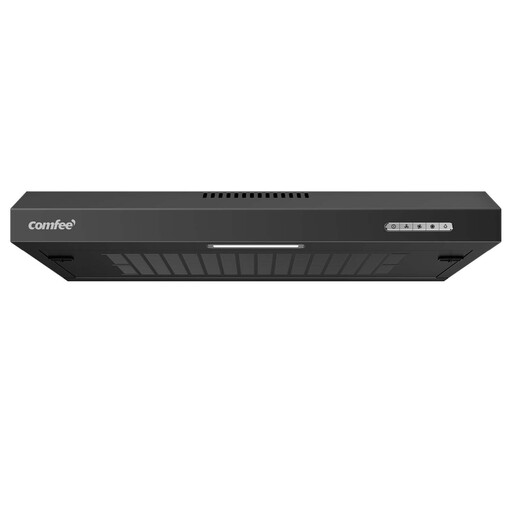
Why this suits this profile: Its 60 cm size works well in smaller kitchens, and the controls are straightforward to use.
It offers two extraction modes and three speeds, so you can use it with ducting or in recirculation mode. The aluminium filter is removable.
Stated airflow of 200 m³/h, LED lighting, stainless steel body and energy class B. The charcoal filter is sold separately.
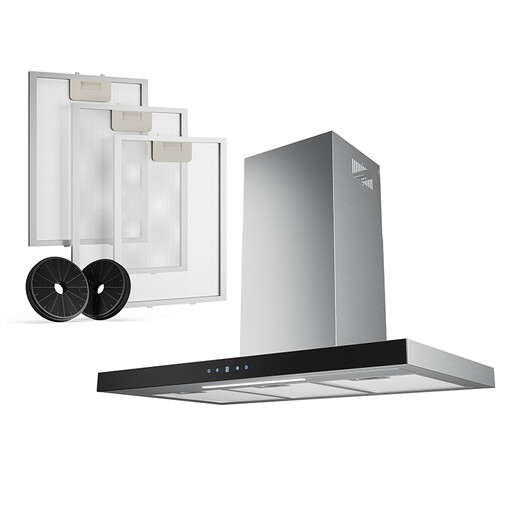
Why this suits this profile: Its 90 cm width and digital display are ideal for larger cooking areas and contemporary kitchens.
The spec sheet shows an airflow of 564 m³/h, two ventilation modes and a charcoal filter included for recirculation.
Energy class A++, touch control, digital display, LED lighting and a five-layer aluminium filter that's dishwasher-safe.

Why this suits this profile: Its slanted design frees up space in front of the hob, and the stated airflow handles everything from everyday cooking to more intense dishes.
It works with both external extraction and recirculation, and includes the stated charcoal filters. The grease filter is removable and dishwasher-safe.
Maximum stated airflow of 580 m³/h, class A+, touch control, LED lighting and a maximum noise level stated at around 64 dB.
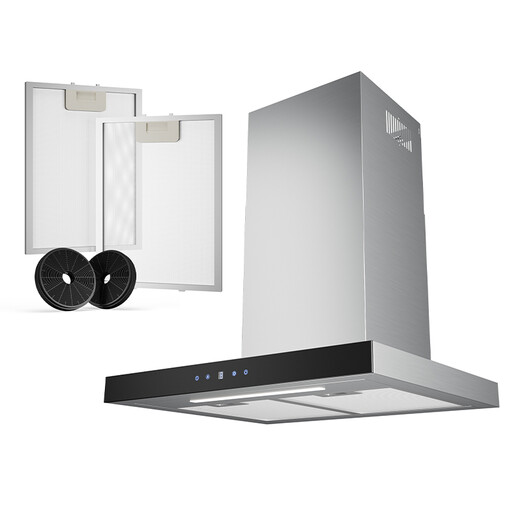
Why this suits this profile: This 60 cm wall-mounted model combines a standard size with a stated airflow of 611 m³/h – a real plus for households that cook often.
The spec sheet details both ventilation modes, the inclusion of a charcoal filter, and a five-layer aluminium filter designed for regular maintenance.
Energy class A++, touch controls, digital display, LED lighting and a dishwasher-safe filter according to the product page.
We've put together a full selection, updated in real time, of products that meet these exacting criteria as well as European safety standards.
Before you drill into the wall, check the duct diameter, the height above the hob, and the electrical compatibility. For an extraction installation, avoid ducting that's too long or has too many changes of direction. In recirculation mode, make sure you have easy access to the filters.
Clean the grease filter every few weeks, depending on how often you cook. Wipe down the surfaces with a soft cloth and a suitable cleaner – don't use anything abrasive. Always unplug the appliance before cleaning it, and follow the manufacturer's instructions.
A 60 cm hood is generally suitable for a hob of a similar width. For a wider hob or heavy use, a 90 cm model will cover the area better, provided you have enough wall space and the ducting allows it.
Yes. Recirculation mode is a good solution when there's no external outlet available. However, you'll need to replace the charcoal filter regularly and clean the grease filter. Performance also depends on the hood's design and the stated airflow.
The running cost depends on the appliance's power, how long you use it, and its energy class. To compare models, check the annual energy consumption on their product pages, and use the appropriate speed setting rather than always running it on maximum.