
Livraison le jour même ou le lendemain

Qualité garantie

Débloquez vos offres de bienvenue: Livraison GRATUITE | Jusqu'à -80 % | 30 jours d'essai gratuits à JoyPlus
Téléchargez l'application
Choosing a cooker hood might seem trivial, but it's a decision that has a lasting impact on the comfort of your kitchen. Make the wrong choice, and you're guaranteed a smoky kitchen, a deafening racket, or an appliance that clashes with your decor. As a Product Specialist at Joybuy, my mission is to help you see clearly and find THE model that meets your needs, while avoiding the common pitfalls.
Before you even start comparing models, let's review the classic mistakes that can turn a good investment into a major regret.
To make an informed choice, focus on these three fundamental parameters. They alone will determine 80% of your daily satisfaction.
This is THE starting point. Your choice will depend exclusively on the options available in your home.
Good to know: most recent models are convertible and allow for both types of installation.
Airflow, expressed in cubic metres per hour (m?/h), measures the volume of air the hood can renew in one hour. A simple rule helps estimate your needs: Minimum Airflow (m?/h) = Kitchen Area (m?) × Ceiling Height (m) × 10
A practical example: for a 15?m? kitchen with a 2.5?m ceiling height, you'll need a hood with at least 375?m?/h. For an open-plan kitchen, don't hesitate to add an extra 20% to 30% margin.
Rule of thumb: the hood's width should be at least equal to that of your hob to effectively capture vapours.
Regarding installation, the main types are:
Here are a few models that cater to different user profiles, taking into account the criteria and pitfalls we've discussed.
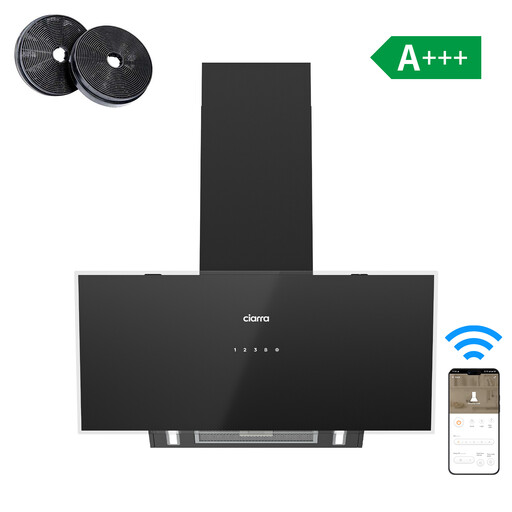
Perfect for large, open-plan kitchens where design matters as much as performance. Its 90 cm width comfortably covers XL hobs. Its angled hood format in black glass adds a modern touch and frees up space above the burners, a real everyday advantage.
It avoids the classic "style over substance" trap. With its airflow of 650 m?/h and its A+++ Class rating, it combines aesthetics with performance. Its controlled noise level (60 dB) makes it perfectly suitable for an open living space.
Its strengths: touch controls and Wi-Fi app connectivity, plus a dual-intake system that optimises smoke capture.
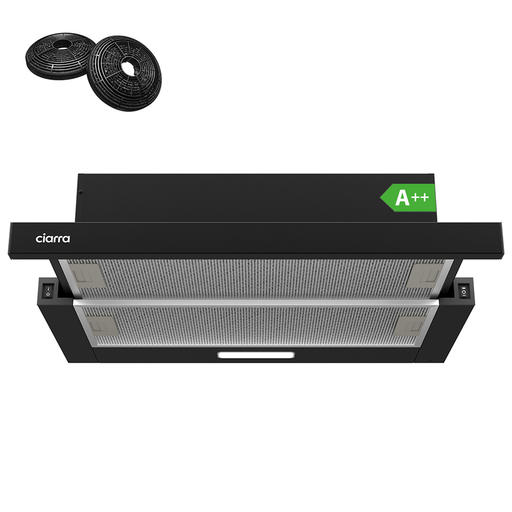
The ideal solution for small kitchens or for those who want absolute discretion. Completely invisible within a wall unit, this 60 cmintegrated hood only extends when you're cooking. A guaranteed space-saver with a minimalist aesthetic.
It avoids the problem of a wall-mounted hood being too bulky for a small kitchen. Its airflow of 370 m?/h is perfectly calibrated for standard-sized kitchens: powerful enough to be effective without being oversized (and therefore unnecessarily noisy or expensive).
Its strengths: a memory function that saves your last settings and its versatility, as it's compatible with both extraction and recirculation modes (charcoal filters included).
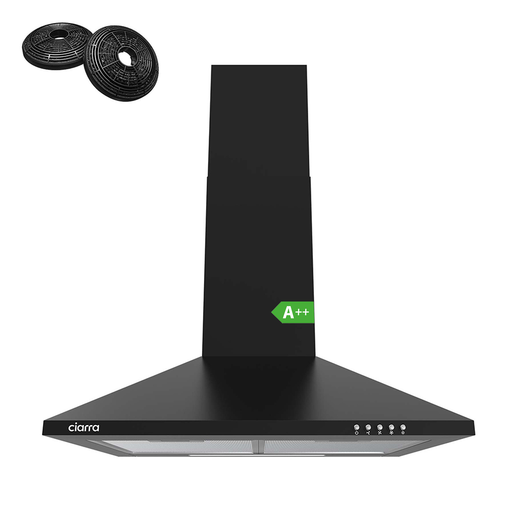
The ultimate versatile and accessible solution, ideal for tenants or apartment owners. This 60 cm model is designed to work just as well in extraction mode as in recirculation mode, offering maximum flexibility without requiring major renovation work.
It directly addresses the first pitfall we mentioned: the ventilation mode. By being convertible and supplied with everything needed for both installation types, it eliminates the risk of buying an appliance that's incompatible with your home.
Its strengths: push-button controls, known for their reliability, and dishwasher-safe metal grease filters for simple, cost-effective maintenance.
Explore our full selection of cooker hoods, all tested and approved according to our performance and safety criteria.
1. What airflow (m?/h) should I choose for my cooker hood? The rule is simple: calculate your kitchen's volume (length × width × height) and multiply this figure by 10. This will give you the minimum recommended airflow. For a 12?m? kitchen with a 2.5?m ceiling height (i.e., 30?m?), you'll need a hood with at least 300?m?/h. Add an extra 20% power for an open-plan kitchen.
2. When should you change the filters on a recirculation hood? The metal grease filters should be cleaned every 2 to 4 weeks (most are dishwasher-safe). As for the charcoal filters that trap odours, they are not washable: they must be replaced every 3 to 6 months, depending on your usage, to ensure optimal efficiency.
3. Is a ductless hood really effective? Absolutely. A modern recirculation hood is very effective, on two conditions: it must be correctly sized for your room, and its charcoal filters must be high-quality and changed regularly. While it doesn't remove moisture like an extraction model, it is formidable against grease and cooking odours.