
Livraison le jour même ou le lendemain

Qualité garantie

Débloquez vos offres de bienvenue: Livraison GRATUITE | Jusqu'à -80 % | 30 jours d'essai gratuits à JoyPlus
Téléchargez l'application
A child's first bike is an unforgettable milestone. The convertible tricycle, in particular, holds the wonderful promise of accompanying your little explorer from their first few months to their first solo rides. But faced with the jungle of available models, it's easy to fall into a trap and turn this purchase into a source of frustration. As a Product Specialist at Joybuy, my mission is to help you cut through the noise and decode the features that truly make a difference.
Before you decide, watch out for these 3 common pitfalls?:
To avoid these disappointments, focus on two fundamental technical points. They are what guarantee the quality, safety, and durability of your convertible 3-wheel bike.
For a tricycle for a 1-year-old, safety is simply non-negotiable. The "push" mode, where the parent guides the child, requires a complete set of features. Check for the presence of the following elements?:
A good convertible tricycle must be easy to transform. The safety elements (bar, handle, footrests) should be simple to remove, ideally without tools. The quality of the materials is the guarantee of its longevity and user comfort.
Rather than an endless list, we've selected products for very specific uses. The goal: to help you find the model that perfectly matches your expectations and your child's age.
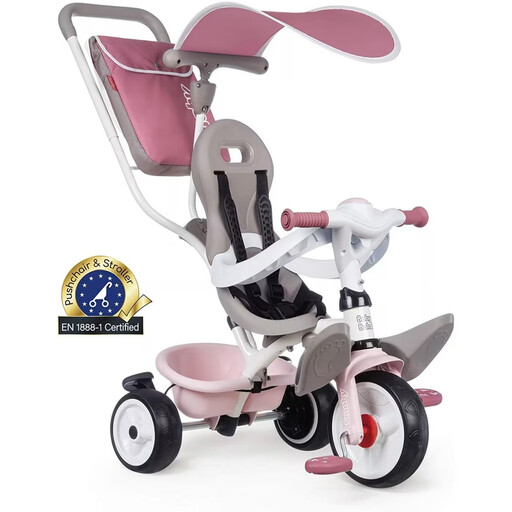
Why we recommend it: It's the archetype of a well-designed convertible tricycle. It accompanies the child from 10 months to over 3 years, transforming from a secure push trike into an independent tricycle. Ideal for parents looking for a single product to keep up with their child's growth.
It checks all the boxes: sturdy metal frame, silent EVA wheels, and, most importantly, a complete parental control system (steerable handle, freewheel, handlebar lock). Its modularity is genuinely well-thought-out.
Its versatility and the quality of its features (harness, safety bar, retractable footrest, small bag...) make it a long-lasting investment that truly adapts to every stage of a child's development.
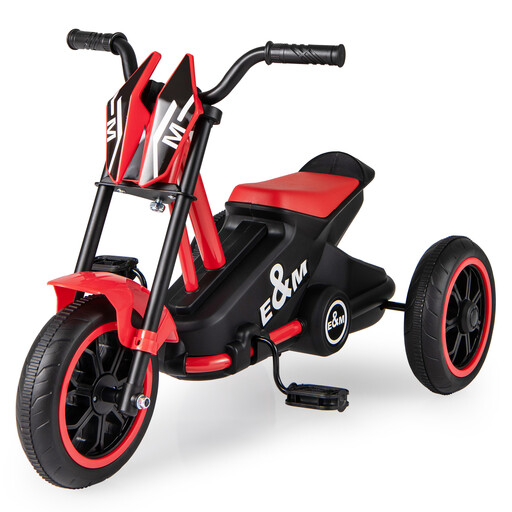
Why we recommend it: This is a simple and sturdy option for a child (from age 3) ready to pedal independently. It's not a convertible model with a push handle, but a first "real" tricycle, pure and simple.
By focusing on the essentials, it ensures excellent stability thanks to its structure and wide wheelbase. This avoids the complexity and fragility of entry-level convertible models.
Safety designed for independence. The handlebar, with its steering limiter that restricts turning angles, prevents overly sharp turns and falls. Perfect for helping a child build confidence at their own pace.
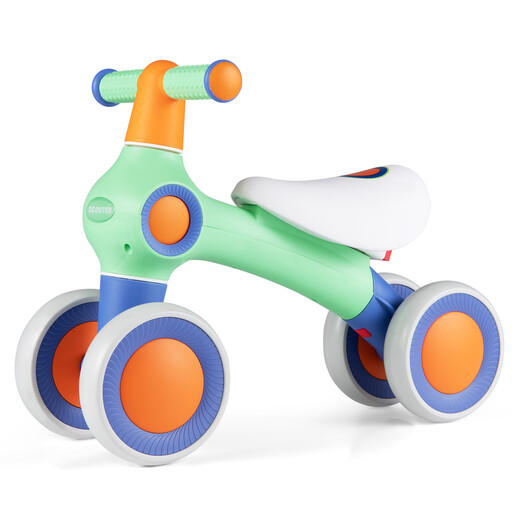
Why we recommend it: This is the alternative to the classic tricycle. For parents who want to focus on learning balance from as early as 12 months, the balance bike is the ideal stepping stone to a "big kid" bike.
It skips the pedals, which are often complex for toddlers. Its enclosed wheels protect little feet, and its steering limiter prevents falls. Its 4 EVA wheels are silent and won't scratch your floors.
Ultra-lightweight (1.8 kg) and assembled in a flash, no tools required. It focuses on a single goal: developing the child's coordination and confidence through play, both at home and at the park.
Discover our full selection of products that meet our quality criteria and current safety standards.
The most comprehensive models (with a harness, safety bar, and parent handle) can be used as an alternative to a stroller from 10-12 months. At this stage, the child is just a passenger. Learning to pedal independently comes later, usually around 24-30 months, once their coordination and strength allow for it.
Yes, and this is a point you should absolutely not overlook. They are very noisy on pavement, slippery on smooth floors, and offer no shock absorption. For your child's comfort (and your own peace and quiet), definitely opt for EVA (dense foam) or rubber wheels. They guarantee much smoother and quieter rides.
A well-designed model is child's play to manoeuvre. Make sure the handle is connected to the front wheel's steering. But most importantly, look for the freewheel system. It disengages the pedals when you push, so they don't spin freely and risk hitting the child's feet. This is what makes the ride truly simple and safe.