
当日/次日达

品质保障

开启新人专享福利: 全场免邮 | 低至 2 折 | 免费试用 30 天 JoyPlus 会员
下载 Joybuy
Living in a small space, whether it's a student studio or a small flat, is a constant challenge: how do you balance functionality, comfort, and aesthetics? Every square metre counts. The need for a spare bed for a guest or the desire for a cosy reading nook often clashes with the harsh reality of limited space.
The convertible chair bed emerges as the ingenious solution to this dilemma. Far from being a simple gadget, this versatile piece of furniture has evolved to offer a variety of designs and surprising comfort. This guide breaks down the essential criteria for finding the perfect model, whether you're looking to successfully furnish your student studio or optimise any small space with space-saving furniture.
Before you get started, let's review the key points that distinguish a good model from another.
The ease with which the furniture transitions from one function to another is paramount. A folding floor sofa is often the simplest: it unfolds in seconds to become a mattress. Other models, like a single sofa bed, may offer multi-level reclining backrests, providing intermediate positions (chaise lounge, recliner). Think about its primary use: will it be for very occasional sleeping, or is it an everyday seat that needs to transform quickly?
The comfort of a guest sleeper chair depends on two elements: the filling and the cover.
Precisely measure the space where you plan to place your chair bed, in both its seating and bed positions. Check the height, width, and depth. For the most restricted spaces, an armless model or a compact small convertible sofa will be a smarter choice. Also, consider its footprint when folded if you plan to store it.
To put theory into practice, here are a few options that meet different needs and styles.
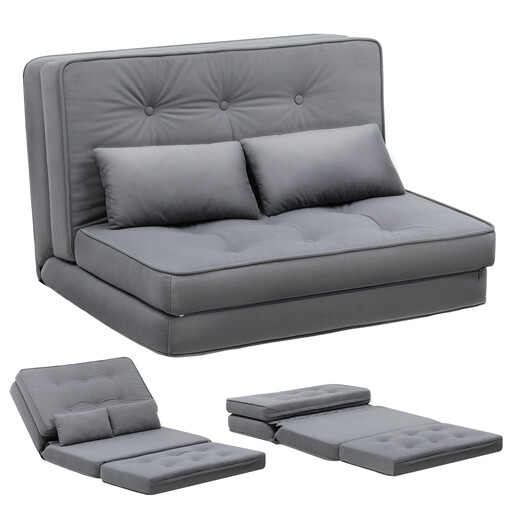
Why it stands out: This model embodies versatility. It effortlessly switches from an upright armchair to a fully flat guest bed, with a chaise lounge position in between. Its floor-level design makes it particularly suitable for relaxed, minimalist, or Japanese-inspired atmospheres.
Key features:
Who is it for? Ideal for students, young professionals in studios, or for furnishing a playroom. Its lightness and compactness make it a portable and easy-to-store solution.
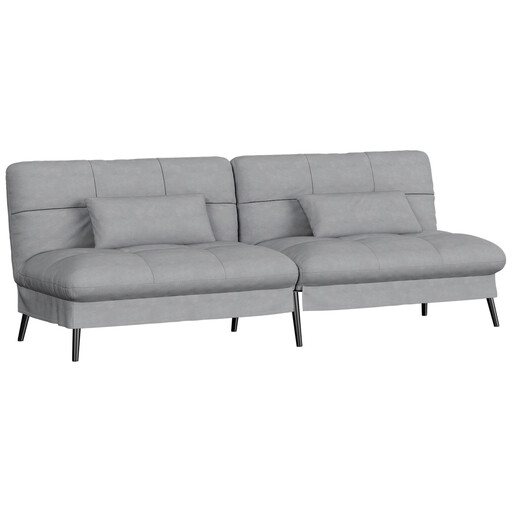
Why it stands out: Closer to a small convertible sofa, this model offers wider seating and a design on legs that integrates easily into a living room. Its split backrest allows for interesting modularity.
Key features:
Who is it for? Perfect for those looking for a main piece of furniture for a small living room, capable of transforming into a comfortable single guest bed. Its understated style adapts to many interiors.

Why it stands out: This option steps outside the traditional chair bed framework to offer an alternative focused on relaxation and style. This indoor hanging chair is a true decorative asset that creates a relaxation space without taking up any floor space.
Key features:
Who is it for? For those who want to create a reading nook or a relaxation bubble in a bedroom or living room. It's less of a guest bed and more of a statement piece that optimises vertical space.
The convertible chair bed is one of many options for intelligently furnishing a small space. If these models don't exactly match your needs, or if you want to explore alternatives like a padded bed backrest to turn a simple mattress into a comfortable seat, other paths exist.
? Explore our full range of modular furniture and bed backrests to find inspiration.
Most chair beds are designed as guest sleeping solutions. Their comfort, while much improved, generally doesn't match that of a dedicated mattress and bed base. For occasional use or for a few nights, they are perfectly suitable. For daily use, you should look for sofa beds specifically designed for this purpose, which have a thicker mattress.
The ideal choice is a model with a fully removable and machine-washable cover. Always follow the manufacturer's instructions. For stains on non-removable covers, use a clean, damp cloth with a little mild soap, gently dabbing the area without rubbing.
For lasting comfort, aim for a foam density of at least 25 kg/m?. Below that, the foam is likely to sag quickly. A high-resilience (HR) foam, often above 35 kg/m?, ensures optimal support and better longevity, for a feel close to that of a real mattress.