
Livraison le jour même ou le lendemain

Qualité garantie

Débloquez vos offres de bienvenue: Livraison GRATUITE | Jusqu'à -80 % | 30 jours d'essai gratuits à JoyPlus
Téléchargez l'application
A connected robotic lawn mower can save you many hours of work, but manufacturers’ promises deserve careful scrutiny. Coverage area, “smart” navigation and wire-free installation do not always tell you how well the robot will actually perform on your lawn.
Before placing your order, keep these three pitfalls in mind:
The area stated by the manufacturer is a useful reference point, not a universal guarantee. To choose an autonomous robotic lawn mower, measure the lawn that is genuinely accessible and allow some headroom if your garden has slopes, several areas or awkward passages.
Some useful guidelines:
The cutting width also determines how many passes are needed. At 18 cm, like some WORX models, a narrow cutting disc can move more easily through tight passages, but may require more cycles than a wider model.
A robotic lawn mower with a boundary wire requires a wire to be installed around the area to be mown. This method is generally reliable and predictable, but the wire must be secured correctly. You also need to plan for borders, trees and planting islands.
A robotic lawn mower without a boundary wire instead relies on a camera, satellite positioning, LiDAR or virtual boundaries. Installation may be quicker, but mapping quality then becomes essential.
These technologies are not all equal:
Also check whether the app supports multiple zones, narrow passages, borders and no-go areas.
The maximum slope quoted must be compared with the reality of your garden. A value of 35% corresponds to approximately 19 degrees, while 45% is equivalent to approximately 24 degrees. Grip also depends on the type of ground, its moisture level and the type of wheels used.
Before switching it on for the first time, check the following:
Even when connected, a robotic lawn mower requires a little maintenance: clean its underside regularly, check the blades, clear the wheels and inspect the sensors. The app makes scheduling easier, but it cannot replace these maintenance tasks.

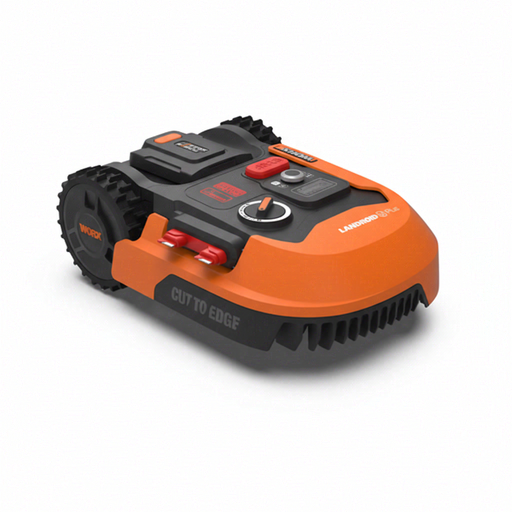
Why this choice suits this profile : With a stated coverage of 150 m² and wire-free operation, it is aimed at small residential gardens where the simplest possible installation is a priority.
Its clearly limited capacity helps prevent you from choosing an oversized machine for a small lawn. The product details also mention obstacle detection and wire-free operation.
Wire-free installation, autonomous movement and a format suitable for lawns of up to 150 m².
Why this choice suits this profile : It is suitable for owners who want to control their autonomous robotic lawn mower from a Wi-Fi app on a moderately sized lawn.
The product details specify a 150 m boundary wire. The installation method is therefore clearly established before purchase.
iOS and Android app, 18 cm cutting width, rain detection, slopes of up to 35% and a 20 V battery.
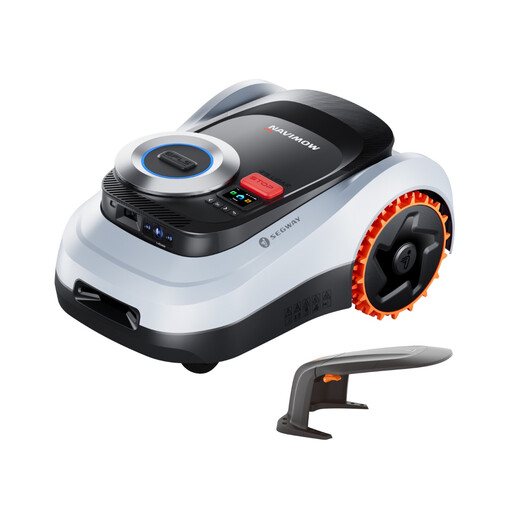
Why this choice suits this profile : Its stated coverage of 1 500 m² and navigation combining LiDAR and vision are designed for large grounds and complex routes.
The product details state that it operates without a wire or antenna and offers automatic mapping. However, check network coverage and any limitations related to the layout of your garden.
LiDAR, vision, multi-zone management from the app, all-terrain wheels and a stated slope capability of up to 45%.
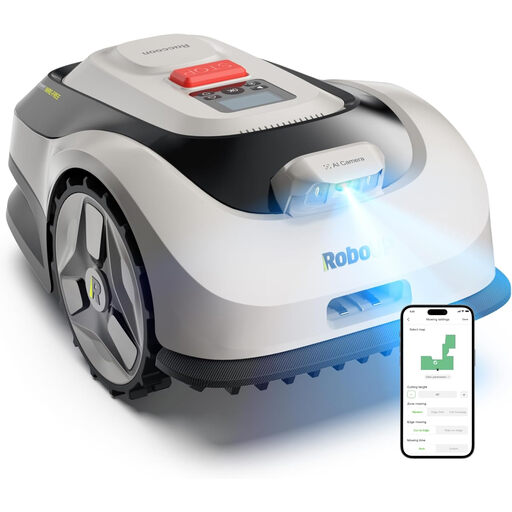
Why this choice suits this profile : It is designed for gardens of up to 600 m² with narrow passages, multiple zones and common obstacles, without requiring an RTK antenna.
The product details specify a passage at least 80 cm wide, support for three zones and virtual boundaries that can be used with the appropriate accessories.
5 Ah battery, stated battery life of up to 150 minutes, app, obstacle detection and slopes of up to 20°.
We have brought together a comprehensive, real-time updated selection of products that meet these demanding criteria and European safety requirements.
Installing a boundary wire takes a little time initially, but the limits of the mowing area generally remain easy to understand. With a wire-free model, allow time for initial mapping, configuring no-go zones and checking how it operates near borders.
Running costs include in particular:
If the robot is controlled via an app, also make sure it is compatible with your Wi-Fi network and smartphone. Check the connection requirements before placing your order.
Not necessarily. Essential functions may work without a permanent connection, while remote scheduling, notifications and certain updates generally require Wi-Fi or Bluetooth. However, requirements vary between models.
It depends on the battery, motor, exposure to moisture and maintenance. Clean the wheels and sensors regularly, replace the blades when they become blunt, and store the machine under cover during winter if recommended in the instructions.
Yes, provided the stated slope capability covers that of your garden with a sufficient margin. Measure the actual slope, check the grip of the wheels and identify obstacles, uneven areas and wet patches. Wire-free mapping cannot compensate for a lack of grip.