Homes without an external air outlet
If there’s no opening or duct to vent air outside, compare condenser appliances rather than a vented tumble dryer. UFC-Que Choisir explains this difference in installation requirements.


If you don’t have an external opening or vent, rule out vented tumble dryers: according to UFC-Que Choisir, condenser models don’t need this connection. If you have room for two appliances and dry laundry regularly, compare heat pump tumble dryers for their electricity consumption. If only one appliance will fit in the room, consider a washer-dryer, bearing in mind that its drying capacity is lower than its washing capacity and its cycles take longer.
If there’s no opening or duct to vent air outside, compare condenser appliances rather than a vented tumble dryer. UFC-Que Choisir explains this difference in installation requirements.
If there’s room for a separate appliance, compare its capacity with the size of your usual loads. UFC-Que Choisir notes that heat pump models use less electricity, while conventional condenser models generally dry clothes faster.
A washer-dryer combines both functions in one appliance. However, check its drying load capacity: according to UFC-Que Choisir, this is lower than its washing capacity, and drying takes longer than with a separate tumble dryer.
First, check whether you can install a separate appliance. Then compare capacity, dimensions and cycle features with your laundry needs.
Consider this if : you have room for a separate tumble dryer and dry laundry regularly, but don’t have an external vent.
Keep in mind : UFC-Que Choisir says these models use less electricity than conventional condenser dryers, but generally take longer to dry clothes.
Consider this if : you can install a separate tumble dryer without an external vent and cycle times are important to you.
Keep in mind : according to UFC-Que Choisir, these models generally dry clothes faster than heat pump models, but use more electricity.
Consider this if : there genuinely isn’t room for a separate washing machine and tumble dryer.
Keep in mind : UFC-Que Choisir notes that drying capacity is lower than washing capacity, and drying takes longer than with a separate tumble dryer.
| Priority | What to check | My needs |
|---|---|---|
| External connection | Check the drying type listed for the model you’re considering. According to UFC-Que Choisir, vented dryers need an external opening or duct, whereas condenser dryers don’t. | I don’t have an external air outlet, so I need a solution that works without this duct. |
| Room ventilation | Check that air inlets aren’t blocked and that the ventilation is working. France Rénov’ notes that it removes moisture produced in the home. | I want to dry my laundry without overlooking any existing damp in the room. |
| Energy use and cycle time | Compare the energy label and the duration of programmes suited to similar loads. UFC-Que Choisir notes that heat pump models use less electricity, while conventional condenser dryers generally dry clothes faster. | If I dry laundry often, electricity use matters; if I need to get through several loads, I’ll also check cycle times. |
| Drying capacity | Compare capacities in kg. For a washer-dryer, check the washing and drying figures separately: UFC-Que Choisir says the latter is lower. | I need to be able to dry my washed loads without exceeding the stated capacity, even if that means splitting them. |
| Size | Measure the available space and compare it with the appliance’s height, width, depth and door opening. | A separate appliance will work for me only if it fits in the space available; otherwise, I’ll compare washer-dryers. |
This type of appliance needs an external opening or duct, according to UFC-Que Choisir, so it won’t suit your home’s installation requirements.
Instead, compare condenser appliances, including heat pump models.
For a washer-dryer, the maximum drying load is lower than the washing load, as UFC-Que Choisir points out.
Check both figures in kg and size your laundry load according to the drying capacity if you want to run both functions one after the other.
If a washed load is too large for drying, you may need to split it across several cycles.
According to UFC-Que Choisir, conventional condenser dryers use more electricity than heat pump models, even though they generally dry clothes faster.
Compare the energy labels and programme times of models with similar capacities, taking into account how often you dry laundry.
An appliance without an external duct doesn’t replace ventilation in your home. France Rénov’ says that excess moisture in a poorly ventilated home can condense on surfaces and encourage mould growth.
Check that the ventilation is working and keep air inlets clear, following advice from Anses.
These brand examples can help you identify features to compare; check the specifications of each specific model before buying.
Bosch’s range includes the WQG2450SFR, a separate heat pump tumble dryer.
Beko offers heat pump tumble dryers and describes how warm air is reused inside the appliance.
Miele’s French catalogue includes 7, 8 and 9 kg tumble dryers, including heat pump models.
This selection includes separate condenser tumble dryers, including heat pump models, as well as a washer-dryer for rooms that can’t fit two appliances.
 Image unavailable
A separate heat pump tumble dryer to consider if you have room for a second appliance without an external air connection.
Listed capacity: 8 kg ; energy rating C. Measure the space and compare energy use per cycle with the other models you’re considering.
 Image unavailable
This separate heat pump tumble dryer is suited to a home without an external air outlet.
Listed capacity: 8 kg ; energy rating D. Check its dimensions and energy use per cycle to see how well it suits your space and needs.
 Image unavailable
This condenser tumble dryer is worth considering if your room doesn’t have an external air outlet.
Its listed capacity is 8 kg and its energy rating is E. Check that it fits your space and compare energy use per cycle and programme times.
 Image unavailable
This condenser washer-dryer combines both functions when there isn’t room for a second appliance.
Its listed capacities are 11 kg for washing and 6 kg for drying : you may need to split a full washing load before drying. Check the dimensions against your available space, as well as the duration and energy use of the combined cycle.
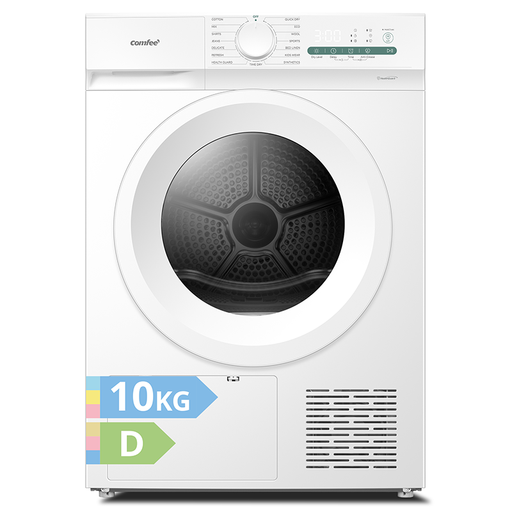 Image unavailable
This separate heat pump tumble dryer is worth considering for a home without an external vent.
Its listed energy rating is D. Confirm the drying capacity of this variant before deciding on load sizes: the available information lists both 8 kg and 10 kg. Also check its dimensions and energy use per cycle.
Yes. A condenser tumble dryer, with or without a heat pump, doesn’t need an external duct. UFC-Que Choisir distinguishes these appliances from vented models, which need an external opening or duct.
No. The appliance not needing its own external duct doesn’t replace ventilation in your home: Anses advises keeping air inlets clear and checking that the ventilation is working, while France Rénov’ highlights its role in removing moisture.
Not necessarily: its drying capacity is lower than its washing capacity, according to UFC-Que Choisir. Check both figures before starting a combined cycle. For example, Electrolux lists a washing capacity of 9 kg and a drying capacity of 6 kg for the EW7W3916DA model.
It’s worth considering if two separate appliances won’t fit in the room. However, check the drying capacity and cycle time: UFC-Que Choisir says washer-dryers take longer to dry clothes than separate tumble dryers, and that you should also factor in the water used during drying.