Who are these options for?
The space available for your appliances will determine whether you can choose a separate tumble dryer or need a single appliance that handles both washing and drying.
People without an external vent
If you don’t have an external opening or a usable duct, look at condenser models rather than vented tumble dryers. You’ll also need to collect the water in a tank or check whether your chosen model can connect to a drain.
Households considering a stacked washer and dryer
If you already have a front-loading washing machine, placing a separate tumble dryer on top can save floor space. Check the model numbers of both appliances, the approved stacking kit and their dimensions before settling on this arrangement.
Homes with space for just one appliance
A washer-dryer combines both functions in one machine. According to UFC-Que Choisir, its drying capacity is lower than its washing capacity. If you want to run a wash and dry cycle without removing any clothes, base your load size on the drying capacity.
What should you check before choosing?
First measure the space and access points, then compare the drying capacity and programme information for models that will actually fit.
| What to consider |
What to check |
Your needs |
| Size and stacking |
Measure the width, height and depth, allowing room for the door and connections. If stacking, confirm which kit is approved and that it is compatible with both models. For one of its kits, Bosch specifies a washing machine with a depth of more than 55 cm. |
I need to be able to open the door and access the parts that need maintenance, not just fit the machine into its space. |
| Energy use and cycle time |
Compare the energy labels and cycle times for the same type of programme on the models you’re considering. For household tumble dryers sold in the European Union, EUR-Lex describes the energy label as a tool for comparing appliances. |
If I dry clothes often, energy use will influence my choice. If I need to use the machine again quickly, I’ll also look at cycle times. |
| Drying capacity |
For a washer-dryer, check the washing and drying capacities separately. Find out the maximum load for a continuous wash-and-dry programme and how long it takes. |
I want to run a wash and dry cycle without finding out afterwards that I need to remove some of the load. UFC-Que Choisir points out that a washer-dryer’s drying capacity is lower than its washing capacity. |
| Water and maintenance |
Check whether condensed water collects in a tank or whether the model can be connected to a drain. Make sure you can access the filters and follow the ventilation and installation instructions in the manual. |
I want to be able to manage the collected water and maintain the appliance without having to move a machine wedged into an alcove. |
A guide to selected brands
These examples of product ranges and accessories can help you work out what to check. They’re no substitute for reading the manual for the model you’re considering.
Bosch
Bosch Home Appliances France offers condensate drainage and stacking accessories for certain separate tumble dryers.
- One of the brand’s kits can direct condensed water into a sink, trap or gully, provided the tumble dryer is compatible.
- The stacking kit described for some appliances requires a washing machine with a depth of more than 55 cm, among other conditions. Check which models it applies to.
Miele
Miele France offers a range of heat-pump tumble dryers that, depending on the installation, can be fitted under a worktop or stacked using a suitable kit.
- A stacked installation is worth considering if floor space is limited.
- Before deciding on this set-up, check the dimensions, required kit and programme information for the specific model.
Beko
Beko France offers washer-dryers for homes where washing and drying need to fit into a single appliance.
- The brand describes programmes that combine washing and drying on certain models.
- Check the capacity for each function, water management and energy use for the exact model. The specifications of one model don’t apply to the entire range.
Joybuy models to consider
These models illustrate three options for a flat without an external vent: a standard condenser tumble dryer, a heat-pump tumble dryer and a washer-dryer. Your choice will still depend on the space available, connections and the loads you need to dry.
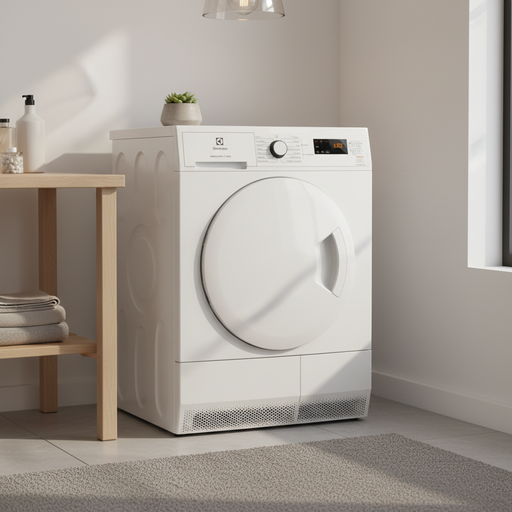 Image unavailable
Electrolux EDH1018CD GentleCare, 8 kg condenser tumble dryer
This separate condenser tumble dryer is an option if you have space for a second appliance but no duct to the outside. It has a stated capacity of 8 kg. Measure the space you have and check how this model handles water, as well as its programmes.
View on Joybuy
 Image unavailable
Hotpoint CHD84MWBSEE, 8 kg heat-pump tumble dryer
This heat-pump model is an option if you want a separate tumble dryer without an external air vent. The title lists an 8 kg capacity and a C energy rating. Compare its programme times and energy information with other models you’re considering, then check the dimensions and drainage.
View on Joybuy
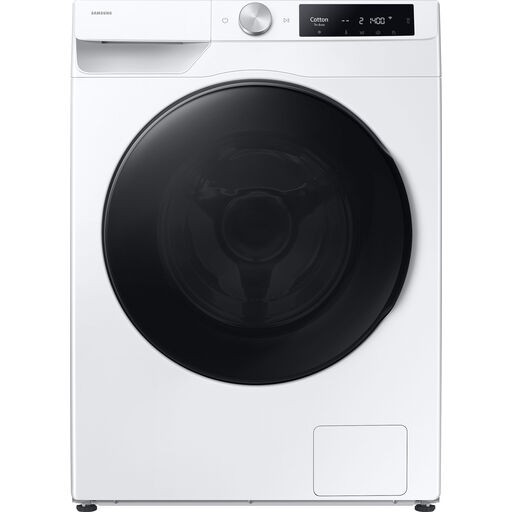 Image unavailable
Samsung WD11DG6B85BEU3, 11 kg / 6 kg washer-dryer
This washer-dryer is designed for homes with space for just one appliance. The title lists an 11 kg washing capacity and a 6 kg drying capacity. To run both functions in sequence without removing any clothes, keep the load within the drying limit. Also check the connections and the length of your chosen programme.
View on Joybuy
 Image unavailable
Comfee CD08EHP05W-HR, 8 kg heat-pump tumble dryer
This separate heat-pump tumble dryer is worth considering if your flat has room for a second appliance. The title lists an 8 kg capacity and a D energy rating. Check the dimensions, how water is collected and the programme times to see how well it will suit your space and needs.
View on Joybuy
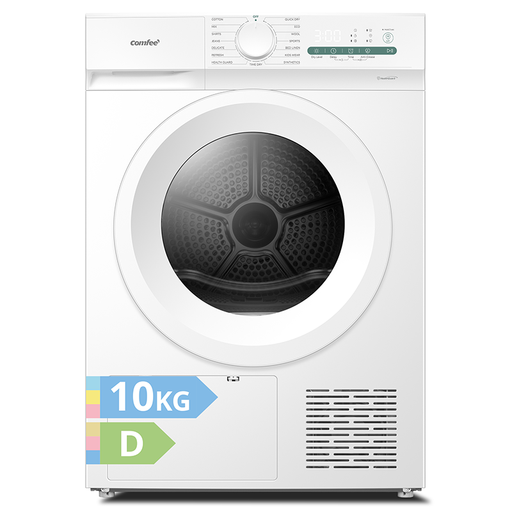 Image unavailable
Comfee CD10EHP05W-HR, heat-pump tumble dryer
This model is a separate heat-pump tumble dryer that doesn’t need an external air vent. Check its drying capacity before planning your loads: the information associated with this model gives conflicting figures of 8 kg and 10 kg. Also check the dimensions and how it handles condensate to make sure it will suit your space.
View on Joybuy
Frequently asked questions
Can you install a tumble dryer without an external vent?
Yes. Standard condenser and heat-pump tumble dryers don’t need an air-extraction duct to the outside. UFC-Que Choisir distinguishes these appliances from vented tumble dryers, which need an external opening or access to a duct. Even so, check the ventilation and installation instructions for your chosen model.
Do you always have to empty a tumble dryer’s water tank?
No, not if the model can be connected to a suitable drain. Bosch Home Appliances France, for example, offers a kit that directs condensed water into a sink or trap. Check your tumble dryer’s manual before planning this connection.
Can you stack any washing machine and tumble dryer?
No. You need to confirm that both models are compatible with the kit specified by the manufacturer, and check the installation requirements. For one of its kits, Bosch specifies a washing machine with a depth of more than 55 cm, among other conditions. So matching widths alone aren’t enough to confirm that the appliances can be stacked.
Can a washer-dryer dry a full load of washing?
Not if the load is larger than its drying capacity. UFC-Que Choisir says that drying capacity is lower than washing capacity. For a continuous wash-and-dry cycle, keep the load within the stated drying capacity or remove some clothes between the two stages.
How can you compare the energy use of the options you’re considering?
Compare the energy information and programmes that match your needs, rather than judging energy use by cycle length alone. EUR-Lex says the energy label for household tumble dryers sold in the European Union is designed to help compare appliances. For a washer-dryer, check its own energy label and product information sheet.


