
Livraison le jour même ou le lendemain

Qualité garantie

Débloquez vos offres de bienvenue: Livraison GRATUITE | Jusqu'à -80 % | 30 jours d'essai gratuits à JoyPlus
Téléchargez l'application
Choosing a new computer desk? A simple task, you might think. Yet, this seemingly minor purchase is crucial for your daily productivity and comfort. Faced with an overwhelming number of options, it's easy to fall into the usual traps that turn a good investment into a lasting regret. To avoid disappointment, let's review the mistakes you should never make to create a workspace that truly works for you.
Design is important, but it should never overshadow the essentials. Otherwise, you might end up with a piece of furniture that's as beautiful as it is unusable. Here are the three red flags to keep in mind.
To make the right choice, you need to look beyond aesthetics. Focus on these key technical features that will guarantee the quality and practicality of your future computer table.
The lifespan of your desk rests on two pillars: the top and the frame. For the top, aim for E1-grade particleboard, a European standard that ensures low formaldehyde emissions and better density. As for the structure, a steel frame remains the best guarantee of sturdiness. Pay attention to the thickness of the steel and the presence of reinforcements, like crossbars or joining brackets. An industrial-style desk, with its visible metal structure, is often a good indicator of robustness, but be sure to take a look at the quality of the welds.
A desk for remote work must, above all, adapt to your body. The standard height ranges from 72 to 76 cm. The important thing is that, when seated, your forearms rest flat on the desktop, forming a 90° angle at your elbows. Also, consider the depth: 60 cm is the minimum for a comfortable distance from your screen. If space is tight, a small desk that's 80 cm wide can work, provided you optimize every square centimetre.
Be aware, the desk isn't the whole story. Pairing it with an ergonomic office chair is absolutely crucial for maintaining good posture and preventing back pain. A chair with adjustable lumbar support, armrests, and an adaptable seat height is not a luxury; it's the essential companion to your setup.
To put theory into practice, here are a few models that meet these criteria perfectly, tailored for different needs and budgets.
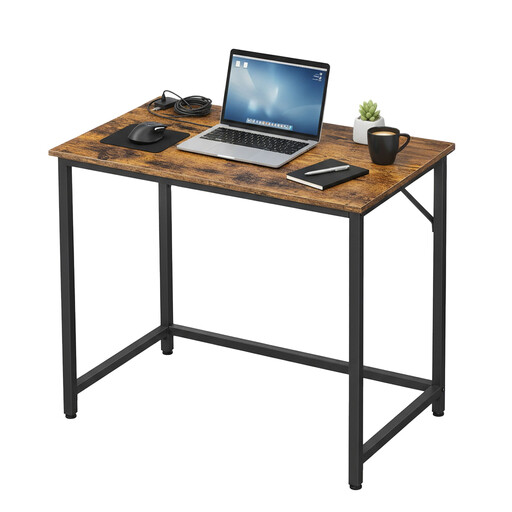
Why we love it: Perfect for students or for setting up a desk corner in a bedroom or living room. Its compact dimensions (80 x 50 cm) allow it to fit anywhere without sacrificing the essentials: enough space for a laptop and a few files.
Its steel frame and adjustable feet ensure rock-solid stability, avoiding the wobbly desk trap despite its minimalist design.
Assembly is a breeze thanks to numbered parts and clear instructions.
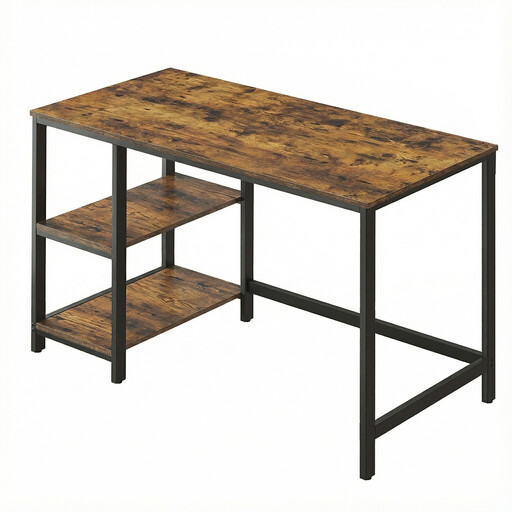
Why we love it: Essential for remote workers who need a perfectly organized space. Its large 120 x 60 cm top can comfortably accommodate two monitors, while the shelves keep files and equipment within arm's reach.
It avoids the poorly designed storage trap: its 2 shelves are reversible and can be installed on the left or right for maximum flexibility.
Its sturdy steel frame and thick top can support a load of up to 50 kg.
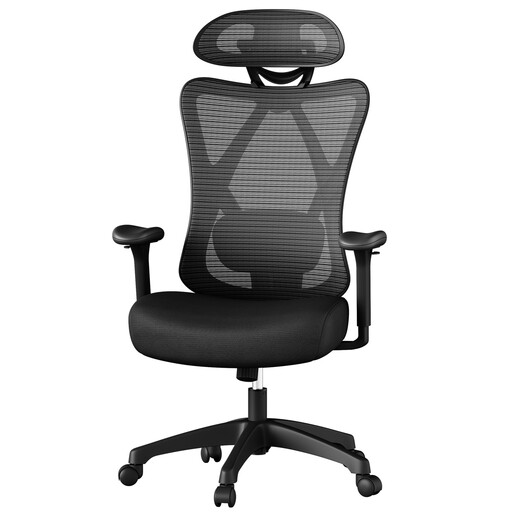
Why we love it: For anyone who spends hours at their desk, postural comfort is non-negotiable. This chair is designed to conform to the body's shape and reduce physical fatigue during long workdays.
This chair addresses the weak link in any setup: comfort, which is too often sacrificed. Its adjustable lumbar support and headrest are designed to actively prevent pain.
A reclining back, high-density foam seat, and breathable mesh backrest provide optimal comfort, even in the height of summer.
We have selected a full range of products that meet our quality criteria and safety standards.
The standard height ranges from 72 to 76 cm. But the perfect height depends mainly on your own height and your chair. The golden rule: when seated, your feet should rest flat on the floor and your elbows should form a 90° angle when your forearms are on the desk. Most of the time, a good adjustable office chair is all you need to solve the equation.
The vast majority of desks sold online are designed for hassle-free assembly. To make your life easier, choose a model with numbered parts and well-illustrated assembly instructions. Generally, assembly only requires the included Allen key and can be done in under 30 minutes. Our tip: assemble the desk directly in its destination room to avoid an unnecessary moving session.
The industrial-style desk is defined by its raw materials, like metal and wood, and its exposed steel frame is often a sign of robustness. Be careful, though, as the term "industrial" is primarily an aesthetic selling point. To judge its real sturdiness, rely on the technical specifications: the thickness of the steel tubes, the quality of the welds, and the presence of reinforcing bars are far more reliable indicators than looks alone.