
Livraison le jour même ou le lendemain

Qualité garantie

Débloquez vos offres de bienvenue: Livraison GRATUITE | Jusqu'à -80 % | 30 jours d'essai gratuits à JoyPlus
Téléchargez l'application
Whether you're on a van road trip, a weekend fishing excursion, or a long haul in a truck, keeping provisions cool is a real challenge. Passive coolers and their ice packs have had their day. Between soggy food, pitifully short cooling times, and the inability to freeze, they quickly show their limitations. The compressor cooler is a game-changer, but be warned: the market is a minefield where one wrong move can be expensive.
To help you see things more clearly and invest in a model that delivers on its promises, our editorial team has broken down the market. Here are the mistakes to avoid and the essential criteria to check before you buy.
On paper, many electric coolers promise the world. In reality, they are not all created equal—far from it. Falling into one of these traps is a surefire way to turn a sound investment into a bitter disappointment.
To ensure you're investing in a high-performance, durable appliance, scrutinize these three points.
The difference is simple: a compressor cooler works exactly like your kitchen refrigerator. Using a refrigerant and a compressor, it actively extracts heat. This allows it to reach true freezing temperatures (down to -20°C) and reliably maintain them, regardless of the outside temperature. It's the only technology that guarantees the performance of a true mini car freezer or a portable RV refrigerator. Thermoelectric models, by contrast, merely move heat around and are completely overwhelmed as soon as the temperature rises.
A good model must be versatile, offering a dual 12v 220v electric cooler power supply. This allows you to plug it into a cigarette lighter (12V/24V) in your vehicle, as well as a standard wall outlet at home or at a campsite. But the most crucial feature is multi-level (H, M, L) battery protection. This smart function automatically shuts off the cooler when the vehicle's battery voltage drops too low, ensuring you always have enough power to start the engine. It's a non-negotiable safety feature for a truck cooler or any road trip.
Expressed in litres, the capacity should be tailored to your needs.
The most advanced portable compressor fridge models go a step further with a dual-zone configuration featuring independent temperature controls. The ultimate luxury: a freezer compartment and a refrigerator compartment running simultaneously. It's an incredibly practical option for extended trips.
Here are a few models that check all the boxes, for different budgets and user profiles.

Why we recommend it: At 22 litres, it's perfect for 2-3 day getaways. It focuses on the essentials: reliable refrigeration and freezing, a dual power supply, and a compact design that fits easily into a car trunk or van.
This is a true compressor model capable of reaching -18°C, light-years ahead of the anemic performance of thermoelectric coolers. It naturally includes battery protection for complete peace of mind.
An unbeatable performance-to-price ratio, giving you access to true, reliable portable freezing technology.

Why we recommend it: Perfect for families, RV owners, or road professionals. Its generous 49-litre capacity, dual-zone functionality, and convenient features (wheels, retractable handle, mobile app control) make it an excellent companion for heavy-duty use and long journeys.
Despite its size, its efficient compressor and quality insulation keep power consumption in check. The dual-zone function ends the frustrating dilemma of choosing between refrigerating and freezing on long trips.
Its large capacity, the flexibility of the dual-zone system, and its well-thought-out features (wheels, app) for maximum user convenience.
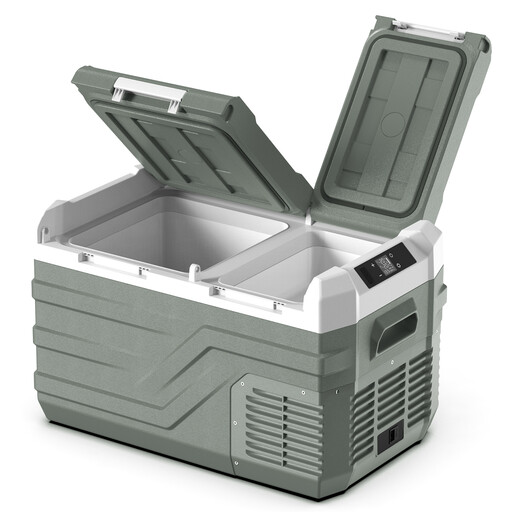
Why we recommend it: This model pulls off the feat of integrating a premium feature—dual-zone cooling—into an ultra-compact 20-litre format. It's perfect for those who want maximum versatility without the bulk: freeze ice cream on one side and keep drinks chilled on the other, all in an effortlessly portable appliance.
It makes a premium feature (dual-zone) accessible, which is usually reserved for larger, more expensive models, while remaining compact and efficient thanks to its ECO and MAX modes.
The flexibility of dual-zone cooling in a portable format. A rare feature that multiplies the possibilities.
Discover our complete selection of models that meet all our criteria for performance, reliability, and safety.
Consumption varies depending on the model, ambient temperature, and settings, but it generally ranges from 40 to 60 watts when the compressor is running. Fortunately, it doesn't run continuously: once the set temperature is reached, it shuts off and only restarts periodically. In ECO mode, the average 24-hour consumption is very low, often comparable to that of a low-energy light bulb.
Yes, but only if the model is equipped with a battery protection system. This is a vital feature. It is advisable to use the "High" (H) or "Medium" (M) protection setting when the engine is off to ensure you save enough power to restart the vehicle.
This depends on the compressor's power, the ambient temperature, and the volume to be cooled. As a general rule, a good model will go from 20°C to 0°C in 30 to 45 minutes. To reach a freezing temperature of -18°C, allow for 2 to 4 hours. The trick to speed up the process? Pre-cool the cooler and its contents before hitting the road.