
Livraison le jour même ou le lendemain

Qualité garantie

Débloquez vos offres de bienvenue: Livraison GRATUITE | Jusqu'à -80 % | 30 jours d'essai gratuits à JoyPlus
Téléchargez l'application
Hitting the road in a van or RV is the dream of absolute freedom. But this freedom comes with a challenge: food preservation. How do you keep your food fresh and your drinks ice-cold, far from any electrical outlet, without the risk of draining your vehicle's battery? The compressor cooler has emerged as the ultimate solution for modern nomads. Faced with an overwhelming number of options, it can be difficult to know where to start. This guide is here to help you navigate the choices and select the perfect model for your adventures, based on essential criteria: performance, capacity, and energy consumption.
Before diving into our top picks, here are the crucial factors to consider to make the right choice.
Unlike thermoelectric models, which can only cool to a few degrees below the ambient temperature, a compressor cooler works just like a home refrigerator. It contains a compressor capable of generating powerful and stable cooling, regardless of the outside heat. This means it can not only refrigerate but also freeze, transforming into a true portable freezer. This is a game-changer for long trips or for storing perishable goods with complete peace of mind.
The capacity, expressed in litres, will depend on the length of your trips and the number of people. But beyond sheer volume, modularity is a major plus. A dual-zone cooler (or dual-compartment cooler) offers incredible flexibility: you can dedicate one zone to refrigerator mode for vegetables and drinks, and the other to freezer mode for meats or ice cream. Each compartment has its own temperature setting, giving you total control over your provisions. This is a particularly valuable feature in a van fridge or an RV cooler, where every square inch counts.
A good 12V portable fridge must be versatile. Check that it can be plugged into various sources: your vehicle's cigarette lighter socket (12V/24V) and a standard wall outlet (100-240V) for use at home or at a campsite. The one point you can't overlook is vehicle battery protection. A multi-level protection system (often noted as H/M/L for High/Medium/Low) is essential. It automatically cuts power to the cooler if the battery voltage drops below a certain threshold, ensuring you can always start your engine without any worries.
With these criteria in mind, we've reviewed several models from the Alpicool range that stand out for their technical specs and features designed for adventurers.
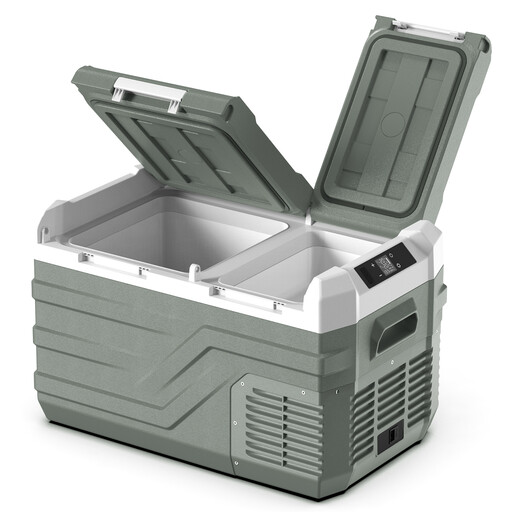
What We Like
This 20L model (with an actual capacity of 23L) is a powerhouse of efficiency. Its dual-zone technology with two independently opening lids allows for easy access and separate temperature management, from -20°C to 20°C. Its high-performance compressor ensures rapid cooling while keeping power consumption in check, especially with its 45W ECO mode.
Pros
Who is it for? Ideal for solo travellers, couples, or weekend getaways. Its compact size makes it an excellent car fridge that fits easily in a trunk or behind a seat.
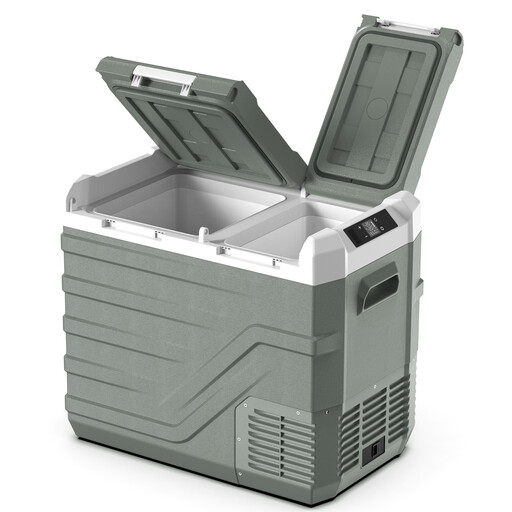
What We Like
With its 39-litre capacity, the NLS55 is aimed at families or adventurers on extended trips. It shares the strengths of the range, including dual-zone technology and a high-efficiency compressor. Its generous capacity can hold up to 58 cans or 12 bottles of wine, enough to keep you well-stocked.
Pros
Who is it for? Aimed at families who love road trips, and owners of RVs or large vans who need significant storage volume without compromising on performance.
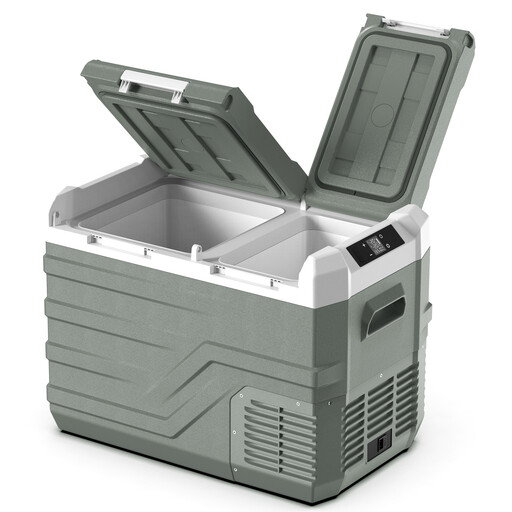
What We Like
The NLS45 model, with its 31-litre capacity, offers an excellent compromise. It's spacious enough to last several days while remaining easy to handle. It includes all the key features of the NLS series, such as the dual compartments, LED control panel, dual power supply, and three-level battery protection.
Pros
Who is it for? A highly versatile choice that will suit most van fridge users and campers looking for the best autonomy-to-size ratio.
This selection highlights dual-zone models for their great versatility. If your needs are more specific or if you want to explore other capacities, many other solutions are available.
Discover our full range of cooling containers
1. How much power does a compressor cooler use? Consumption depends on several factors: the size of the cooler, the set temperature, and the ambient heat. That said, compressor models are very energy-efficient. Most include an "ECO" mode that optimises the compressor's operation. The models presented here, for example, consume between 45W and 60W. Thanks to their good insulation, the compressor does not run continuously, which significantly reduces overall consumption.
2. Can you leave a 12V cooler plugged in continuously without draining the battery? Absolutely, provided the cooler is equipped with a battery protection system. These systems, usually adjustable to three levels (High, Medium, Low), constantly monitor your vehicle's battery voltage. If it drops below a critical threshold, the cooler automatically shuts off to ensure you always have enough power to start the engine.
3. What is the difference between a compressor cooler and a thermoelectric one? It's night and day! A thermoelectric cooler (using the Peltier effect) can only cool its interior by 15 to 20°C relative to the outside temperature, and it is incapable of freezing. During a 35°C heatwave, it will struggle to keep your food below 15°C, meaning you can forget about maintaining the cold chain. In contrast, a compressor cooler works like a real fridge: it can reach sub-zero temperatures (down to -20°C) even in high heat, guaranteeing a reliable cold chain and the ability to freeze your food.