
Livraison le jour même ou le lendemain

Qualité garantie

Débloquez vos offres de bienvenue: Livraison GRATUITE | Jusqu'à -80 % | 30 jours d'essai gratuits à JoyPlus
Téléchargez l'application
Whether you're a new homeowner tackling flat-pack furniture, a car enthusiast maintaining your vehicle, or simply the designated go-to for everyday repairs, a complete tool kit is an essential investment. The problem? The market is flooded with seemingly attractive deals that often prove disappointing in practice. To help you navigate the options, we've broken down the pitfalls to avoid and the criteria that truly make a difference.
Venturing into the DIY aisle can quickly become a headache. Many tool kits promise the world, but their flaws only become apparent with use. Here are the most common mistakes.
The piece count is often just a marketing gimmick. In reality, these kits are frequently padded with dozens of low-quality screwdriver bits or sockets in obscure sizes you'll never use. The real price is paid in the quality of the essential tools: ratchets, standard sockets, pliers, and more. It's better to have a more compact set composed of reliable and genuinely useful tools.
The quality of the steel is the heart of the tool. Too many entry-level kits use basic steels that deform, wear out, or rust at the first opportunity. One stubborn bolt, and the head of your wrench is already damaged. Chrome-vanadium steel isn't just technical jargon; it's your guarantee of better durability and increased resistance to both torsion and corrosion.
What good are great tools if you can't keep them organised or transport them? Many cases are moulded from flimsy plastic, with hinges and latches that give out after just a few uses. Each tool should have its own dedicated slot and stay securely in place, even when the case is shaken.
To make an informed decision, focus on the features that have a direct impact on the usability and lifespan of your tools.
Chrome-vanadium steel (Cr-V) is an alloy renowned for its toughness and resilience. The chromium protects it from oxidation (rust), while the vanadium increases its hardness and wear resistance. A Cr-V tool won't deform under high stress, a crucial point for auto mechanics or any high-torque application. A surface treatment, like a polished chrome finish, also makes cleaning easier and enhances protection.
The ratchet is often the centrepiece of a socket set. Its effectiveness depends on the number of teeth in its mechanism. A 72-tooth ratchet needs only a 5° swing arc to engage, compared to 10° or 15° for entry-level models. This difference is critical when working in tight spaces, like an engine bay. Also, check for the three most common ratchet sizes (1/4", 3/8", and 1/2") for maximum versatility.
A good tool kit for your car or home needs to be robust. Opt for a blow-moulded case, which is thicker and more impact-resistant. The slots should be clearly marked and hold the tools firmly in place. Metal or heavy-duty plastic latches are a good indicator of quality.
Rather than drowning you in dozens of options, we've selected solutions tailored to clear user profiles.
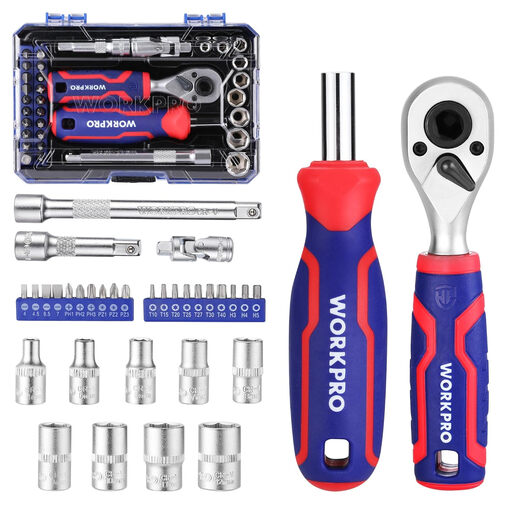
Why we chose it: Ideal as a first home repair kit. It contains the essentials for assembling furniture, tightening a screw, or handling small fixes, without being cluttered with superfluous parts. Its compact size makes it easy to store in a cupboard.
It avoids the "mega-kit" trap by focusing on 34 genuinely useful pieces, including a 72-tooth ratchet and the most common bits.
The tools are made of chrome-vanadium steel, ensuring far greater durability than budget kits. The transparent case lets you see the contents at a glance.
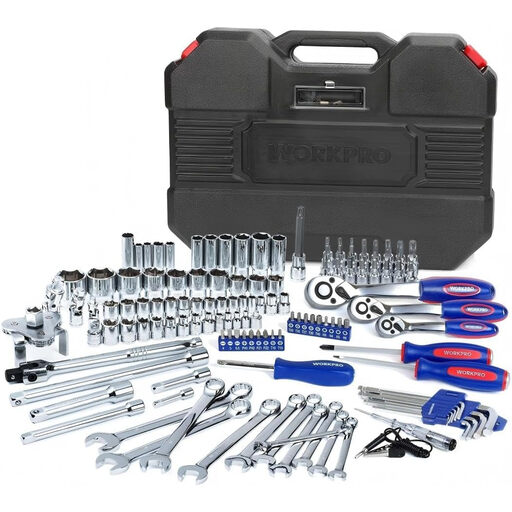
Why we chose it: A very comprehensive solution for anyone who maintains their own vehicle. The inclusion of all three ratchet sizes (1/4", 3/8", 1/2") and a wide range of sockets (metric and SAE) makes it an excellent choice for automotive mechanical work.
It bypasses the low-quality trap with a heat-treated, polished, triple-chrome finish. The result: durable protection against rust, even in damp environments.
The moulded case is designed for the workshop, protecting and organising tools effectively. Its versatility allows you to switch from an auto repair to a DIY project without changing kits.
For more advanced needs, such as auto body work, we have also selected products that meet demanding selection criteria.
With proper maintenance (cleaning after each use, storing away from moisture), a set of chrome-vanadium steel tools can last a lifetime for home use, and many years for semi-professional use. The toughness of this alloy prevents deformation and wear on the most-used parts, like sockets and wrench heads.
It all depends on your use case. For everyday DIY tasks, a well-chosen 30 to 50-piece kit is more than enough. However, if you're tackling auto mechanics or more varied projects, a comprehensive set like the 123-piece model becomes worthwhile. It offers a greater variety of sockets, wrenches, and extensions that will prevent you from getting stuck mid-repair. The secret is to prioritise the actual quality and utility of the pieces, not just the count.
Even the best corrosion-resistant tools benefit from a little maintenance. After each use, especially in damp conditions or after contact with liquids, wipe them down with a dry cloth. For long-term protection, a thin coat of penetrating lubricant (like WD-40) can be applied occasionally to metal parts, particularly on ratchet mechanisms. Finally, always store the case in a dry place.