
Livraison le jour même ou le lendemain

Qualité garantie

Débloquez vos offres de bienvenue: Livraison GRATUITE | Jusqu'à -80 % | 30 jours d'essai gratuits à JoyPlus
Téléchargez l'application
Whether you're a pro mechanic, an occasional DIYer, or just someone who wants to be prepared for minor everyday repairs, choosing a complete tool kit can quickly become a real headache. Faced with an overwhelming market, it's easy to fall into the classic traps that turn a good investment into a source of regret. As a product expert for Joybuy, I'm here to help you navigate the options. Let's break down the mistakes to avoid and the true criteria for making the right choice.
Marketing often highlights features that mask a product's real quality. Here are the three most common pitfalls when buying a car repair tool kit or a set for DIY projects.
To ensure you don't make a mistake, focus on the technical specifications that truly make a difference.
The secret to a tool that lasts? Its material. Chrome Vanadium (Cr-V) steel is the benchmark for quality hand tools. This alloy offers far superior resistance to torsion and wear compared to standard carbon steel. Furthermore, a heat treatment and a chrome finish (polished or matte) effectively protect it against rust and corrosion—an essential feature for a professional tool set intended for the garage or job sites.
The ratchet is arguably the tool you'll use most. A good model should check several boxes:
A good DIY tool box must, above all, protect and organise your equipment. Check the quality of the latches (preferably metal), the strength of the hinges, and the clarity of the layout. Every tool should have its own dedicated spot. This ensures you can find it in the blink of an eye and verify that nothing is missing after a job.
Rather than an endless list, here are our targeted recommendations by user profile, all of which meet the quality criteria we've just discussed.
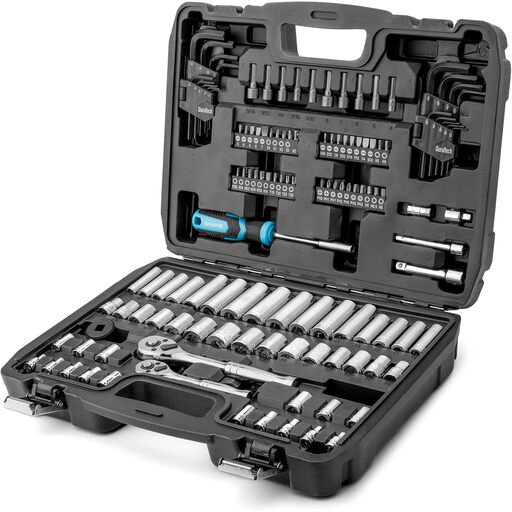
Why we chose it: This is the ideal starter kit. It covers the essentials for home maintenance, furniture assembly, or minor car/motorcycle repairs. All in a compact and well-designed format.
This kit gets straight to the point with 121 genuinely useful pieces (ratchets, sockets, Allen keys, bits), without overwhelming you with useless gadgets. Quality over quantity.
Made from heat-treated Chrome Vanadium (Cr-V) steel. The case is sturdy, and the sockets are clearly marked for easy identification.
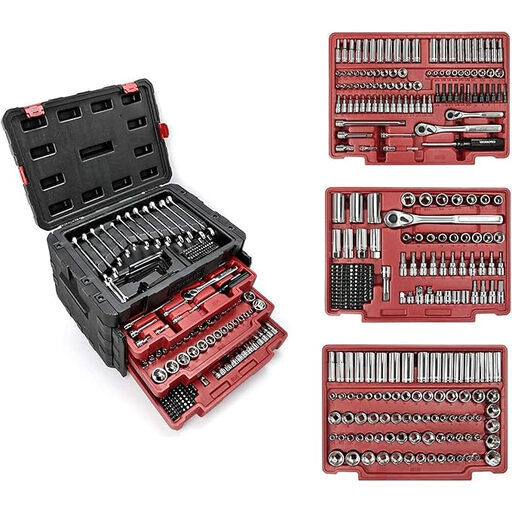
Why we chose it: For those who spend their weekends under the hood, this mechanic's tool case covers nearly every need: three ratchet sizes, a full range of sockets, combination wrenches, and much more.
Here, the high piece count is justified. It's not filler, but a true arsenal to tackle any situation in mechanics.
All tools feature an anti-corrosion chrome finish. The 4-tier moulded case ensures meticulous organisation and excellent durability.

Why we chose it: For repetitive and demanding tasks (changing tyres, removing seized suspension components...), a powerful electric tool is the indispensable complement to hand tools. The time and effort savings are phenomenal.
This is a specialised tool that doesn't try to do everything. It excels at its mission: delivering massive torque where a manual ratchet would give up.
A maximum torque of 2000 N·m and a brushless motor for maximum longevity. The kit is complete with batteries, a charger, and a carrying case.
Explore our full selection of products that meet our quality criteria and current safety standards.
Carbon steel is a basic material, more economical but also more susceptible to bending under high stress and to corrosion. Chrome Vanadium (Cr-V) steel is an alloy enriched with chromium and vanadium, which radically increases its hardness, wear resistance, and protection against rust. For regular use, it's a much smarter investment.
For a beginner, a kit of 100 to 150 pieces often represents the best compromise. It should contain the essentials: a socket set with a ratchet (3/8" is a good starting point), a few combination wrenches in common sizes (8 to 19 mm), a screwdriver with an assortment of bits, pliers, and Allen keys. This is enough to cover 90% of common household needs.
Yes, a 72-tooth ratchet is the industry standard today. It is perfectly suited for most automotive mechanical work. Its 5-degree swing arc allows for efficient work even when manoeuvring space is very limited. Ratchets with more teeth (90 or 120) exist for even greater finesse, but the 72-tooth model offers the best balance of precision, durability, and price.