
Livraison le jour même ou le lendemain

Qualité garantie

Débloquez vos offres de bienvenue: Livraison GRATUITE | Jusqu'à -80 % | 30 jours d'essai gratuits à JoyPlus
Téléchargez l'application
Whether you're a weekend DIYer, a new homeowner, or a seasoned professional, choosing the right complete tool case can be a daunting task. The market is flooded with promises, but not all offers are created equal. A poor choice guarantees disappointment: tools that rust, bits that wear out in record time, or a case whose latches give out after just a few jobs. As a product expert at Joybuy, my mission is to help you cut through the noise and focus on the criteria that truly make a difference.
Before you start, here are the three most common traps that turn a sound investment into a source of frustration:
To avoid falling into these traps, focus on objective characteristics. Here are the three points to check before you buy.
The durability of your hand tools depends directly on the steel used. Don't settle for a vague description like "high-strength steel."
A good tool case should protect and organise your tools, not just transport them. Examine the internal design: are the tools held securely in dedicated, moulded slots? Are the compartments logically arranged? For a toolbox with a drill, a dedicated compartment for the power tool and its accessories (battery, charger) is a real bonus. It protects the drill from impacts with other metal tools. The latches and handle must be robust and able to support the total weight without buckling.
Rather than the piece count, evaluate the relevance of the tools for YOUR projects, whether it's home repairs or professional jobs. A good kit focuses on the essentials: a set of screwdrivers (precision and standard), several pliers (combination, cutting, long-nose), a hammer, a tape measure, a spirit level, and a set of wrenches and sockets covering the most common sizes. The inclusion of a quality cordless drill transforms a simple kit into a true mobile workstation.
To illustrate these principles, here are a few models that meet specific needs, with a focus on design quality and user relevance.
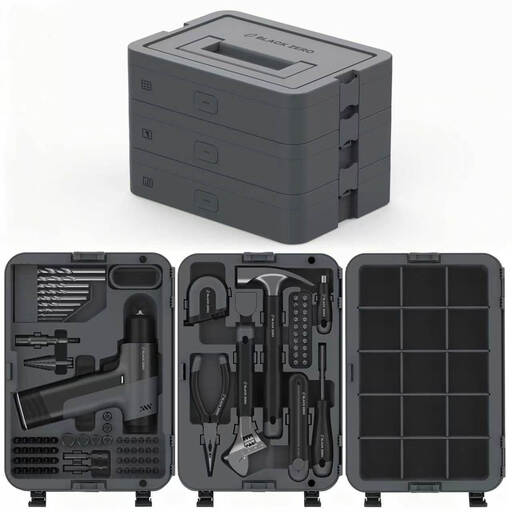
Our take: The perfect companion for homeowners and creatives who refuse to compromise on efficiency or style. This kit is designed for everyday repairs and maintenance, with an organisation system that ensures immediate access and optimal tool protection.
It sidesteps the "organised chaos" trap with its patented 3-layer structure, including an independent compartment that isolates and protects the drill. Here, quality takes precedence over quantity.
Its smart storage system and sleek industrial design make it as practical as it is stylish, fitting in perfectly in a workshop or a modern apartment.
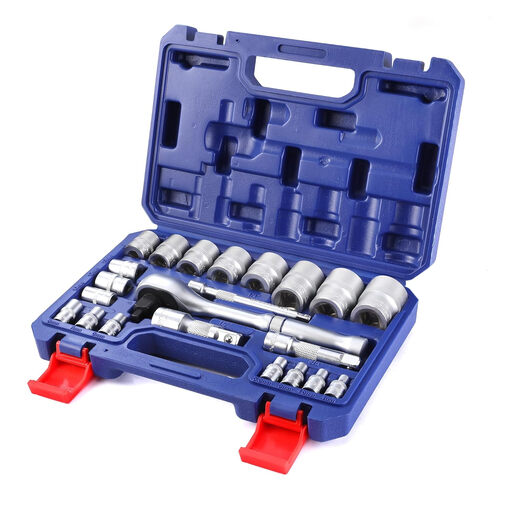
Our take: For those who work on cars or motorcycles, the quality of the sockets is non-negotiable. This specialised kit is the perfect addition to an existing toolbox or an excellent foundation for getting seriously equipped.
It avoids the "quantity" trap by focusing on a set of impact sockets made from Cr-Mo steel, a material built for performance and durability. No dozens of useless accessories here.
Its Cr-Mo steel construction and thin-wall design allow you to work in the tightest spaces while ensuring maximum strength. A decisive asset in auto mechanics.
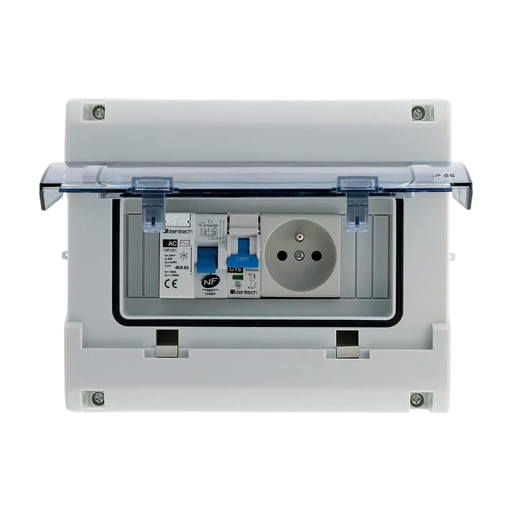
Our take: Proof that for certain jobs, like an electrical installation in a damp environment (garage, laundry room, pool house), a general-purpose tool case won't cut it. You need specialised, compliant equipment to ensure safety.
It highlights the limits of "all-in-one" kits. For such critical tasks, compliance with standards (NF certification) and technical specifications (IP65 rating) take precedence over versatility.
It offers a turnkey, pre-equipped, and certified solution for electrical installations in harsh environments, guaranteeing total safety and compliance with French regulations.
We have put together a complete selection of products that meet our quality criteria and current safety standards.
Absolutely not. Relevance always trumps quantity. A well-thought-out 50-piece kit with quality Cr-V steel tools, sturdy pliers, and ergonomic screwdrivers will be far more valuable for 90% of everyday repairs than a 200-piece kit filled with low-quality bits and superfluous tools. Before buying, scrutinise the tool list and ask yourself the only question that matters: "Will I actually use this?"
It all depends on the quality of the battery (opt for Li-ion), its capacity (in Ah, or amp-hours), and how often you use it. For regular home use, a well-made drill will last several years. The battery remains the weakest link and will wear out first, but on good models, it is fortunately replaceable.
It's simple, but essential. After each job, clean your tools to remove dust and debris. Store the case in a dry place to prevent rust. Check the condition of the latches and hinges from time to time. Finally, make it a habit to put every tool back in its place. Not only will you prevent them from knocking against each other, but you'll also immediately spot a missing tool.