
Livraison le jour même ou le lendemain

Qualité garantie

Débloquez vos offres de bienvenue: Livraison GRATUITE | Jusqu'à -80 % | 30 jours d'essai gratuits à JoyPlus
Téléchargez l'application
A compartmentalised lunch box helps you organise your meal, keep different foods separate and cut down on disposable packaging. But some models disappoint quickly: lids that don't seal properly, compartments that are too shallow, or cleaning that's far more fiddly than expected.
Before buying a bento box or a compartmentalised lunch box, it's worth looking beyond the design and the marketing claims. Here are the criteria to consider, the pitfalls to avoid, and a few models suited to different needs.
A box divided into several sections doesn't guarantee that liquid foods will stay separate. An integrated compartment limits mixing between foods, but it doesn't replace an independent closure with a seal.
If you want to transport a sauce, soup or salad with dressing, look for a leak-proof lunch box or a sealed food container whose closure system is clearly described. In any case, always check that the lid is properly locked before slipping the box into a bag.
Five compartments aren't right for every meal. Narrow sections can be handy for fruit, crudités or small portions, but they're much less suitable for a main course. Conversely, a single large compartment gives you more freedom, at the cost of less effective separation between foods.
The total volume, depth and internal shape are often more important than the number stated on the packaging.
A box advertised as dishwasher-safe also needs to be easy to take apart: the seal, lid and clips can trap food residue. For hot foods, check the compatibility of the container and the lid separately. A plastic lid generally can't be used in the same way as a metal container.
For a lunch box intended for school or the office, compare the following points:
A lunch box for a child also needs to be easy to open. Clips that are too stiff can be a problem for a schoolchild, while a closure that's too loose might open at the bottom of the bag.
For a 304 stainless steel food storage box, check that this specification refers to the body of the container. The lid and seal may be made from other materials.
The PURECOOK set listing states a container in 304 stainless steel, a BPA-free food-grade PP lid and a silicone seal. It also specifies that the container has no coating. This information helps you distinguish the main material from the removable parts.
For a plastic model, check the details about food contact, washing and temperature. A box designed for the fridge isn't necessarily suitable for the oven or microwave.
A food container with a clip-on lid should close evenly. Systems with two or four clips distribute pressure across several sides, while a single closure can be quicker to operate.
Also check the following points:
The mention dishwasher-safe box should always be considered alongside the manufacturer's recommendations. Even when machine washing is allowed, gentle hand washing can help preserve the lid's appearance and the seal's elasticity.
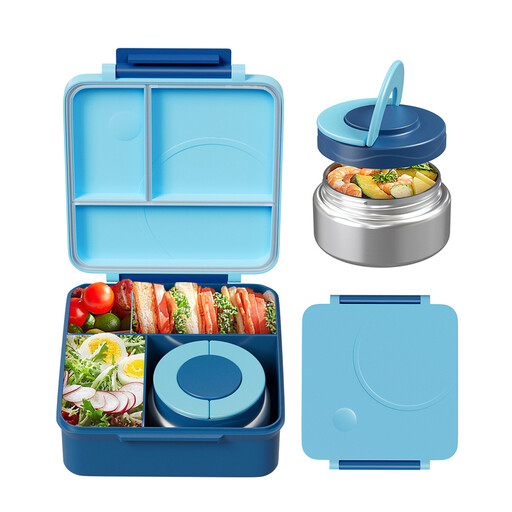
Why this choice suits this profile: its compartmentalised design is ideal for anyone looking for a simple box to take a meal to school, the office or on the go.
The single latch is quick to operate. It avoids having multiple clips, but you need to make sure the lid is properly closed before transporting it.
54 oz capacity as stated in the product name and internal separation for organising your food.
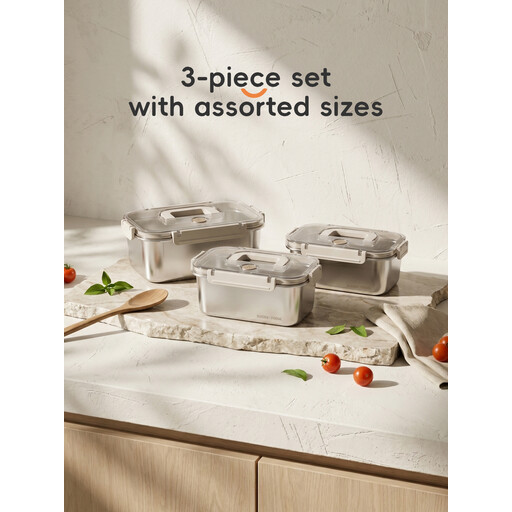
Why this choice suits this profile: this set of three containers is designed for households that alternate between storing leftovers, meal prepping and organising the fridge.
The four clips and silicone seal are designed to hold the lid in place. The listing nevertheless recommends locking all clips before filling the container with liquid.
Set includes 1 container of 1,700 ml, 1 of 2,100 ml and 1 of 3,200 ml, in 304 stainless steel, with handled lids.
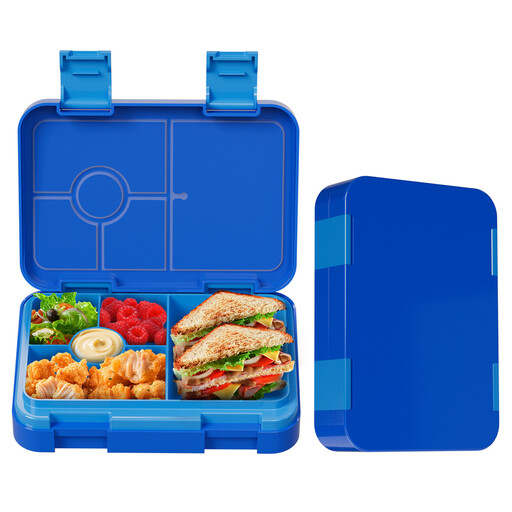
Why this choice suits this profile: its five compartments and two latches are ideal for well-organised meals, picnics and days when foods need to stay separate.
The two latches let you visually check the closure. The fixed compartments limit mixing, but they don't remove the need to check leak-proofing before placing liquid foods inside.
Five storage sections and a double latch closure, with an organisation suited to fruit, sides and small portions.
We've put together a comprehensive, real-time updated selection of products that meet these demanding criteria and comply with European safety regulations.
Not necessarily. Integrated compartments aren't always designed to hold liquids. To transport soup, choose a container explicitly described as leak-proof, check the condition of the seal and keep the box upright.
It all depends on the material and the manufacturer's instructions. Stainless steel can be suitable for some heating uses, but it must never go in the microwave. The lid should generally be removed. For the dishwasher, check the instructions for the container, lid and seal separately.
The lifespan depends mainly on the condition of the lid, seal and clips, rather than a set period. Replace the box if the lid becomes warped, the seal turns porous or the closures no longer hold the box together properly. Regular cleaning and thorough drying after each use help prevent odours and residue from building up.