
Livraison le jour même ou le lendemain

Qualité garantie

Débloquez vos offres de bienvenue: Livraison GRATUITE | Jusqu'à -80 % | 30 jours d'essai gratuits à JoyPlus
Téléchargez l'application
A compact mechanical gaming keyboard frees up space for your mouse, is easy to transport, and performs just as well for gaming as it does for remote work. The problem is that product listings can sometimes blur the lines between a true mechanical keyboard, a keyboard with a "mechanical feel", and a simple backlit model. To avoid a disappointing purchase, it's best to look beyond the number of RGB colours and check the form factor, switches, connectivity and key layout.
Some models use a membrane that mimics the feel of a mechanical keyboard. This is the case with the MageGee TS91, which is described as having a "mechanical feel". It might be fine for everyday use or on a tight budget, but it doesn't necessarily include genuine, replaceable mechanical switches like a hot-swap model would.
On a real mechanical keyboard, each key has its own switch. The product listing should specify the type, actuation force, travel distance and, where applicable, compatibility with 3-pin or 5-pin switches.
A 60% gaming keyboard significantly reduces the footprint, but it typically omits the function row, arrow keys and navigation cluster. These commands are often still accessible via the "Fn" key, which takes a little getting used to.
The 75% layout usually keeps the arrow keys and the F row, while removing the numeric keypad. This is often the best compromise for a compact keyboard intended for a PC or Mac. The 80%, 96% and 98% layouts retain even more keys, including those that come in handy for office work.
An RGB mechanical keyboard improves key legibility in a dark room, but the lighting reduces the battery life of wireless models. The listing for the AJAZZ AK820 MAX, for example, claims up to 120 hours without backlighting, compared to 55 hours with RGB. These figures vary depending on the brightness selected and usage conditions.
Also remember to check the available connection modes: Bluetooth, 2.4 GHz and USB-C. A tri-mode mechanical keyboard offers greater flexibility, while a wired model avoids recharging and eliminates any potential latency issues associated with wireless.
The layout matters just as much. A QWERTY US keyboard doesn't place keys the same way as a French AZERTY keyboard. QWERTZ, which is very common in Germany, also changes the position of several letters. Check the key markings and compatibility with your habits before placing an order.
Linear switches offer a smooth, consistent keystroke. Tactile models add a noticeable bump at the point of actuation, while clicky switches produce a distinct click that can quickly become annoying in a shared space.
A hot-swap mechanical keyboard allows you to replace the switches without getting out a soldering iron. However, you need to check the stated compatibility: 3-pin or 5-pin, plate-mounted or proprietary design. The listings for the AJAZZ AK820, Lofree OE914, KEYSME Lunar 01 and AJAZZ AK980 all mention hot-swap compatibility.
For competitive gaming, a USB-C cable provides a direct connection and removes the need to monitor the battery level. Bluetooth is more practical with a tablet or laptop. 2.4 GHz, when supplied with a USB receiver, aims for a more responsive wireless experience.
Before buying, check compatibility with Windows, macOS, Android, iOS, iPadOS and your consoles. Connecting to a PS4, PS5 or Xbox may require an adaptor sold separately. Finally, a lithium-ion battery must never be disassembled, punctured or exposed to high heat.
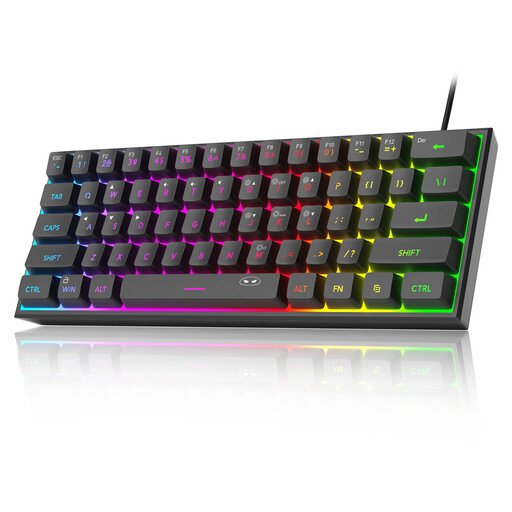
Why this choice suits this profile: Its 60% form factor and USB connection fit perfectly on a small desk or in a first gaming setup. The listing states compatibility with PCs, Macs, PS4 and Xbox One.
The listing clearly states it is a membrane design with a mechanical feel. The buyer therefore knows it is not a hot-swap mechanical keyboard.
61 keys, RGB backlighting with multiple modes and an IPX4 rating against accidental splashes.
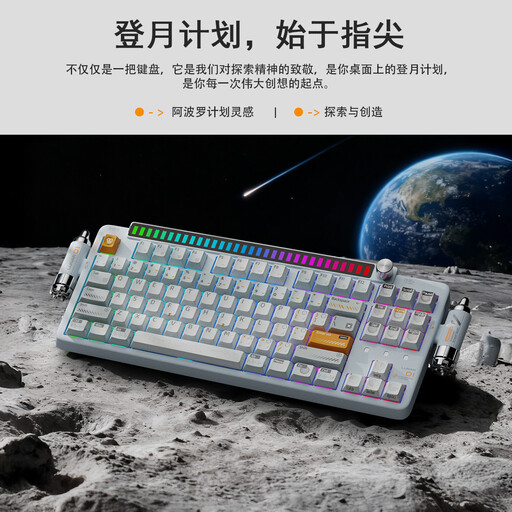
Why this choice suits this profile: This model is aimed at fans of polished setups who want extensive customisation, multi-mode connectivity and a design that stands out from the crowd.
The 80% form factor retains more controls than a 60%. The listing also details Bluetooth, 2.4 GHz and Type-C connections, rather than just a vague "wireless".
5-pin hot-swap, PBT keycaps, programmable knob, 4,000 mAh battery and detachable light bar.
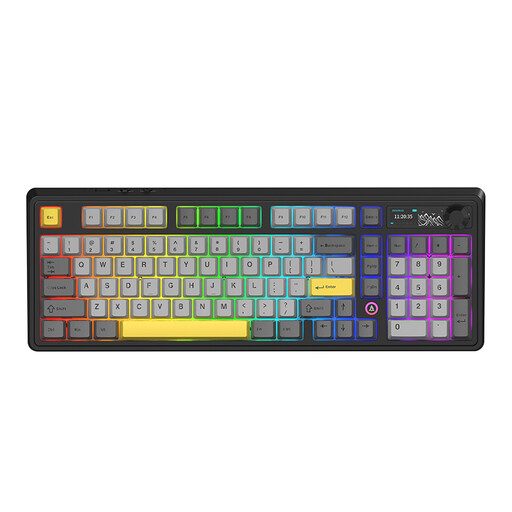
Why this choice suits this profile: With its 97 keys, this keyboard is ideal for those who switch between gaming, document typing and multimedia controls.
The listing clearly distinguishes the three connection modes and states two battery capacities depending on whether the screen is present or not.
TFT screen, metal knob, gasket mount, hot-swap PCB, RGB lighting and wired, Bluetooth and 2.4 GHz connections.
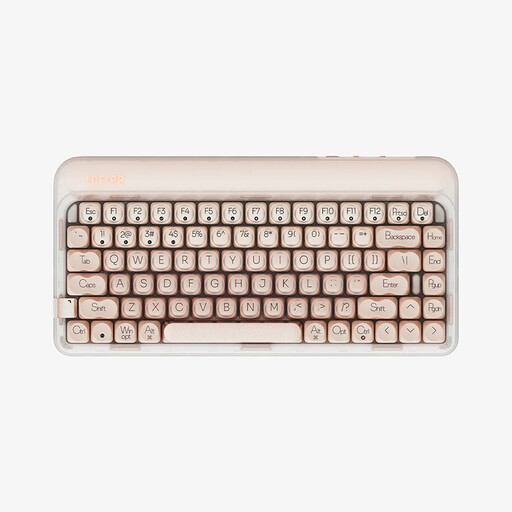
Why this choice suits this profile: Its 84-key form factor and compatibility with Windows, macOS, iOS, iPadOS and Android make it a strong candidate for a workstation shared between a computer and mobile devices.
The listing details the three connection modes, the 4,000 mAh capacity and a stated polling rate of 1,000 Hz, rather than promising a speed that is hard to evaluate.
Pre-lubricated linear switches, hot-swap, warm-toned backlighting, dampened structure and Bluetooth 5.3.
We've put together a comprehensive, real-time updated selection of products that meet these demanding criteria and European safety standards.
Yes, provided you choose a form factor that works with your usual shortcuts. A 75% or 80% model retains the arrow keys and the F row, which avoids having to use multiple "Fn" combinations. For intensive number entry, a 96%, 98% or full-size layout will be more comfortable.
It depends on the switches, the electronics, the intensity of use and the maintenance. Some listings claim up to 50 million, or even 600 million keystrokes for certain components. However, these values correspond to stated specifications and do not guarantee an identical lifespan for all users. Avoid liquids, unplug the keyboard before cleaning it and remove the keycaps with a suitable puller.
A wireless mechanical keyboard can be perfectly suitable for gaming, especially when it has a dedicated 2.4 GHz connection. Bluetooth is practical with a laptop, tablet or phone, while wired mode is still welcome when the battery is low or a direct connection is needed. For everyday use, a tri-mode mechanical keyboard offers greater flexibility, provided you check the presence and compatibility of the USB receiver.