
Livraison le jour même ou le lendemain

Qualité garantie

Débloquez vos offres de bienvenue: Livraison GRATUITE | Jusqu'à -80 % | 30 jours d'essai gratuits à JoyPlus
Téléchargez l'application
A compact fridge can save valuable space in a small kitchen, an office or a student bedroom. But behind the label "mini-fridge", you'll find appliances that have very little in common with one another. A 6-litre model will never replace a family-sized secondary fridge, just as a simple drinks cooler won't be suitable for long-term storage of highly perishable food.
Before placing an order, three mistakes crop up time and again:
Start by measuring the available space, remembering to allow clearance around the appliance so heat can escape. A compact model also needs to remain easily accessible for opening the door, cleaning the seals and carrying out maintenance.
Here are some useful benchmarks:
The volume stated in litres isn't everything. Also look at the shelf layout, the available interior height and whether it fits your bottles. An 18-bottle wine cooler is designed to hold standard bottles, whereas a more versatile model can optimise space for cans and 50 or 55 cl bottles.
Thermoelectric appliances, including some portable fridge models, often quote a temperature difference relative to the ambient air. This figure should be interpreted with caution: it doesn't guarantee that the contents will reach a precise temperature, especially during hot weather.
For regular household use, a compressor model generally offers more stable temperature control. In particular, check:
For a wine cooler, a glass door, suitable shelves and an adjustable temperature are often more important than a simple cooling function. If your collection is starting to grow, a 46-bottle wine cooler may be more suitable, provided you have the necessary space and can support its weight.
A car mini-fridge must be compatible with a 12 V socket. For home or office use, check that it works on a standard 220–240 V mains socket. Some appliances accept both types of power supply, making them more convenient to transport.
In any case, keep these precautions in mind:
An electric cool box or a thermoelectric mini-fridge is mainly suitable for drinks, outings and journeys. For sensitive food items, follow the storage recommendations and the instructions in the manual.
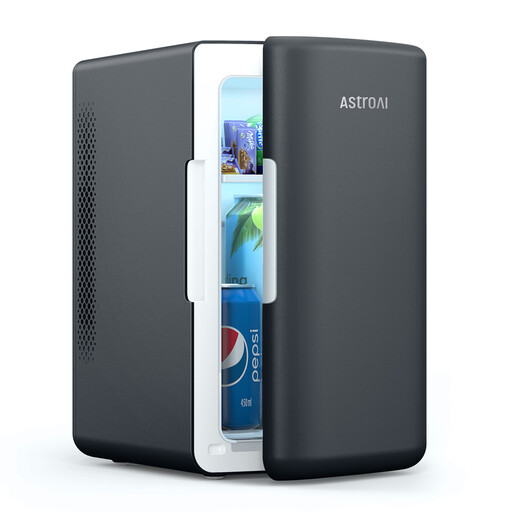
Why this choice suits this profile: With its compact footprint, this model fits easily on a desk, in a bedroom or as a first appliance for personal drinks. It works on both mains power and a 12 V socket.
The product page clearly states it uses thermoelectric technology and does not freeze. This helps avoid mistaking it for a proper compressor fridge.
6 L capacity, external dimensions 25 × 31 × 18.5 cm, with cooling and warming modes up to 66 °C according to the product page.
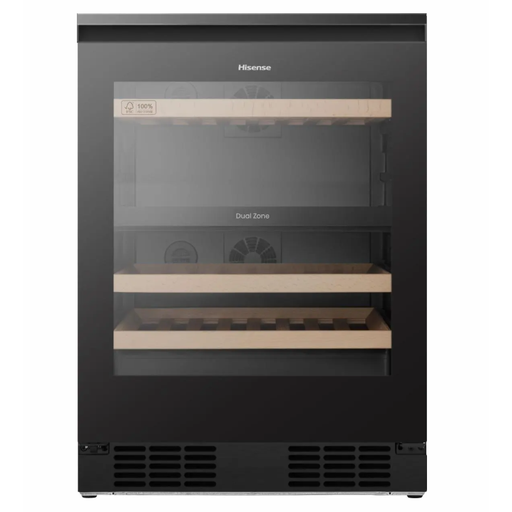
Why this choice suits this profile: This model is aimed at households wanting to organise a wine collection in a dedicated appliance, with two temperature zones and connected control.
The product page details the 128 L volume, dimensions of 595 × 819 × 575 mm and compressor technology. This lets you accurately assess the space needed.
Up to 46 bottles, two independent zones, adjustable temperature from 5 to 20 °C, glass door with UV protection and stated noise level of 37 dB(A).
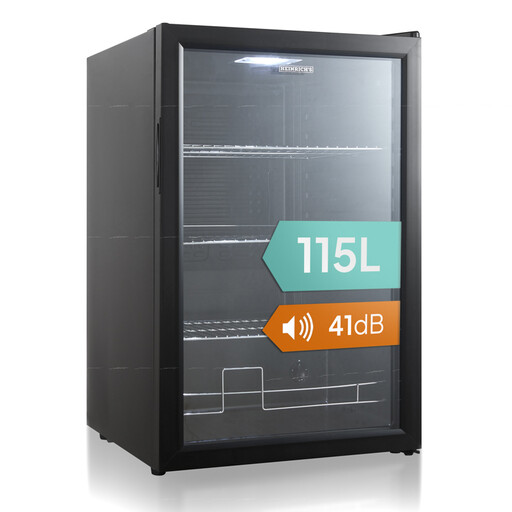
Why this choice suits this profile: Its generous capacity suits a shared office, games room, holiday let or covered outdoor space where drinks quickly pile up.
The product page states it is freestanding and recommends leaving a 10 cm clearance all around. A point to factor in from the moment you calculate the location.
Stated capacity of 115 L, glass door, switchable interior light, noise level of 41 dB and adjustable temperature down to 1 °C according to the description.
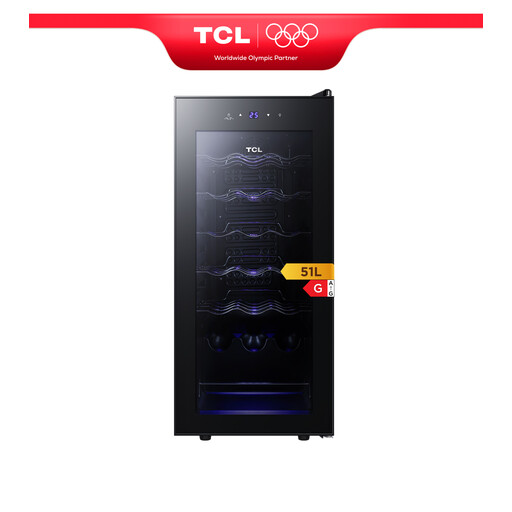
Why this choice suits this profile: With its 51 L capacity, this model targets couples, flats and enthusiasts who want to keep a selection of bottles without sacrificing a large amount of space.
The product page presents it as a freestanding appliance. Avoid built-in installation and respect the clearances needed for proper ventilation.
51 L, up to 18 standard bottles, glass door, display, temperature adjustment, interior light and adjustable shelves.
We've put together a comprehensive, real-time updated selection of products that meet these demanding criteria and European safety standards.
It all depends on its technology, the actual temperature reached and the manufacturer's recommendations. A portable thermoelectric model is primarily designed for drinks and small snacks. For highly perishable foods, choose an appliance capable of maintaining a stable temperature and follow food safety rules.
The cost depends on the appliance's power, how long it runs, the ambient temperature and the price of electricity. Where available, refer to the annual consumption in kWh shown on the energy label or technical data sheet. A larger appliance may use more energy, but it will also be better suited to heavy use.
Place it on a flat surface, away from a radiator, oven and direct sunlight. Leave the recommended clearance around the ventilation grilles as stated in the manual. If the appliance is designed for freestanding installation, do not slide it into an enclosed cabinet without explicit manufacturer approval.