What should you check before choosing?
Choose the size before comparing programmes: it determines where the appliance can go and how it will be supplied with water and drained.
Plumbed-in compact worktop model
Consider it: if your worktop can accommodate the appliance and the water supply, drain and socket are accessible in line with its instructions.
Bear in mind: the appliance will take up food-preparation space, and its hoses must reach the connections without getting in the way in your kitchen.
Compact model with a water tank
Consider it: if there’s no compatible fixed water supply, provided the model can be filled manually.
Bear in mind: you’ll need to fill the tank and arrange drainage in line with the instructions.
Slimline 45 cm appliance
Consider it: if you have a permanent space for an appliance with a capacity better suited to the amount of washing-up you do.
Bear in mind: you’ll need enough space and suitable connections. An integrated model may also need a furniture door panel, as noted on a BUT product listing for a 45 cm appliance.
| Priority |
What to check |
What you need |
| Water supply and drainage |
Check how the appliance is designed to be supplied with water, where it drains and the route the hoses will take. Also make sure the socket and connections meet the model’s requirements. |
I want to install the appliance in my kitchenette without assuming that a water tank also takes care of drainage. |
| Space and capacity |
Measure the width, depth and height, as well as the space needed with the door open. Compare the stated capacity with the washing-up you usually have, especially dishes and pans. |
I need to keep my food-preparation space usable, but I don’t want an appliance that’s too small for everyday meals. |
| Noise and consumption |
According to ADEME, the energy label shows information including kWh per 100 cycles, litres per reference cycle, the duration of the Eco cycle and the noise level. Compare these figures across capacities that suit your needs. |
Noise matters in a single living space, too. I want to compare consumption using its measurement basis, rather than looking at energy ratings alone. |
| Rented property |
Check whether installation uses the existing fittings or requires them to be altered. ANIL notes that written permission from the landlord is needed if the property or its fittings are to be modified. |
I’d rather find out before choosing whether a tap, waste trap, cupboard or electrical installation will need to be altered. |
About the brands
There’s no brand information to display in this section.
Worktop dishwashers on Joybuy
These worktop models are suited to smaller kitchens. Some have a water tank; before ordering, check that the dimensions and drainage method work for your space.
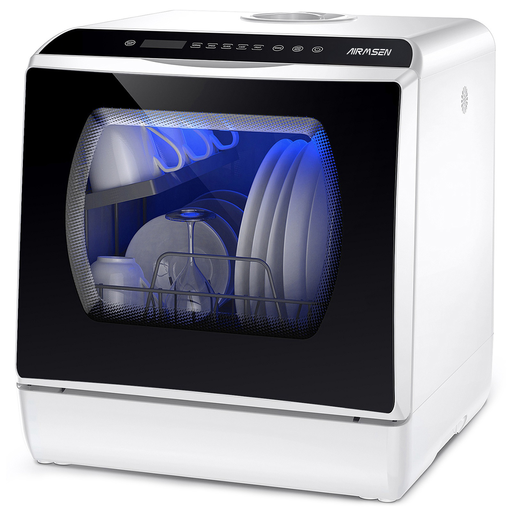 Image unavailable
AIRMSEN worktop model, 5 L tank, 5+1 cycles
The built-in tank may suit you if you need to fill the appliance without a fixed water supply, depending on how it’s designed to be used. The product title lists 5+1 wash cycles. Check the available space and drainage method in the instructions: the tank doesn’t remove the need to drain wastewater.
View on Joybuy
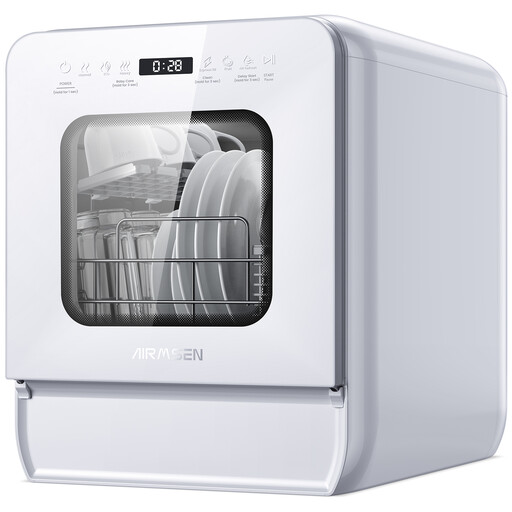 Image unavailable
AIRMSEN tabletop model, 5 L tank, 9 programmes, white
This model is listed as 37 cm wide, so it may suit a narrow worktop. Its depth is given differently in the product information: 50 or 51 cm. Before buying, confirm the exact measurement, the space needed with the door open and the drainage instructions.
View on Joybuy
 Image unavailable
Heinrich's HTG 8840 Schwarz, 6 place settings
With a stated capacity of 6 place settings, this could suit a small household whose washing-up exceeds what a very small worktop model can handle. The title lists 7 programmes and 47 dB; check the energy label to compare noise levels using documented figures. Measure the space and check that the connections and drainage are suitable.
View on Joybuy
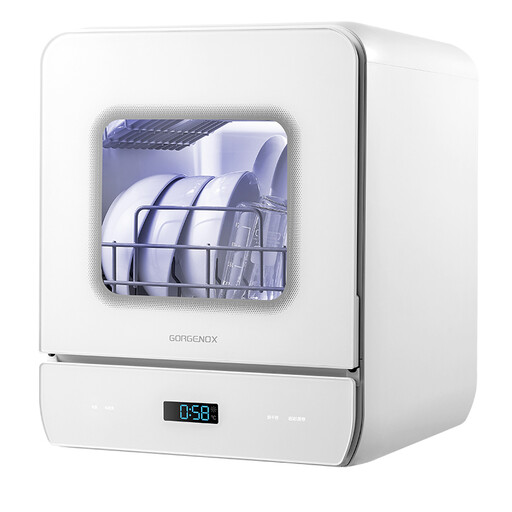 Image unavailable
GORGENOX DW5-D40A, 3 place settings
With a stated capacity of 3 place settings, check that it can handle the amount of washing-up you usually have. The title mentions washing, drying and storage functions, but makes no claims about hygiene benefits. Before choosing this model, check its dimensions, water supply and drainage requirements in the instructions.
View on Joybuy
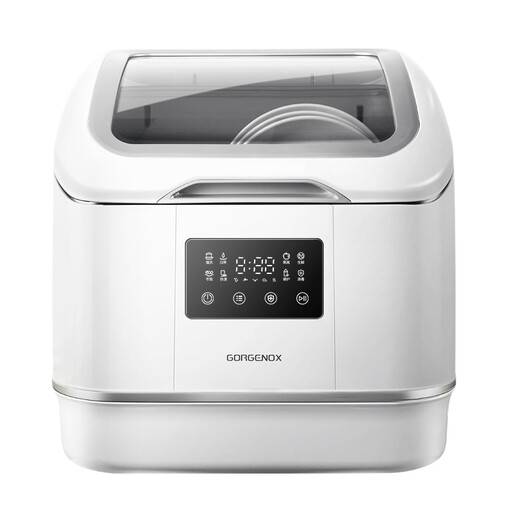 Image unavailable
GORGENOX DW4-D30A, 3 place settings
With a stated capacity of 3 place settings, this model is designed for a small amount of washing-up. Check that it can handle your everyday dishes, too. The title mentions washing, drying and storage. See the instructions for the space required, water supply method and drainage solution.
View on Joybuy
Frequently asked questions
Will a model with a water tank work without any connections?
No. Depending on the model and how it’s designed to be used, the tank may mean you don’t need a fixed water supply. You’ll still need the electrical supply and drainage specified in the instructions. Make sure the surface it stands on is stable, too.
What should I measure for a worktop dishwasher?
Measure the width, depth and height, as well as the space needed with the door open. Allow room for the hoses and cable, then check the clearances required in the instructions for your chosen model.
Can I alter a connection in a rented property?
In France, ANIL says you’ll need the landlord’s written permission to alter the property or its fittings. If your plans involve changing a tap, waste trap or electrical installation, get permission before starting work.
How should I compare the consumption of two appliances?
According to ADEME, a dishwasher’s energy label shows information including energy use in kWh per 100 reference cycles and water use in litres per reference cycle, as well as capacity, Eco cycle duration and noise level. Compare these figures across appliances with a capacity that suits your needs, rather than relying on the energy rating alone.
Why should I check the water hardness?
Water hardness affects how much detergent to use and how to set up the appliance. The National Consumer Institute recommends asking your local council or regional ARS, or using a test strip. Then follow the appliance instructions and the guidance on the products you use.


