Without a space for a built-in appliance, start by choosing a spot and checking the connections specified in the model’s instructions. A compact countertop dishwasher suits smaller loads if your worktop is suitable; a 45 cm model gives you more capacity in a narrower width, while a 60 cm freestanding model needs more floor space. Choose an integrated model only if your kitchen has a suitable space and door panel, then compare each appliance’s features rather than relying on its size alone.
Who are these formats for?
Moving into your first home without a fitted kitchen
If there’s no space for a built-in appliance, a freestanding model means you don’t need to rely on a kitchen cabinet door panel. UFC-Que Choisir highlights its flexible placement compared with an integrated model; you’ll still need to find a suitable spot and check the connections.
A small household with room on the worktop
A compact countertop dishwasher can handle smaller loads without taking up floor space. UFC-Que Choisir describes models with a capacity of 6 place settings for smaller homes. Make sure your worktop and connections are suitable for the model you’re considering.
A household short on width but with daily washing-up
If a compact model doesn’t have enough room for your dishes, consider a 45 cm model. UFC-Que Choisir describes models with a capacity of 9 place settings, while Beko and Whirlpool offer models with a capacity of 10 place settings. The space you’ll need also depends on the appliance’s depth and how far the door opens.
What should you check before choosing?
The format depends on the space you have and how much washing-up you need to do, but whichever of the four options you choose, you’ll still need to check the installation requirements for the specific model.
Compact countertop
Consider it: if you have a suitable worktop and only a small amount of washing-up.
Trade-off: the 6-place-setting format described by UFC-Que Choisir limits how much you can wash in each cycle.
45 cm freestanding
Consider it: if floor space is limited but a compact model doesn’t have enough capacity.
Trade-off: the appliance still takes up floor space; check that your larger dishes fit in the baskets.
60 cm freestanding
Consider it: if you have enough floor space and want to wash more dishes without needing a built-in space.
Trade-off: allow for the appliance’s depth and the clearance needed to open its door.
Integrated
Consider it: only if your planned kitchen includes a compatible space and a suitable door panel.
Trade-off: installation takes more preparation; Bosch recommends using a professional to fit its built-in models.
| What to consider | What to check | What matters to shoppers |
|---|
| Connections and installation |
Check the model’s instructions for the water supply, waste outlet and electrical supply, and make sure they’re accessible from the spot you’ve chosen. |
When moving into a new home, I want to be able to use the appliance without finding out that the available connections aren’t suitable. Around 36% of consumers prioritise whether installation is possible. |
| Space needed |
Compare the overall dimensions with your measurements, remembering to allow for the door opening or the space available on your worktop. |
When every bit of space counts, I mainly want to know where I can put the appliance without getting in the way in the kitchen. Around 29% of consumers prioritise the space it takes up. |
| Capacity |
Compare the number of place settings and the basket layout with the dishes you usually wash, especially saucepans and larger dishes. |
I don’t have much width to spare, but I don’t want to run extra cycles for my everyday dishes. Around 21% of consumers prioritise capacity within the available space. |
| Everyday use and repairability |
Compare the kWh per 100 cycles, litres per cycle and noise level on the label. Also check the repairability information for the model. |
If I have an open-plan kitchen or run the appliance frequently, I look first at its everyday-use features and repairability. Around 14% of consumers prioritise this group of features. |
ADEME explains that the energy label shows electricity use in kWh per 100 reference cycles and water use in litres per reference cycle. Consider both figures alongside the model’s capacity and noise level: a narrower width alone doesn’t tell you how much energy or water it uses, or how noisy it is.
Mistakes to avoid
-
Assuming a compact model is ready to use without checking the connections
Having space on the worktop doesn’t mean the appliance can be connected to the water and electricity supplies, or that its waste water can be drained as specified in the instructions.
Before you order, check the instructions for your chosen model against the space and connections available.
-
Choosing an integrated model as if it were freestanding
An integrated model needs a suitable kitchen layout and may require a compatible door panel. Bosch recommends using a professional to fit its appliances.
Check that the space and door panel are compatible before choosing this option. If your kitchen isn’t set up for it, consider a freestanding or compact model instead.
Preparing a matching door panel and arranging the installation may add to the project.
-
Judging energy use by width alone
Two dishwashers in the same format won’t necessarily use the same amount of energy or make the same amount of noise.
Once you’ve chosen the width and capacity, compare the labels of the models you’re considering using the same measurements.
-
Comparing water and electricity as if they were measured over the same cycle
According to ADEME, electricity use is shown in kWh per 100 reference cycles, while water use is shown in litres per reference cycle. These figures use different units, so you can’t compare them on the same basis.
Keep the units in view when comparing two labels, and check the capacity and duration of the eco programme too.
Brands to consider by format
Bosch
Bosch’s range in France includes 45 and 60 cm freestanding models, as well as compact dishwashers.
- For a specific example, Bosch lists the SPS4EMI17E freestanding model at 845 × 450 × 600 mm.
- These dimensions don’t apply to other models; check the instructions and available space for the one you choose.
Beko
Beko’s range in France includes 45 cm freestanding dishwashers, including models with a stated capacity of 10 place settings.
- This format gives you the option of more capacity than the 6-place-setting compact models described by UFC-Que Choisir when width is limited.
- The half-load function is only available on some models; check the features and energy label of the one you choose.
Whirlpool
Whirlpool’s French range includes 45 and 60 cm freestanding and integrated models.
- Whirlpool lists its WSFO3T223P freestanding model as 45 cm wide, with a capacity of 10 place settings, a noise level of 43 dB and water use of 9 L.
- These figures apply to this model only and don’t describe the range as a whole.
Electrolux
Electrolux offers 45 cm models in France, both freestanding and integrated.
- Electrolux lists its ESG42310SW freestanding model with a capacity of 9 place settings, an energy rating of D and a noise level of 45 dB.
- If you’re considering fitting it under a worktop, check the dimensions and whether the top can be removed for this model.
Freestanding models on Joybuy
These two freestanding models have a capacity of 14 place settings and are suited to kitchens without a built-in space, provided the spot you’ve chosen can accommodate the appliance. If space is more limited, measure the available area before considering either model.
 Image unavailable
Hotpoint H4FD641A freestanding dishwasher, 14 place settings, white
Worth considering if you’re looking for a freestanding model for larger loads and have enough space for it.
The model name indicates a width of 60 cm, a capacity of 14 place settings, a noise level of 41 dB and an energy rating of C. Check the overall dimensions and make sure the connections are suitable, following the instructions before you order.
View on Joybuy
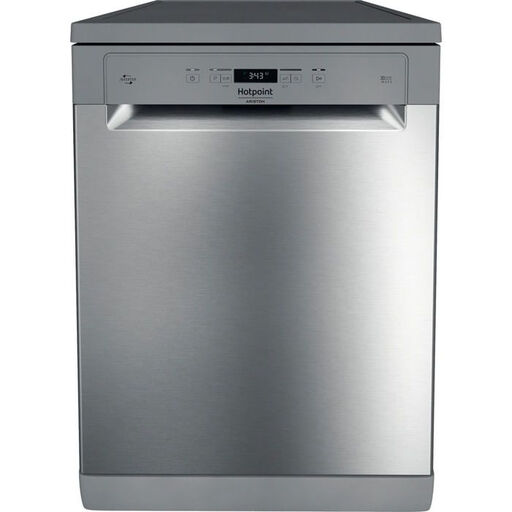 Image unavailable
Hotpoint HFC3C32WX freestanding dishwasher, 14 place settings, grey
Worth considering for a kitchen without a built-in space if you need a stated capacity of 14 place settings.
The model name indicates an energy rating of D. Check its dimensions, the clearance needed to open the door and the connections required at your chosen spot. Refer to its energy label to compare consumption.
View on Joybuy
Frequently asked questions
Which connections should you check in a kitchen without fitted units?
Check the water supply, waste outlet and electrical supply specified in the instructions for your chosen dishwasher. Bosch lists all three as necessary to install its appliances. Also check the requirements for your specific model and make sure the connections are accessible from the spot where you plan to put it.
Is a compact dishwasher enough for a small household?
A compact model may be enough if you have a small amount of washing-up and a suitable worktop. UFC-Que Choisir describes countertop models with a capacity of 6 place settings. If your saucepans or larger dishes quickly fill that space, compare the basket layout with that of a 45 cm model.
What should you compare on the energy label?
Compare the capacity, kWh per 100 cycles, litres of water per cycle and noise level. ADEME sets out these measurement units: keep them in mind when comparing two models, and don’t assume that a narrower appliance necessarily uses less energy.
Is an integrated dishwasher suitable for a kitchen without a built-in space?
Not unless you have a suitable kitchen layout: check that the space and door panel required for the model are available. Bosch recommends using a professional to fit its dishwashers. If your kitchen isn’t set up for an integrated model, a freestanding one means you won’t need a kitchen cabinet door panel.


