
Livraison le jour même ou le lendemain

Qualité garantie

Débloquez vos offres de bienvenue: Livraison GRATUITE | Jusqu'à -80 % | 30 jours d'essai gratuits à JoyPlus
Téléchargez l'application
A compact biometric safe lets you protect jewellery, cash, passports or sensitive documents without taking up too much space. But be warned: a small size doesn't always mean sufficient security. Some models focus entirely on their digital display or quick-opening mechanism, at the expense of anchoring, battery life or the robustness of the casing.
Before you place your order, here are the main pitfalls to avoid and the criteria to examine when choosing a small secure safe for your home or office.
A fingerprint safe offers fast access to your belongings. However, the reader can struggle to recognise a damp, dirty or overly dry finger. It's therefore wise to have a backup solution, with a digital keypad and emergency override keys.
Automatic opening is handy when you need to access the safe with one hand, but it doesn't compensate for a flimsy structure or a lack of fixing.
A compact safe is simple to install, but it's also easier to carry away if it isn't secured. Even a steel model with concealed hinges can disappear if it's left sitting on a shelf.
Check for the inclusion of a bolting kit and the compatibility of the surface: a floor, a sturdy piece of furniture or a firmly fixed shelf. Anchoring reduces the risk of the whole safe being taken, though it doesn't offer absolute protection against a break-in.
External dimensions don't reflect the actual usable space. The thickness of the metal, the locking mechanism and the internal tray all reduce the effective capacity.
For storing jewellery and cash, a removable tray makes it easier to separate watches, necklaces and coins. If you're looking for a safe for important documents, first measure the passports, envelopes or folders you plan to put inside.
A compact model is best suited to small valuables that don't take up much room. As a guide, the Master Lock MLD08EB has the following external dimensions:
Its internal space measures 5.6 × 24.6 × 17.0 cm. This capacity can accommodate jewellery, cash, passports or certain folded documents, but not bulky files.
If you're considering a safe for firearms, you must check that its dimensions and layout match the weapon in question. In the UK, storage requirements can vary depending on the category of firearm and your circumstances. A small safe intended for personal effects should not be considered a regulatory device suitable for all weapons.
A safe equipped with a digital keypad allows you to set a code that can be changed. The fingerprint gives registered users direct access, while the backup keys take over in the event of low battery or recognition issues.
For family or professional use, be sure to check:
Avoid storing the emergency keys in the same piece of furniture as the safe. They should remain accessible to authorised people, but be kept away from the device itself.
A steel casing, concealed hinges and a design intended to resist prying attempts all strengthen physical protection. However, these elements must be evaluated alongside the anchoring and the quality of the locking system.
The MLD08EB features a removable fabric-covered tray and internal padding designed to minimise scratches on delicate items. Its gas strut allows for automatic, silent opening after authentication. This mechanism makes access easier, but check that the lid stays stable once open.
The recommendations below are based solely on the product's stated features. The same model can suit several uses as long as the items to be protected remain small.
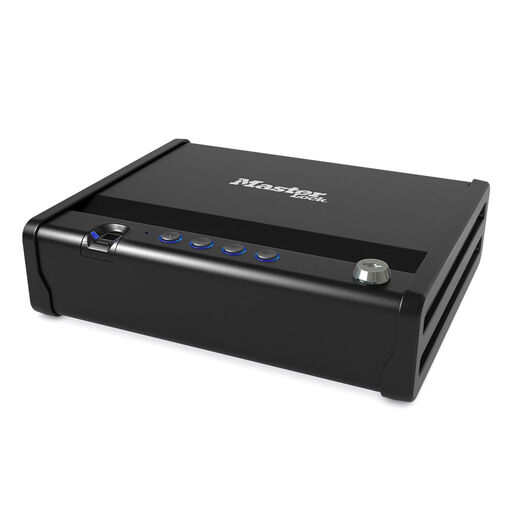
Why this choice suits this profile: its compact size, three access modes and removable tray make for a straightforward first home installation to protect small items.
The fingerprint reader is backed up by a resettable digital code and two backup keys. The included fixing kit reduces the risk of the safe being moved.
Steel construction, concealed hinges, compact footprint and a fabric-covered tray to protect the interior.
Why this choice suits this profile: the combination of biometric access, code and backup keys suits those who want smooth opening without giving up a fallback option.
The steel structure and concealed hinges avoid the weaknesses of a simple lightweight casing, while the padding protects items from scratches.
Silent automatic opening via gas strut, removable tray and the ability to store multiple fingerprints.
Why this choice suits this profile: fingerprint access and one-handed opening are ideal for an office, bedroom or any space where the safe is used regularly.
The automatic mechanism means you don't have to hold the lid open, while the three access modes reduce reliance on a single technology.
Fast access, steel construction and included bolting kit for fixing to furniture or the floor.
We've put together a complete, real-time updated selection of products that meet these demanding criteria as well as European safety standards.
To get the most out of your compact biometric safe:
The lifespan depends on factors such as how often you open it, the condition of the batteries, the environment and how well it's maintained. Avoid excessive humidity, impacts and abrasive cleaning products.
The biometric reader and digital keypad typically run on batteries. The backup keys allow you to regain access when the batteries are flat, provided you've stored them separately.
Choose a discreet, dry location that's difficult to move. A sturdy shelf, a fixed piece of furniture or the floor can work if the surface allows bolting. Avoid spots visible from a window or easily accessible to visitors.
Ongoing costs are mainly limited to replacing the batteries and, if necessary, buying or installing the fixing hardware. To avoid nasty surprises, check the type of batteries used, whether there's a low battery indicator and whether the anchoring kit is included.