
Livraison le jour même ou le lendemain

Qualité garantie

Débloquez vos offres de bienvenue: Livraison GRATUITE | Jusqu'à -80 % | 30 jours d'essai gratuits à JoyPlus
Téléchargez l'application
Want to hang a picture frame, mirror or whiteboard without reaching for the drill? Be careful: not all Command no-damage wall fixing strips are created equal. The right model depends on both the weight of the object and the type of wall. A poorly chosen product can peel off, leave marks or simply fail to stick properly.
Here are the most common mistakes to avoid before buying, followed by a selection of solutions suited to different indoor uses.
A no-drill fixing isn't magically compatible with every surface. Adhesive strips for frames are generally designed for smooth, clean and dry surfaces: painted walls, glass, metal, tiles or certain laminated panels.
Porous, rough or fragile surfaces are more problematic. The product information sheets consulted advise against fitting on wallpaper, vinyl, textured surfaces or freshly painted walls. After repainting a wall, it's best to wait the recommended drying time before installing the strips.
Choosing a hanging strip should be based on the total weight of the frame, not just its dimensions. Glass, a solid wood frame or a whiteboard can quickly add up.
Depending on the size and reference, the stated capacities go up to 5.4 kg, 7.2 kg or 9 kg. Always check the instructions and keep a safety margin rather than pushing the maximum limit. For a very heavy object on a plasterboard wall, a hook specifically designed for that surface will often be more suitable than an adhesive strip.
Even removable adhesives lose much of their effectiveness on a dusty, damp or greasy surface. Poor preparation is one of the main causes of peeling.
Fitting generally requires:
For a small photo frame, a medium-sized model will usually suffice. The medium Command strips presented here claim a capacity of up to 5.4 kg, while the large sizes go up to 7.2 kg, according to their product information. The XL model designed for whiteboards supports up to 9 kg.
How the weight is distributed also matters. A large frame needs to be fixed at several points to stay stable and sit flush against the wall. Always check the consistency between the number of strips used, the size of the support and the actual weight of the object.
Command repositionable strips are intended for indoor use on smooth surfaces. Before using them to hang a frame without damaging the wall, check the following points:
For plasterboard, drywall hooks offer another option. The 3M CLAW model uses metal claws that insert into the plasterboard. This is not an adhesive fixing, but a solution designed for heavier objects.
Adhesive strips for frames are particularly handy when the décor is likely to change, for example in a rental property, shared office or classroom. However, their repositioning depends on the type of product and whether replacement strips are available.
Never pull the frame directly towards you. Hold the tab and stretch it gradually downwards, parallel to the wall. This is the method recommended in the general instructions for several Command references.
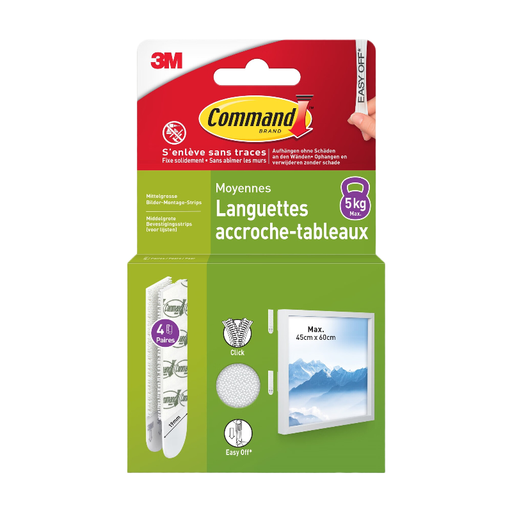
Why this choice suits this profile: This size is ideal for frames and photos of moderate weight, in a home where you'd rather avoid tools and holes in the walls.
Its stated capacity of 5.4 kg lets you check the load before buying, rather than choosing a product based only on the frame size.
A medium white size, discreet fixing behind the frame and removal that is claimed to be residue-free, according to the product information.
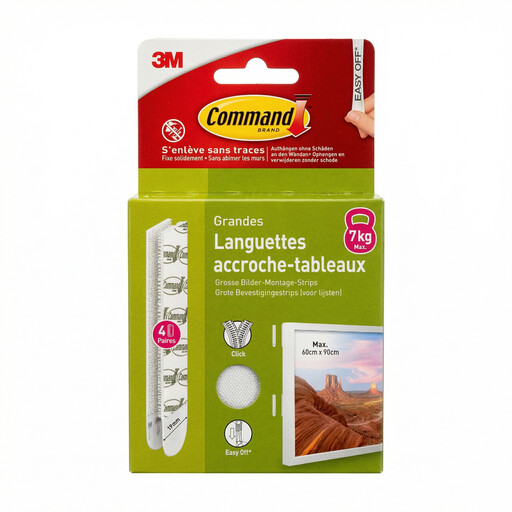
Why this choice suits this profile: The large size is aimed at those who want to install sizeable frames in a living room, office or indoor gallery.
The stated maximum load of 7.2 kg lets you ensure a heavy frame stays within limits before fitting.
White strips that are easy to hide behind the frame, a flush hold and removal that is presented as clean according to the available information.
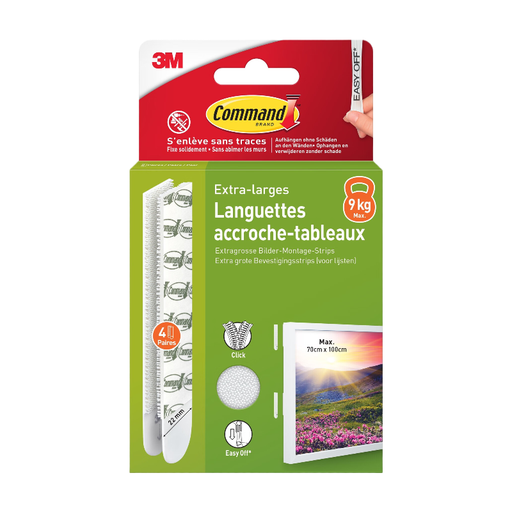
Why this choice suits this profile: This product is aimed at offices, schools and workspaces that need to install a whiteboard without making lots of holes.
Its specific indication for whiteboards reduces the risk of choosing strips that are too small for a large support.
An XL size, a stated capacity of up to 9 kg and removal that is presented as clean, provided the instructions are followed.
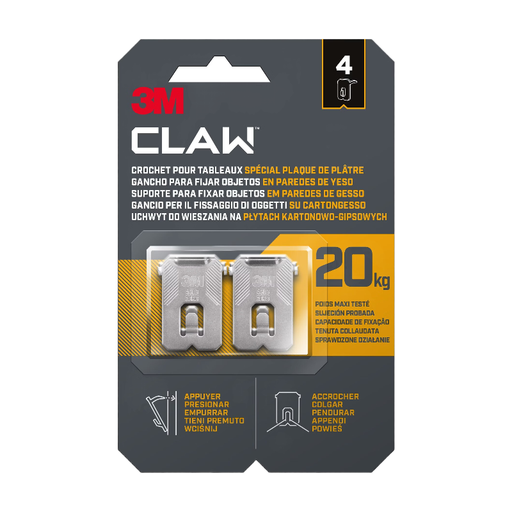
Why this choice suits this profile: This hook is suitable for those who need to hang a mirror or heavy frame on a plasterboard wall.
It doesn't rely on an adhesive strip: its metal claws are designed to anchor into the plasterboard, with a stated capacity of up to 20 kg.
Tool-free installation and a pack of four hooks, with a design specifically for plasterboard walls.
We've put together a comprehensive, real-time updated list of products that fully meet these strict selection criteria and European safety regulations.
The information sheets for the products featured generally advise against fitting on wallpaper, rough surfaces, vinyl and freshly painted supports. Always check the packaging of the model you choose before starting. In most cases, the surface must be smooth, clean and dry.
The time varies depending on the product. Some instructions recommend pressing the strips for around 30 seconds, then waiting an hour before hanging the object. Follow the instructions rather than relying on how the adhesion feels to the touch.
They allow you to remove or move a frame when the fitting and removal instructions are followed. However, strips that have already been used are not necessarily reusable. Check whether the model accepts replacement strips and never exceed the stated maximum load.