
Livraison le jour même ou le lendemain

Qualité garantie

Débloquez vos offres de bienvenue: Livraison GRATUITE | Jusqu'à -80 % | 30 jours d'essai gratuits à JoyPlus
Téléchargez l'application
There's nothing like frames, photos, or works of art to personalise your space and make it feel truly like home. But let's face it: the mere thought of getting out the drill, making holes, and juggling wall plugs and screws is enough to put anyone off. It's a real nightmare, especially if you're a tenant or love to change your decor on a whim. The promise of an adhesive picture hanger is tempting, but be warned: the market is flooded with solutions that fall far short of their claims.
Before you turn your wall into a battleground for low-quality adhesives, let's review the pitfalls that lead straight to a broken frame and a damaged wall.
To hang a frame without drilling and sleep soundly, don't just grab the first box you see. Three essential criteria should guide your choice to ensure a long-lasting hold and a drama-free removal.
This is the non-negotiable criterion. Before buying anything, weigh your frame (including the glass and frame itself). Command strips, for example, are categorised by size and the weight they can hold:
Our advice: follow the recommendations on the packaging to the letter. It's better to use several pairs of strips to distribute the load evenly than to bet everything on a single one.
The effectiveness of an adhesive picture hanger depends entirely on its substrate. The adhesive doesn't stick the same way everywhere. Smooth, non-porous surfaces are ideal:
Ignoring this compatibility is a guarantee of a removal that damages the surface, defeating the entire purpose of a no-hole picture hanger.
Not all strips are alike. There are two main types:
To help you make the right choice, here are our targeted recommendations, matching each need with the ideal hanging solution.
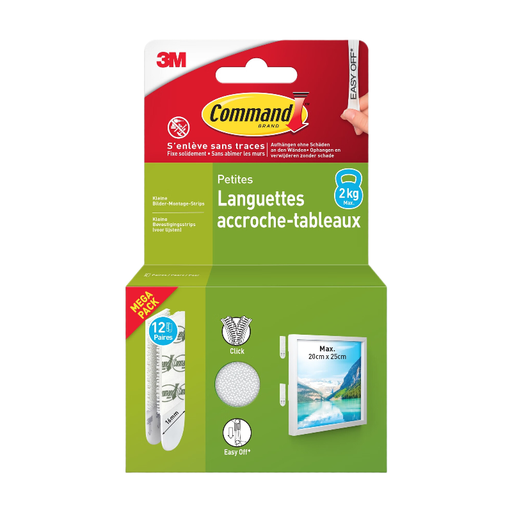
Why we chose it: For those who want to hang small photos, postcards, or very lightweight frames. This value pack is a perfect starting point for adding multiple small decorations in a student room or office.
By offering a solution perfectly calibrated for feather-light items (up to 2 kg), this pack prevents you from over-specifying your purchase or, worse, underestimating the weight with an unsuitable adhesive.
The 12-pair pack offers excellent value for money, allowing you to decorate an entire room with small items without waste.
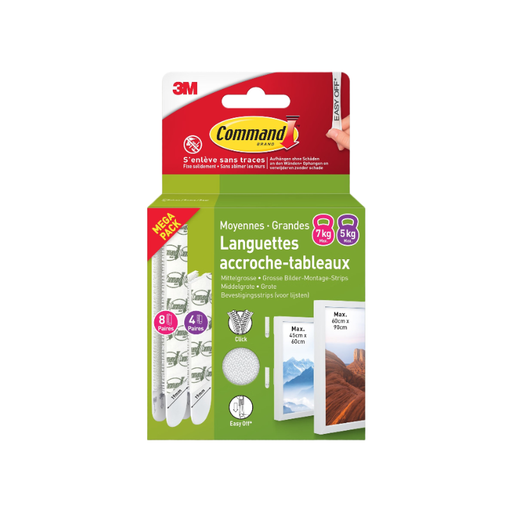
Why we chose it: Perfect for decor enthusiasts who want to create a gallery wall with items of various sizes and weights. This mixed pack offers all the flexibility needed to adapt to different projects.
This pack saves you the headache of running out: you always have the right size on hand, preventing the risk of overloading a strip that's too small and watching everything come crashing down.
The versatility of sizes (Medium up to 5.4 kg, Large up to 7.2 kg) allows you to handle most standard frames with a single purchase.
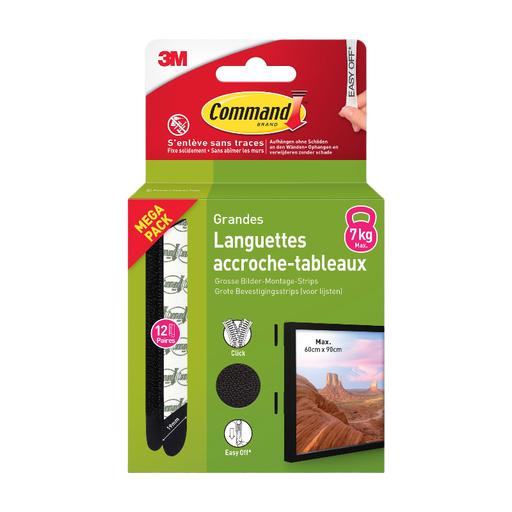
Why we chose it: The solution for those with black or very dark frames. The black Command strips blend perfectly with the frame, providing a seamless and polished finish while supporting a significant load.
It solves the aesthetic problem of a white strip being visible on the side of a dark frame—a detail that can ruin the visual effect of a wall composition.
It combines a high load capacity (up to 7.2 kg) with absolute discretion, making it the go-to choice for discerning decorators.
Our editorial team has tested and compiled a complete list of products that meet our selection criteria and safety standards.
Once correctly applied to a compatible surface under normal indoor conditions (away from moisture or extreme temperature fluctuations), a strip is designed to last for several years. Its longevity depends entirely on following the installation instructions and weight limits.
The adhesive strip itself is single-use. Once removed from the wall or frame, it loses its adhesive properties and should not be reused. However, if you are using the hook and loop system, you can detach the frame from the wall (the two parts of the strip separate) and rehang it as many times as you like.
The secret to damage-free removal lies in the technique. Never pull the strip towards you, perpendicular to the wall. Grab the small removal tab (the one that sticks out at the bottom) and stretch it very slowly and straight down, always parallel to the wall. Continue to stretch gently until the strip releases completely from the surface. This action stretches the adhesive and releases it cleanly without damaging the surface.