
Livraison le jour même ou le lendemain

Qualité garantie

Débloquez vos offres de bienvenue: Livraison GRATUITE | Jusqu'à -80 % | 30 jours d'essai gratuits à JoyPlus
Téléchargez l'application
Want to hang a picture frame, a whiteboard or some décor without reaching for the drill? Command no-drill adhesive picture hanging strips can be a real help at home, in student accommodation, at the office or in the classroom. But a successful installation depends less on the promises on the packaging than on three very practical factors: the actual weight of the item, the condition of your wall, and following the fitting steps to the letter.
A stated capacity of 5.4, 7.2 or 9 kg doesn't mean that every wall and every shape of object can handle that weight. A deep or bulky frame puts more strain on the fixing than a lightweight poster that sits flush against the wall. So, treat the stated load as a maximum limit, not a target weight to aim for.
Picture hanging strips are generally designed for smooth, clean, dry and sufficiently solid interior surfaces. Wallpaper, textured walls, fresh paint, dust or crumbly surfaces can all compromise adhesion. Even the best strip on the market won't make up for a poorly prepared surface.
Pulling the tab towards you or outwards risks tearing the paint or leaving a mark. To remove a wall fixing without damage, stretch it slowly downwards, parallel to the wall, following the manufacturer's instructions. Also remember to allow the recommended adhesion time before hanging your item.
Start by weighing the complete item: frame, fittings and contents included. Then compare the result with the load stated on the packaging. For wide frames, the distribution of fixing points is just as important as the total weight. Use strips suited to the size of your item and position them according to the instructions.
The medium-sized models featured on Joybuy state a capacity of up to 5.4 kg. Larger formats can reach 7.2 kg, while an XL version designed for large whiteboards claims up to 9 kg. These values only apply under the intended installation conditions and on compatible surfaces.
Commonly listed surfaces include painted walls, painted or varnished wood, glass, metal, tiles and some laminates. That doesn't mean every wall in a British home will automatically be suitable. Avoid surfaces covered in wallpaper, textured walls and freshly applied paint. After repainting a wall, wait for the time recommended by the manufacturer before applying the strips.
Clean the area with a suitable product, then let it dry completely. Some Command references recommend using isopropyl alcohol to remove greasy residues: always check the instructions for your chosen model. Once the strips are in place, press firmly for the stated time and generally wait one hour before hanging the item, if this instruction appears on the packaging.
These precautions apply equally to removable picture hanging strips, whiteboard strips and no-drill hanging solutions. The promise of "no holes" doesn't let you off checking your wall's compatibility.
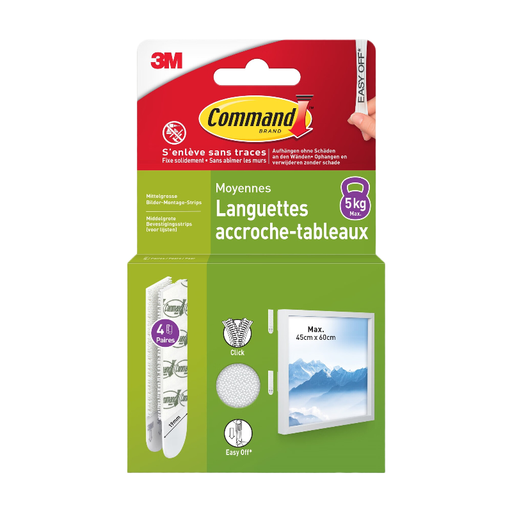
Why this choice makes sense: This size is ideal for moderately heavy frames and decorations in a home, office or student room, without needing to buy extra accessories.
Its stated capacity of 5.4 kg lets you choose a suitable reference rather than undersizing your fixing. Installation and removal must follow the instructions.
A medium format, discreet white strips, a flush hold and removal designed to minimise marks on compatible surfaces.
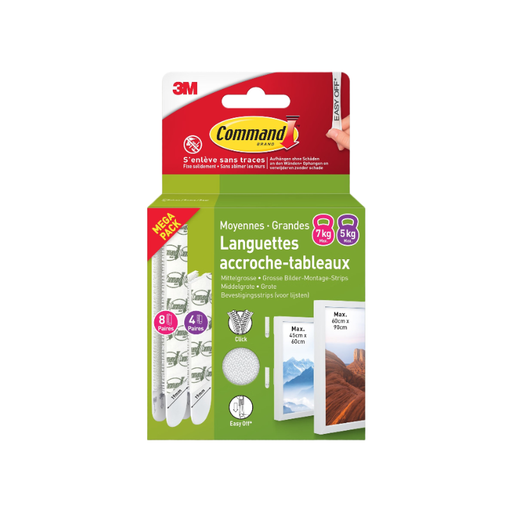
Why this choice makes sense: This multipack lets you coordinate several frames, create a gallery wall or kit out different spaces with two strip sizes.
The pack separates medium strips, stated at up to 5 kg, from large strips, stated at up to 7 kg. This lets you match the size more precisely to your item.
4 medium pairs and 8 large pairs, stated compatibility with several smooth surfaces and a repositionable fixing mechanism.
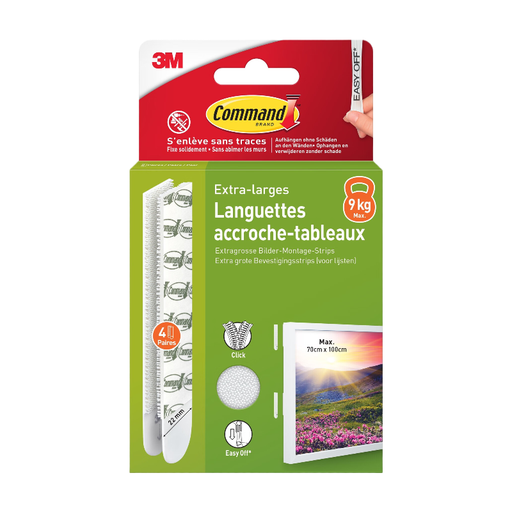
Why this choice makes sense: This reference is designed for large whiteboards and heavier items in a meeting room, classroom or workspace.
Its XL size and stated load of 9 kg stop you treating a large whiteboard like a simple lightweight decoration. This limit must not be exceeded.
An XL version dedicated to whiteboards, removal stated as residue-free on compatible surfaces and tool-free, screw-free installation.
We've selected a complete, real-time updated list of products that meet these strict criteria, while complying with European safety regulations.
Repositionable fixing strips are not necessarily reusable after removal: however, some surfaces can be re-equipped with compatible replacement strips. Check the packaging before moving your item.
The references shown generally state that they should not be used on wallpaper, delicate, rough or unpainted surfaces. Compatibility depends on both the product and the surface: read the instructions before fitting and, if possible, test on an inconspicuous area.
Several references recommend waiting one hour after the initial press to give the adhesive time to bond properly. The exact time may vary depending on the model. A cold, damp or dusty surface can also affect the result.
They are designed to remove cleanly from compatible surfaces, but no adhesive fixing can guarantee no damage at all in every situation. Fragile, insufficiently dry or poorly adhered paint may peel off. Always respect the maximum load, the removal method and the manufacturer's warnings.