Households that often cook in the oven
If you regularly make gratins, bakes or several dishes at once, check the usable capacity, cooking levels and space required before choosing a conventional oven.


When renovating your kitchen, start by thinking about how you cook and the space available: choose a conventional oven if oven cooking is your priority, a convection microwave to combine both functions in one appliance, or two separate appliances if you’d rather keep them apart. Then compare the installation dimensions, features and fitting requirements for each model. A study by INC and ADEME covering four combination ovens and ten conventional ovens does not show that one category always uses less energy than the other.
If you regularly make gratins, bakes or several dishes at once, check the usable capacity, cooking levels and space required before choosing a conventional oven.
If you want to combine oven cooking and microwave functions in one built-in space, compare the capacity, available modes and housing dimensions of the combination ovens you’re considering.
If your kitchen units can accommodate two appliances, you could choose an oven for baking and a separate microwave for reheating, defrosting or grilling, depending on the model.
Your choice depends first on the space available for the appliances and which function you want to prioritise.
Consider this if : you often cook in the oven and want to explore the options for cooking on several levels.
The trade-off : you’ll need another appliance if you also want microwave functions.
Consider this if : you want a single built-in appliance for both convection cooking and microwave use.
The trade-off : capacity and modes vary by model, and a compact design doesn’t guarantee better energy efficiency.
Consider this if : you want to keep two dedicated appliances and have space for both.
The trade-off : your kitchen units and installation need to accommodate both appliances.
| Criterion | What to check | Who it suits |
|---|---|---|
| Oven cooking | The model’s usable capacity and convection functions, as well as the dimensions of the space available. | I often cook dishes in the oven and want a cavity that suits my recipes. Around 40% of consumers prioritise this need. |
| One appliance housing | Installation dimensions, capacity and clear confirmation that the modes you want are included. | I only have space for one appliance and want to combine oven cooking and microwave use. This comes first for around 30% of consumers. |
| Separate functions | The space needed for two appliances and the installation instructions for each one. | I’d rather have one appliance for oven cooking and another for microwave use, provided my kitchen units can accommodate both. Around 30% of consumers prefer this separate set-up. |
Two appliances with a similar front width may still need different installation heights or clearances.
Before ordering, compare your kitchen plan with the instructions for the model you’ve chosen. Check the housing dimensions, depth, ventilation and access to the connection point.
INC and ADEME compared four combination ovens with ten built-in conventional ovens. The small number of combination ovens means the results can’t be applied to every model.
Compare the figures for the specific models and programmes that suit your cooking habits, rather than drawing conclusions based on the category alone.
The built-in Electrolux Y4SM25TBK microwave offers microwave and grill modes, but not fan-assisted cooking. It therefore can’t replace a convection microwave on its own.
If you’re looking for convection cooking, check that this mode is explicitly listed in the specifications for your chosen model.
The connection and access to the power supply must be suitable for the appliances you’re planning to install. Promotelec, for example, describes a dedicated circuit for an oven as part of a kitchen’s electrical installation.
Ask a qualified professional to assess any new or altered circuit, and follow the installation instructions before fitting the appliances.
According to Bosch, the built-in Bosch HBG272EB3F oven measures 595 × 594 × 548 mm. The brand lists a 3D Hotair function for cooking on three levels on this model.
Electrolux’s KVLAE2XH is a convection microwave designed for a 450 × 560 × 550 mm housing, while its Y4SM25TBK is a built-in microwave with grill designed for a 380 × 560 × 550 mm housing.
The sample in INC and ADEME’s technical study includes the Sauter SKC6302LW combination oven and the SOP2434X conventional oven.
The Siemens iQ700 CM776G1B1/020420 combination oven is included in the sample studied by INC and ADEME.
This model is a built-in conventional oven. To decide whether it’s right for your renovation, compare its specifications and instructions with your kitchen plan, then assess the features of any combination oven or microwave separately.
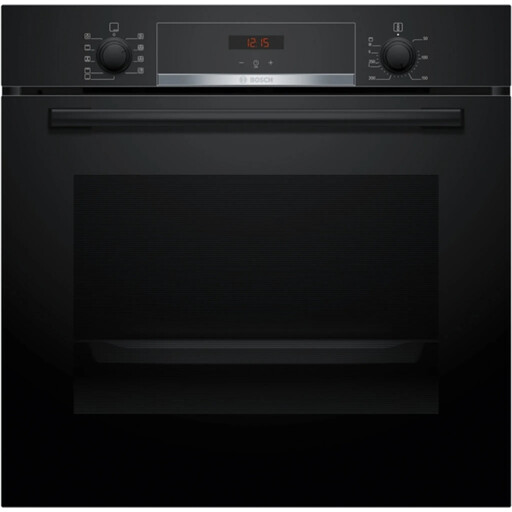 Image unavailable
Worth considering if you’re looking for a built-in oven for your baking and roasting. The product details list a 71 L capacity, 3D fan-assisted cooking and a stainless steel finish.
The product title calls it a “double oven”, while the other information describes a single cavity. Confirm the exact configuration before ordering. Also check the housing dimensions and ventilation requirements in the instructions, and ask a qualified professional to confirm that the electrical circuit is suitable.
No. You can’t assume lower energy use based on the category alone. The INC and ADEME study compared four combination ovens with ten built-in conventional ovens across three recipes. Its limited sample of combination ovens isn’t enough to establish a general rule. Compare the figures for the models and programmes that match how you cook.
The front doesn’t give you all the measurements needed for a built-in installation. Electrolux specifies a 450 × 560 × 550 mm housing for the KVLAE2XH combination oven, compared with 380 × 560 × 550 mm for the Y4SM25TBK microwave. These dimensions are specific to each model. Also check the depth and ventilation guidance in the instructions.
Ask a qualified professional to assess any new or altered circuit before the appliances are fitted. Promotelec describes a dedicated circuit for an oven as part of a kitchen’s electrical installation. The planned connection must also comply with the manufacturers’ instructions for the models you’ve chosen.
Ask for the units, appliances and planned work to be itemised so you can check that the spaces available match the models you’re ordering. The French National Consumer Institute recommends getting a detailed kitchen quote. In particular, ask for the chosen appliances and the requirements for installing them to be clearly specified.