Which set-up is right for you?

If you often reheat or defrost food

A combination oven can handle these tasks as well as cooking in one appliance. Check the modes available on the model you’re considering rather than assuming that every built-in microwave offers convection cooking.

If you cook large dishes

If fitting large dishes and cooking on several levels matter more than combining functions, start by comparing the cavities of traditional ovens. A separate microwave can take care of reheating and defrosting.

If you’re replacing a built-in appliance

Measure the existing housing and compare it with the installation diagram for the exact model. The stated capacity and marketed width alone won’t tell you whether a new oven will fit.

Which factors affect your choice?

Combination oven

Consider it: if you’d like to switch between oven cooking and microwave functions in one appliance.

Bear in mind: the cavity of your chosen model may limit the size of your dishes.

Traditional oven

Consider it: if large dishes or cooking on several levels are your priorities.

Bear in mind: the oven alone doesn’t include microwave functions.

Separate oven and microwave

Consider it: if you often cook one dish while reheating another portion.

Bear in mind: you’ll need suitable space for both appliances.

What matters to you What to check Who is this for?
Combining functions Check the microwave, convection and combination modes on the exact model, and see whether it has a defrost function. If reheating or defrosting is part of my routine, I want to do it in the appliance I also use for cooking; around 36% of consumers put combining these functions first.
Capacity and installation Compare your dishes with the cavity volume and internal dimensions; for a built-in appliance, measure the housing H × W × D and consult the manual. If I cook large dishes or am replacing a built-in oven, I need a suitable cavity and an appliance that fits the housing; this is the top priority for around 29% of consumers.
Energy use Check the information that applies to the model and the modes you’ll use. Don’t judge its energy consumption on the word “combination” alone. I want to assess energy use without assuming that the results of a trial recipe apply to all my meals; around 21% of consumers put this comparison first.
Using appliances at the same time Think about when cooking and reheating overlap, then check whether you have room for two appliances. While one dish is cooking, I sometimes need to reheat another portion without waiting for the oven to become free; for around 14% of consumers, being able to use two appliances at once comes first.

What should you watch out for before buying?

  • Relying on the marketed size alone

    The stated width of an oven doesn’t give you all the measurements needed for fitting it into a housing. Compact models and traditional ovens, as discussed here, aren’t designed for the same housing requirements.

    Measure the available height, width and depth, then follow the installation diagram and requirements for the exact model.

    Which brands should you compare?

    These examples are for comparing specific models and don’t necessarily reflect the features of every range from each brand.

    Samsung

    Samsung France lists the NQ5B6753CAK as a 50 L built-in combination microwave oven.

    • For this model, Samsung lists convection, microwave and combination modes.
    • If you’re replacing a larger traditional oven, compare its 50 L cavity with the dimensions of your dishes.

    Siemens

    Siemens Home Appliances France offers the compact built-in CM776G1B1 combination oven, with a stated capacity of 45 L.

    • Its specifications list a maximum microwave power of 900 W, as well as pyrolytic and hydrolytic cleaning functions.
    • Check the specifications and format of this specific model, particularly against the dimensions of your housing and dishes.

    Whirlpool

    Whirlpool France lists the OMR551RR0X as a 71 L built-in traditional oven.

    • The specifications for this model list cooking on two levels, as well as pyrolytic and hydrolytic cleaning.
    • This oven doesn’t combine the microwave reheating and defrosting functions you’d get with a combination model.

A combination oven to consider on Joybuy

This 42 L combination model is worth considering if you’d like to combine oven cooking and reheating without choosing a traditional built-in oven. Check its exact modes and installation requirements before you decide.
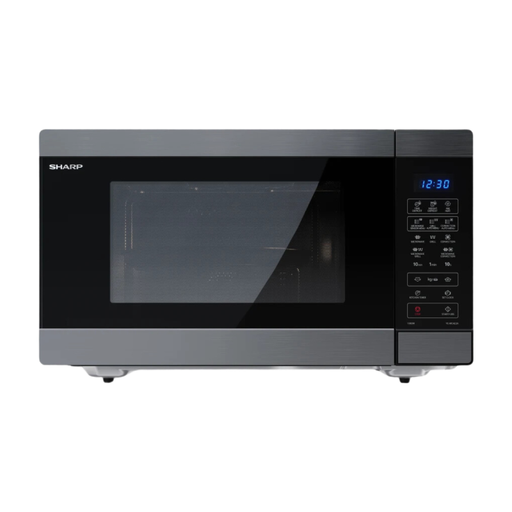
SHARP YC-MC422AE-SB 42 L combination microwave oven

SHARP YC-MC422AE-SB, 42 L combination microwave

Worth considering if you’d like to switch between oven cooking and reheating with one appliance. Its stated capacity is 42 L; check the manual to make sure it has the defrost mode you need, and to find out how much space and clearance are required for installation.

View on Joybuy

Frequently asked questions

Can you directly compare the energy label of a combination oven with that of a traditional oven?

Not always: European Delegated Regulation No 65/2014 excludes ovens with a microwave heating function from its energy labelling requirements. Check the information that applies to each model, and don’t interpret a difference in energy labels as proof that one uses more or less energy.

How can I tell whether a built-in combination oven will fit in my kitchen?

Measure the housing and compare it with the exact model’s built-in dimensions and the requirements in its manual. For example, for the KVLBE08X, Electrolux France specifies a housing of 450 × 560 × 550 mm; the marketed size or external dimensions alone aren’t enough to confirm it will fit.

Does a combination oven always use less energy than a traditional oven?

No. The trial by the French National Consumer Institute and ADEME doesn’t support that general conclusion. It covered four combination ovens, ten convection ovens and three recipes; results vary depending on the appliances and dishes tested.

What should I do if the oven delivered doesn’t match its description?

In France, the statutory guarantee of conformity applies to goods sold by a business to a consumer, as the Ministry of the Economy explains. Tell the seller about the difference; if the issue relates to installation, clarify who was responsible and keep the instructions provided.

What should I do with my old oven after replacing it?

Ask the seller whether they offer a take-back service, and look into local collection or reuse options. In France, electrical and electronic equipment has a separate collection scheme from ordinary household waste, according to the ministry responsible for ecological transition.