In a small kitchen, a freestanding combi microwave is worth considering if you often reheat and defrost food but also want to bake in one appliance. If oven cooking is your priority, compare convection ovens instead. And if you have the room, two separate appliances let you keep a dedicated microwave. A study by ADEME and the National Consumer Institute found no universal advantage to combi microwaves: results vary depending on the dishes, models and brands.
Who might each option suit?
One appliance for a small kitchen
You want to cook, reheat and defrost without cluttering your worktop with several appliances. A freestanding combi microwave could suit these needs, provided its dimensions, cavity and the clearances specified in the manual are suitable for your chosen spot.
Oven cooking comes first
You regularly make gratins, bake or cook meals for the family. First, check that the capacity and cooking modes suit the dishes you prepare. In its comparison of combi ovens and convection ovens, ADEME and the National Consumer Institute found that results vary depending on the dishes and models.
Everyday reheating and defrosting
You mainly use the microwave for leftovers and frozen food, while oven cooking is occasional or handled by another appliance. Consider whether you would use a combi microwave’s oven function often enough to justify the space it takes up in your kitchen.
What sets these appliances apart?
Freestanding combi microwave
Consider it: if you regularly need one appliance to reheat, defrost and oven-cook in a limited space.
Bear in mind: versatility does not guarantee the same results for every dish, as the comparison by ADEME and the National Consumer Institute highlights.
Convection oven
Consider it: if oven cooking is your main use and you can reheat or defrost food another way.
Bear in mind: this option does not combine microwave functions in the same appliance.
Separate oven and microwave
Consider it: if you have room for one appliance dedicated to reheating and defrosting, and another for oven cooking.
Bear in mind: two appliances take up more space than one.
| Criteria |
What to check |
Who is it for? |
| Available space |
Measure the appliance and door clearance, and check the clearances specified in the manual. Make sure your dishes will fit inside the cavity. |
When worktop space is limited, I want one appliance for cooking, reheating and defrosting without sacrificing the room my dishes need. Saving space would be the top priority for around 33% of consumers. |
| Oven cooking |
Compare the model’s capacity, cooking modes and temperature range with the recipes you make. |
If I often cook gratins or bake, I don’t want to choose based on the oven function’s name alone. Oven cooking would be the top priority for around 27% of consumers. |
| Energy use and useful features |
To compare energy use, look at the same dish, quantity and a comparable cooking mode. Check which features you would actually use. |
I want to avoid basing my choice on energy figures for different types of use or on features I don’t need. This would be the main concern for around 20% of consumers. |
| Installation |
Check the permitted installation type, ventilation, plug and electrical requirements in the manual for the exact model. |
Before choosing an appliance, I need to be able to position and use it in line with its manual, without blocking its vents. This would be the top criterion for around 20% of consumers. |
What should you watch out for before buying?
-
Assuming ‘multifunction’ means the same cooking results for every dish
The comparison by ADEME and the National Consumer Institute found that performance varies depending on the dishes, models and brands, with no clear advantage for combi microwaves over convection ovens.
Start with the recipes you usually make, then check the modes, capacity and accessories of the model you’re considering rather than counting its functions.
-
Choosing based on capacity in litres alone
The cavity’s capacity does not tell you whether the appliance will fit in your chosen spot or whether your dishes and plates will fit inside it. The interior layout can also vary depending on whether the model has a turntable.
Measure the space, the clearance needed to open the door and your cookware. Then check the shape of the cavity and the model’s external dimensions.
You may also need to replace dishes or accessories that are not compatible.
-
Blocking the vents to make the appliance fit
Whirlpool says that a microwave’s ventilation grilles must not be obstructed.
Follow the clearance requirements and positioning instructions in the manual for your chosen model. Don’t place anything on top of the appliance if the manual says not to.
-
Comparing energy use figures for different types of use
ADEME’s annual benchmarks for cooking appliances and a test based on a particular dish or programme do not describe the same type of use.
To compare two appliances, look for figures based on an equivalent dish, quantity and cooking mode, then relate them to the way you usually cook.
Combi oven brands to compare
These ranges offer examples of features to look at on specific models. The brand name is no substitute for checking the dimensions and manual.
Panasonic
In France, Panasonic offers freestanding combi microwaves that combine microwave, convection and grill functions, depending on the model, and sometimes include a steam function.
- Panasonic’s specification for the NN-C69KSM lists a 30 L capacity and fan oven function; its NN-CS88LB specification also describes steam cooking.
- Check the dimensions and accessories for the exact model. These features do not mean it will suit every dish you make.
Samsung
Samsung’s range in France includes freestanding combi microwaves, including large-capacity models.
- Samsung describes defrosting and cooking functions, as well as a Smart Sense humidity sensor, on the MC455TFRCBB.
- These features of the MC455TFRCBB do not mean that every model in the range will perform as well as a convection oven.
Whirlpool
In France, Whirlpool offers freestanding microwaves and combi models, with different sizes and cavity layouts depending on the model.
- Whirlpool describes the MWF259SG as a 25 L combi microwave without a turntable, featuring a grill and steam function.
- Measure the space and check the ventilation requirements. Whirlpool reminds users that ventilation grilles must not be obstructed.
Combi microwaves to consider on Joybuy
The model featured here is a combi microwave that brings several functions together in one appliance. Before choosing it, compare the space it needs and its cooking modes with the dishes you usually make.
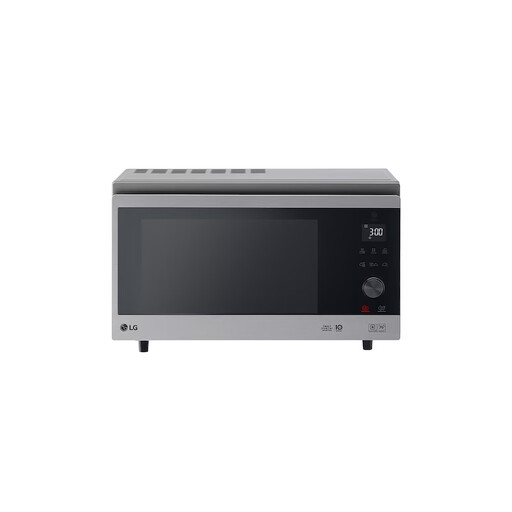 Image unavailable
LG MJ3965ACS, 39 L combi microwave, stainless steel and black
Worth considering if you want one appliance for cooking, reheating and defrosting. It has a stated capacity of 39 L. Check that your dishes fit inside the cavity, then check the external dimensions, ventilation and electrical requirements in the manual for the exact model.
View on Joybuy
Frequently asked questions
Can a combi microwave replace a convection oven for all my dishes?
No, it depends on the dishes you make and the model you choose. In a comparison of four combi ovens and ten convection ovens, ADEME and the National Consumer Institute found that results vary depending on the dishes, models and brands. Check that the capacity and cooking modes suit your recipes.
What should I measure before buying a freestanding combi microwave?
Measure the width, height and depth of the space, then allow for the door to open and the clearances specified in the manual. Measure your dishes too: a capacity in litres alone does not confirm that they will fit inside the cavity.
Can I put a combi microwave in an enclosed space?
Only if the manual for that model permits it and you can meet its ventilation requirements. Whirlpool says that a microwave’s ventilation grilles must not be obstructed. Don’t treat a freestanding model as a built-in appliance.
Are the electrical requirements the same for all these appliances?
No. Check the power rating, required socket and installation instructions for the exact model before choosing. Don’t assume that a freestanding combi microwave has the same requirements as another model or a built-in appliance.


