
Livraison le jour même ou le lendemain

Qualité garantie

Débloquez vos offres de bienvenue: Livraison GRATUITE | Jusqu'à -80 % | 30 jours d'essai gratuits à JoyPlus
Téléchargez l'application
Buying colouring pens and markers seems simple… until the nibs become flattened, the ink bleeds through the pages or the colours are not suitable for the intended use. The right criteria vary depending on whether you are shopping for a child, a student, a bullet journal enthusiast or a keen artist.
Here are the key points to check before buying, along with a selection of products suited to several types of users in France.
A large set is not necessarily the most practical choice. If all the nibs have the same shape, it can be difficult to create fine details as well as broad areas of colour or headings. Conversely, double-ended markers often offer more possibilities with fewer pens to store.
So check the exact configuration of the set: fine nib, bullet nib, chisel nib, brush nib or round tip. The number of colours comes afterwards.
The term “washable” should be interpreted with caution. Some models are designed to wash off skin and most fabrics more easily, but an old stain, delicate textile or porous surface may still retain marks.
For children, washable water-based pens for children are generally the most suitable for everyday activities. It is still best to protect the table and clean any stains with water as soon as possible.
A pen that is not capped properly gradually loses its moisture. Models with anti-drying ink may cope better with a short interruption, but no pen should be left uncapped repeatedly.
Lifespan also depends on the paper used, the pressure applied and how often the pen is used. When recommended by the manufacturer, storing pens horizontally helps maintain a steady flow of ink to the nib.
For detailed drawing, fine-tip pens should retain their shape. A metal barrel can also make them easier to use with a ruler or stencil.
Water-based ink is generally suitable for paper, notebooks and colouring. Depending on the manufacturer’s instructions, it can also be diluted on sufficiently thick paper to create a watercolour effect.
Acrylic paint pens are designed for a different purpose. Their pigmented ink is intended for surfaces such as wood, glass, ceramic, plastic, canvas or stone. It is best to test the pen on a small area, especially when decorating a fragile or valuable item.
For notebooks and worksheets, check the ink’s transparency and the risk of bleed-through. Even a formula marketed as limiting transfer can mark thin paper.
For a set intended for children, check the recommended age, warnings about small parts and whether the pens have ventilated caps. Information about the manufacturer, importer or responsible person in the European Union must be available.
Ink described as water-based, alcohol-free or odourless does not mean that it can be swallowed. Pens are not chew toys and young children should use them under adult supervision. For products sold as toys, check the applicable compliance information and the warnings in French.
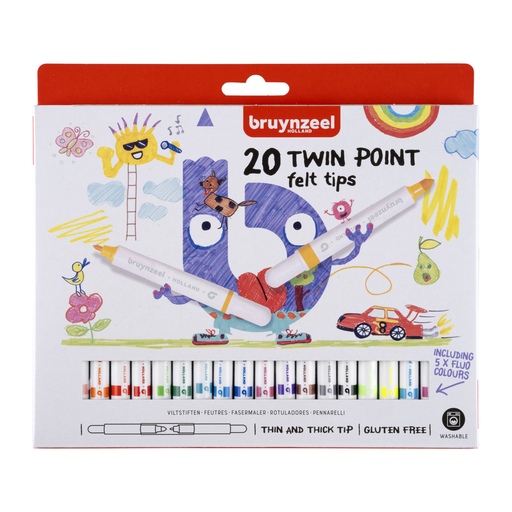
Why this choice suits this profile : This pack of 20 pens offers two nibs per marker: one fine and one broad. It is suitable for first colouring activities, outlining and filling, without having to buy several different sets.
The double-ended design means you do not need to buy several sets to achieve different line widths. According to the product listing, the water-based ink can be reactivated with a little water if the nib dries out after a period of non-use.
20 assorted colours, two nib sizes and a recommended age of 5 years and over, according to the product listing.
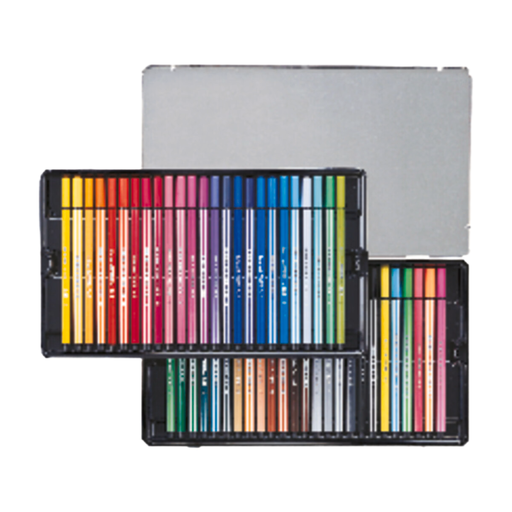
Why this choice suits this profile : With 50 shades, this set is aimed at artists who want to build a varied palette for colouring, broad areas of colour and watercolour effects on suitable paper.
The metal case protects and keeps the pens organised, while the 1 mm bullet nib provides an even line for both drawing and colouring.
50 pens, water-based odourless ink according to the product listing, 1 mm nib and metal case.
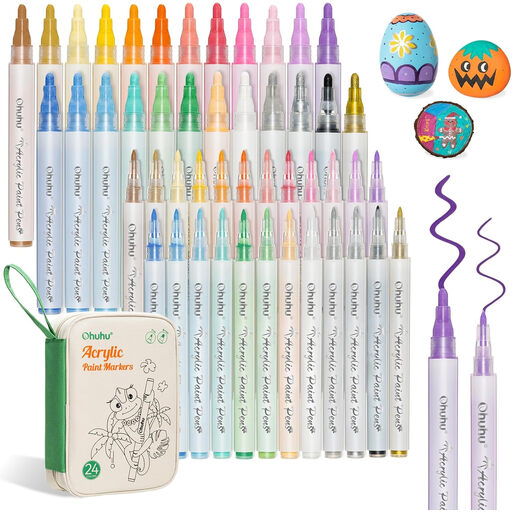
Why this choice suits this profile : This set is designed for creative projects on a range of surfaces, including wood, glass, ceramic, canvas, stone and plastic.
The 24 colours are supplied with a fine nib and a reversible round or chisel nib. This means you do not need to combine several palettes for one project.
48 markers, 24 coordinated shades, nibs measuring 0.7 mm, 1.8 to 2 mm and 4 mm, depending on the tip.
We have put together a complete, real-time updated list of products that fully meet these strict selection criteria and European safety regulations.
Replace the cap until it clicks, or until it is fully closed, after every use. Follow the storage position specified by the manufacturer and avoid very hot or sunny places. With some water-based models, a slightly dry nib can sometimes be reactivated, but this is no substitute for careful maintenance.
They are designed to make cleaning skin and many fabrics easier, but the result depends on the material, colour and how quickly you act. Rinse the stain with water as soon as possible and check the product information. For delicate clothing, test the pen first on an inconspicuous area.
The price mainly depends on the number of colours, whether the pens have two nibs, the type of ink and the case. A simple set is enough to get started with colouring, while a larger or acrylic selection is worthwhile for varied, regular use. Compare the price per marker, but also check whether replacement nibs are available and how well the pens are stored.