
Livraison le jour même ou le lendemain

Qualité garantie

Débloquez vos offres de bienvenue: Livraison GRATUITE | Jusqu'à -80 % | 30 jours d'essai gratuits à JoyPlus
Téléchargez l'application
Choosing colouring pens and artist markers isn’t just about counting how many colours come in a set. A nib that’s wrong for the job, ink that bleeds through the paper, or a marker that doesn’t work on your surface can quickly turn a promising purchase into a disappointment.
Drawing, lettering, bullet journaling, customising objects or creative hobbies – whatever your project, three common pitfalls keep cropping up.
The claim “does not bleed through paper” should also be taken with a pinch of salt. The result depends on the paper weight, texture and number of passes. For a bullet journal or notebook, always test the pen on a page near the back of the book.
Medium-tip pens, typically between 0.7 and 1 mm, offer a very practical compromise for colourful writing, outlines and sketches. The Paper Mate Flair, for example, comes in 0.7 mm or 1 mm tips depending on the reference. They’re suitable for annotations, visual organisation and drawings with a moderate level of detail.
Fine-tip pens are better suited to small lettering, precise outlines, calendar notes and intricate patterns. STAEDTLER Lumocolor permanent markers in 1 mm are designed for marking and labelling, particularly on plastic, glass, metal, cardboard and paper.
Brush-tip pens respond to a different technique. The pressure you apply varies the line width, making them especially interesting for lettering, flourishes and expressive illustrations. For consistent lines without too much difficulty, an ogive or round 1 mm tip will be easier to control.
Water-based pens are widely used for writing, colouring and drawing on paper. They generally have little odour and can allow you to create blends or watercolour effects when the product description says so. The STABILO Pen 68 features water-based, odour-free ink and a 1 mm tip.
Permanent pens use ink designed to produce long-lasting marks. Their resistance to water and rubbing depends on the surface and the drying time. STAEDTLER Lumocolor pens are presented with quick-drying, alcohol-based ink that is water-resistant once dry. Use them in a well-ventilated room and avoid contact with skin.
Acrylic markers deposit an opaque layer, generally suitable for wood, stone, glass, metal, ceramic, plastic, fabric or canvas, depending on the manufacturer’s instructions. Non-porous surfaces should be cleaned and then tested on an inconspicuous area. These products are not intended for skin or surfaces that come into contact with food.
A compact set of colouring pens slips easily into a bag and is suitable for school, work and travel. A metal box protects the nibs better and makes it easier to organise the shades. If you use your pens very regularly, also check the availability of replacement nibs, storage conditions and the need to recap each pen promptly.
A palette of 12 to 18 colours is often enough to get started. Sets of 30 colours offer more shades, while a 90-pen set like the Faber-Castell Pitt Artist Pen is aimed more at varied practices requiring several nib shapes.
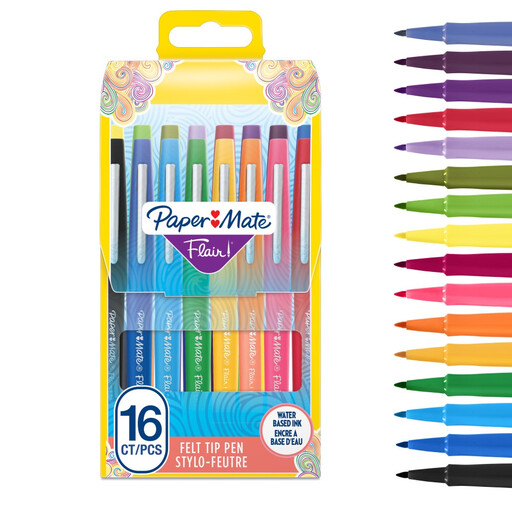
Why this choice suits this profile: A versatile assortment for colourful notes, bullet journaling and first drawings, with a medium 0.7 mm tip and water-based ink.
The 16-colour set avoids paying for a huge palette straight away and lets you test different uses on standard paper.
Medium tip, assorted colours and ink presented as smudge-resistant and designed to limit bleed-through on paper.
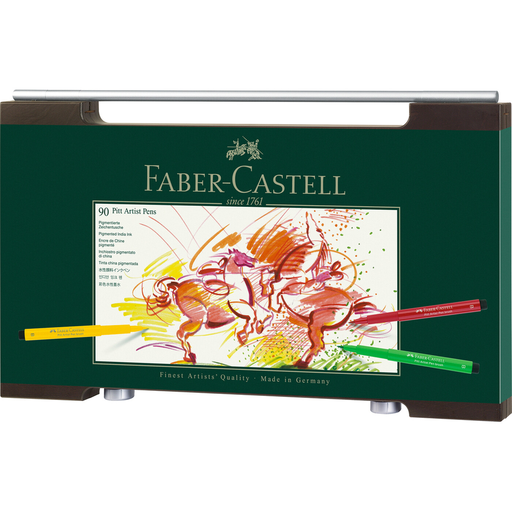
Why this choice suits this profile: The variety of nibs – brush, fine, medium, broad and chisel – meets the needs of illustrators, lettering enthusiasts and projects requiring several levels of precision.
The box brings together several nib types and avoids having to buy separate sets for drawing, writing or expressive strokes.
90 pens, water-based pigment ink presented as water-resistant and lightfast, compartmentalised wooden box.
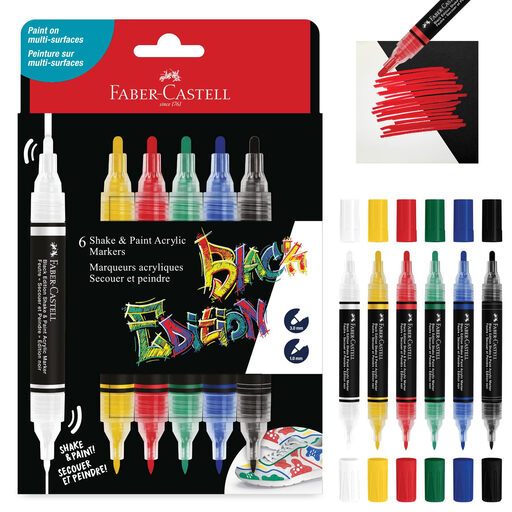
Why this choice suits this profile: Customisation projects on wood, glass, stone, metal or fabric require opaque acrylic ink and several line widths.
The product description mentions a double tip of 3 mm and 1 mm: you can fill an area, then go back to details without changing marker.
Opaque acrylic ink, six colours, stated water resistance and compatibility with many creative surfaces.
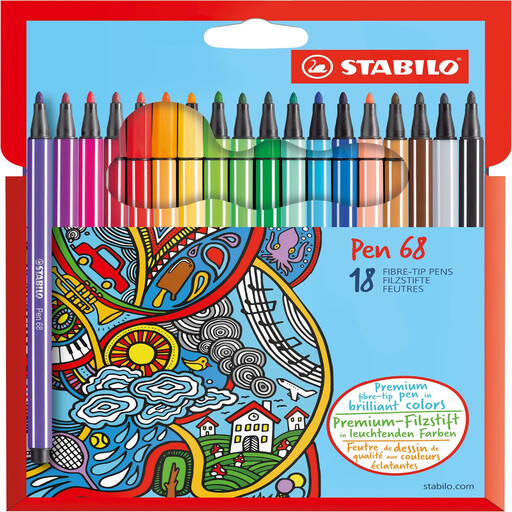
Why this choice suits this profile: The 1 mm ogive tip and water-based ink are suitable for colouring, filling areas and the watercolour effects mentioned in the product description.
The number of colours remains reasonable for starting to blend, without forcing you to store a large set from your first purchase.
18 assorted colours, 1 mm line, odour-free ink and anti-dry-out technology stated to last up to 24 hours without the cap.
We’ve put together a comprehensive list, updated in real time, of products that meet these demanding selection criteria and European safety regulations.
Medium-tip pens, from 0.7 to 1 mm, are suitable for titles, boxes and annotations. Choose a water-based ink and check it doesn’t bleed through by testing on a page near the back of the notebook.
A permanent pen is primarily used for long-lasting marking on different surfaces. An acrylic marker generally deposits a more opaque layer, which is particularly useful for decoration and customisation. How well it lasts depends on the surface, surface preparation and drying time.
Replace the caps firmly, store the pens according to the manufacturer’s recommendations and avoid leaving them near a radiator or a sun-exposed window. For frequent use, choose a box that separates the colours and protects the nibs.