
Livraison le jour même ou le lendemain

Qualité garantie

Débloquez vos offres de bienvenue: Livraison GRATUITE | Jusqu'à -80 % | 30 jours d'essai gratuits à JoyPlus
Téléchargez l'application
Buying coloured pens and felt-tip pens seems simple… until the ink bleeds through the pages, the nib gets squashed or half the colours remain at the bottom of your pencil case. Students, parents, colouring enthusiasts, bullet journal fans and professionals do not all have the same expectations. An assortment designed for drawing will not necessarily be the most practical choice for taking everyday notes.
Before filling your pencil case, take the time to separate marketing promises from the features that really matter.
A large set is not necessarily the most practical. For revision or meetings, 8 to 15 carefully chosen shades can be more than enough. Artists and fans of creative stationery, on the other hand, will benefit more from choosing an extensive palette for creating gradients, contrasts and detailed colour codes.
Also check that the advertised number of colours matches the contents of the set. A range may offer 65 shades, while the pack you are interested in contains only 10, 15 or 20.
Water-based inks are generally suitable for everyday paper, drawing and colouring pens, but their finish can vary depending on the paper weight. Gel inks often provide smooth writing and clearly defined visual effects, while ballpoint pens are better suited to documents and taking quick notes.
Even when advertised as water- or smudge-resistant, ink should be tested on the material you intend to use. The thin paper in a school notebook will not react in the same way as a thick sheet designed for creative hobbies.
A precise nib is not everything: if the pen barrel is uncomfortable, long writing sessions soon become tiring. Look for a soft grip area, a well-balanced barrel and a reliable mechanism. Storage also deserves your attention: a pencil case, hard case or compartmentalised set makes it easier to find colours and prevents caps from getting lost.
The nib directly determines the result on the page:
Fine-tip felt pens and multicoloured fineliners help you structure revision notes or draw neatly along a ruler. To fill a large area, a bullet-tip felt pen such as the STABILO Pen 68 will generally be quicker.
For a notebook or diary, observe how the ink behaves on paper of a standard weight. Gel inks and some alcohol-based inks can bleed through thin sheets. If you use bullet journal pens, test one on a page near the back of the notebook before decorating a double-page spread.
On non-porous surfaces such as plastic, glass or metal, a quick-drying permanent marker will often be more suitable. Bear in mind that its ink may leave a lasting mark, and use it in a properly ventilated space.
Replace the caps after every use, even if the model has technology designed to limit drying out. Keep felt-tip pens away from heat and direct sunlight. Gel pens can be stored horizontally, while some ballpoint pens perform more consistently when stored with the tip facing upwards.
For refillable models, check that refills are available before buying. This information is far more useful than a vague promise of long-lasting performance: the actual lifespan depends on how often the pen is used, the pressure applied and the type of paper.
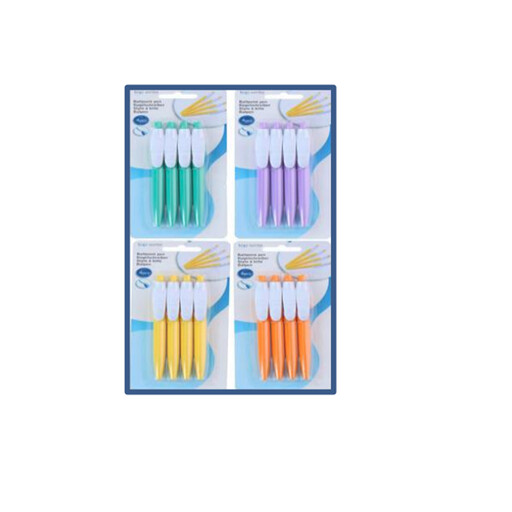
Why this choice suits this profile : This set of 4 colourful writing pens is suitable for early school use, homework and simple drawings, without overcrowding the pencil case with countless different products.
The compact format reduces the risk of buying shades that will hardly ever be used. The barrel is designed for children and the ballpoint nib encourages smooth, consistent writing.
4 assorted colours, ballpoint ink and a grip designed for younger users.
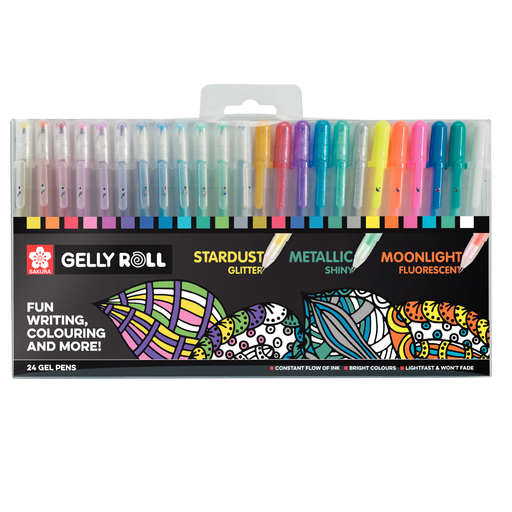
Why this choice suits this profile : This set is ideal for anyone who wants to vary effects in a creative journal, on a card or in an illustration, on both light and dark paper.
The 4 effects are clearly identified: glitter, metallic, neon and white. This lets you choose the finish suited to the surface, rather than buying several separate sets.
24 gel pens, water-based pigment ink and stated compatibility with white, coloured, matt and satin-finish paper.
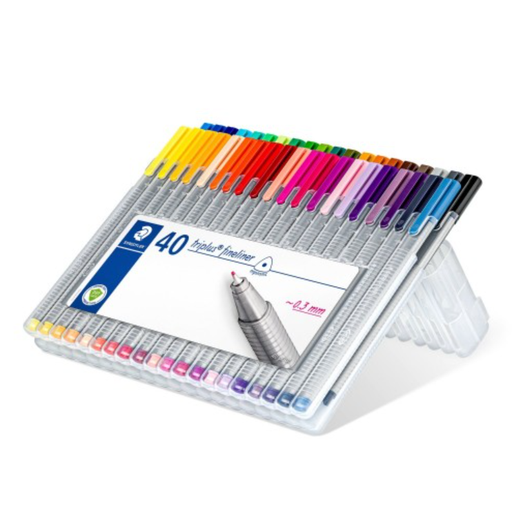
Why this choice suits this profile : Its 0.3 mm nib and 40-colour palette meet the needs of users who switch between detailed writing, diagrams, drawing and planning.
The set clearly states the line width and number of shades, making it easier to check whether it matches your needs for bullet journalling or fine annotations.
0.3 mm fibre-tip nib, triangular barrel and case with 40 slots for carrying and organising the pens.

Why this choice suits this profile : Each pen combines four colours: a practical solution for lessons, the office or travelling, when every centimetre of space in your pencil case matters.
The buttons let you select a colour without rummaging around for the right pen. The ink level remains visible thanks to the transparent barrel.
3 pens, each with black, blue, red and green ink, a 0.7 mm ballpoint nib and a non-slip grip.
We have brought together a complete, real-time updated selection of products that meet these demanding criteria and European safety standards.
An assortment of 8 to 15 colours is generally enough for organising your notes, decorating a diary or getting started with colouring. Sets of 30 to 65 shades become worthwhile for gradients, illustrations and regular creative projects.
Always test the pen on a page made from paper similar to that in your notebook. Place a sheet of scrap paper beneath the page and choose thicker paper for highly pigmented inks or felt-tip pens. A fine nib also often deposits less ink than a broad nib.
This depends on the type of ink, how often it is used and storage conditions. Replace the caps immediately, avoid high temperatures and keep the pens in their case. For intensive use, refillable models can help you avoid replacing the entire pen.