
Livraison le jour même ou le lendemain

Qualité garantie

Débloquez vos offres de bienvenue: Livraison GRATUITE | Jusqu'à -80 % | 30 jours d'essai gratuits à JoyPlus
Téléchargez l'application
Whether you're organising your planner, starting a new colouring book, or refining an illustration, the right coloured pen can transform a simple activity into a true creative experience. The problem? The market is flooded with options, and manufacturers' promises don't always live up to the hype. The wrong choice is a recipe for disappointment: pages ruined by ink that bleeds through, dull colours, and a wasted budget. As Head of Product Selection at Joybuy, my mission is to guide you through this jungle. This guide breaks down the pitfalls to avoid and gives you all the keys to finding the perfect pens for your projects.
Before you fall for a palette with a thousand colours, it's crucial to know the deal-breaking flaws that quickly turn enjoyment into frustration.
To avoid these disappointments, focus on two essential technical criteria: the ink type and the tip shape.
The ink's composition directly influences the colour rendering, its reaction with the paper, and the pen's versatility.
The tip is the element that will define the nature and fineness of your strokes.
To move from theory to practice, here are a few products that perfectly illustrate these criteria, each suited for a specific use.
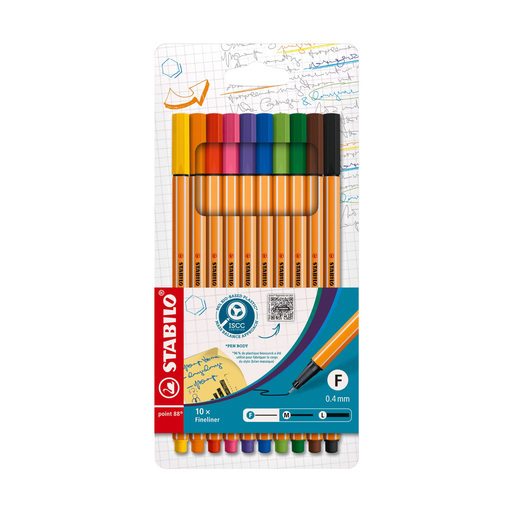
Why we chose it: It's a staple in every student's pencil case and the perfect partner for a bullet journal. Ideal for note-taking, revision cards, and diagrams. Its fine tip ensures clean writing and precise lines, while its water-based ink is gentle on most common types of paper.
The metal-encased tip is designed to withstand pressure and repeated use with a ruler, without flattening or fraying. Its water-based ink drastically limits the risk of bleeding through the pages of a standard notebook.
A precise 0.4 mm line and anti-dry-out technology that allows it to be left uncapped for several hours without drying out.
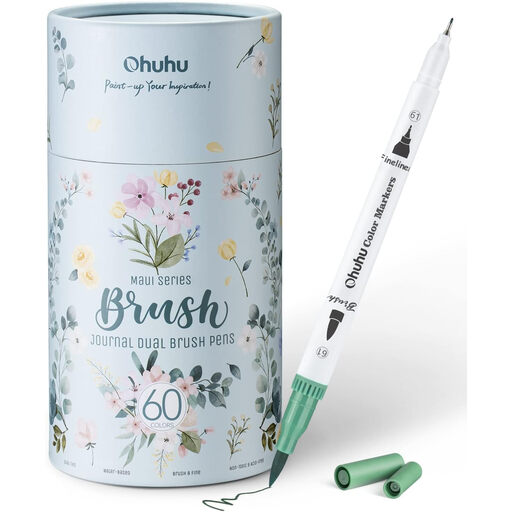
Why we chose it: A set with unbeatable value for money, perfect for getting started with art markers, calligraphy, or art colouring. Its dual tip offers formidable versatility, and the vast 60-colour palette opens up a world of possibilities for ambitious projects.
The dual-tip pen concept (brush + fine) saves you from investing in two separate sets. The included DIY colour swatch card ensures absolute colour accuracy, putting an end to unpleasant surprises.
The water-based ink is water-soluble, ideal for creating subtle gradients on suitable paper. Bonus: the set includes replacement tips, a rare detail that significantly extends the life of the pens.
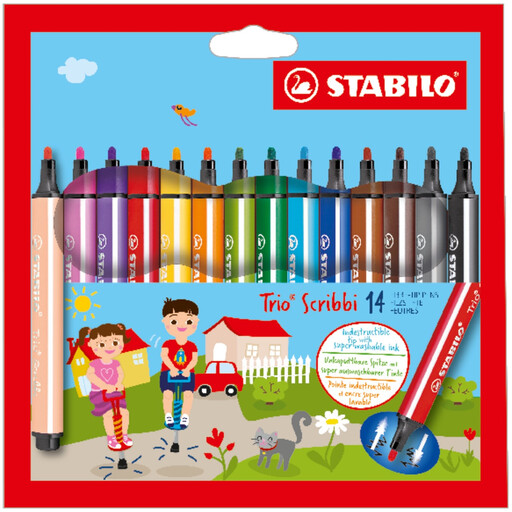
Why we chose it: Specially designed for the youngest artists, this pen combines a triangular ergonomic shape perfect for small hands, "super-washable" ink for stress-free activities, and a tip built to withstand the most... enthusiastic artists.
Its spring-loaded tip is nearly indestructible. If too much pressure is applied, it retracts into the barrel of the pen instead of flattening. No more pens headed for the bin after a single use!
Its "super-washable" ink comes off skin and most textiles with ease. You can look forward to colouring afternoons with complete peace of mind.
Discover our full selection of products that meet our quality criteria and current safety standards.
To go a step further, here are the answers to the questions you ask us most often.
The golden rule: always cap the pen firmly immediately after use. You should hear a "click". For dual-tip or alcohol-based models, storing them horizontally is highly recommended. This ensures both tips remain perfectly saturated and extends their lifespan.
Absolutely. The secret is to use a fairly thick paper (like watercolour or mixed-media paper, over 200?gsm) that won't buckle when it comes into contact with water. Apply the pen's colour to the paper, then use a slightly damp brush to dilute and spread the ink. Pro tip: apply some ink to a non-porous surface (a plastic palette, a laminated sheet) and pick up the colour with your wet brush, just as you would with pan paints.
Dye-based ink, the most common type, is a solution where the colour molecules are fully dissolved. It produces vibrant colours but can be sensitive to light (UV) and water. Pigment-based ink, like that found in the famous SAKURA Pigma Micron pens, contains tiny solid colour particles suspended in the liquid. Once dry, it becomes insoluble, making it permanent, water-resistant, and lightfast. It's the preferred choice for works intended to last (archival quality).