
Livraison le jour même ou le lendemain

Qualité garantie

Débloquez vos offres de bienvenue: Livraison GRATUITE | Jusqu'à -80 % | 30 jours d'essai gratuits à JoyPlus
Téléchargez l'application
Choosing a set of coloured pencils for drawing and colouring is not a decision to take lightly. From pencils designed for school to models for young children and artistic drawing materials, the feel in the hand, the composition of the core and the care requirements can dramatically change the experience.
Some marketing claims also deserve careful consideration. A very extensive palette is not necessarily more practical, while a pencil described as durable may prove fragile if its diameter or storage is not suited to the intended use.
A 48-colour set offers more shades, but it also takes up more space and can make storage more difficult, both at home and in the classroom. For beginners, 12 to 24 carefully chosen shades are generally enough. More comprehensive palettes are mainly aimed at fans of detailed colouring and users who like layering colours to create gradients.
A classic hexagonal barrel is suitable for students and adults looking for a precise, stable grip. For smaller hands, a triangular or jumbo pencil, or one with a non-slip grip area, may be easier to hold. The core diameter matters too: a thick core covers large areas quickly, but can sometimes lack the precision needed for details.
The word ‘washable’ does not mean that every mark will disappear from every type of fabric. Instead, check which surfaces are covered and review the cleaning instructions provided by the manufacturer. When children are using them, an apron, a protected table and closed storage are still sensible precautions, even with wax crayons or washable models.
Break-resistant pencils are particularly popular in nursery, at school and when travelling. Look for a specific feature, such as a reinforced core, a stated diameter or a design described as ‘break-resistant’. A soft core lays down more opaque colour and is well suited to blending, but wears down more quickly. A firmer core is preferable for details and crisp outlines.
Wax crayons and very thick pencils often lay down dense colour, making them ideal for flat areas of colour. Traditional coloured pencils offer greater precision. For artistic drawing, pastel pencils stand out for their dry, powdery texture, which can be blended. Once the drawing is finished, however, applying a suitable fixative may be necessary to reduce the risk of smudging.
For children’s coloured pencils, check the recommended age, whether there are any small parts and whether the supplied sharpener is compatible. Ergonomic triangular models encourage a stable grip, but do not replace adult supervision for younger children.
Jumbo and super-jumbo pencils are designed to be easier for small hands to hold. They are particularly suitable for colouring large areas. For decorative writing, outlines and detailed illustrations, however, a slimmer pencil is still more suitable.
Watercolour pencils can be used dry, then blended with a damp brush to spread the pigment. This technique requires sufficiently thick paper to prevent it from buckling. Some multi-purpose pencils can also be used on card or certain smooth surfaces, but check the manufacturer’s recommendations and clean non-porous surfaces promptly.
Wood certifications, such as PEFC or FSC, provide an indication of how the raw material has been sourced when they are clearly shown on the product page. They do not replace checking the safety instructions, recommended age and compliance information.
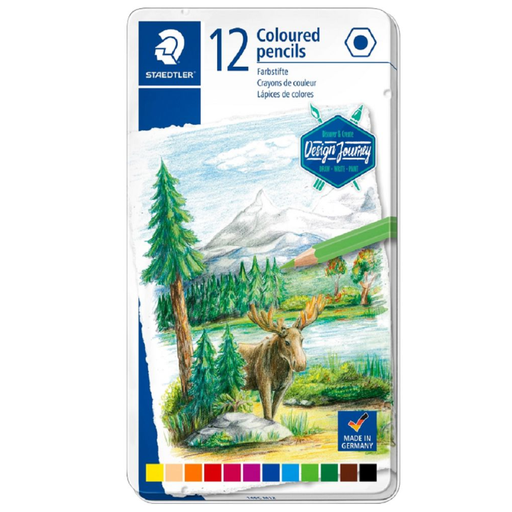
Why this choice suits this profile : With 12 colours, this set remains compact and is suitable for homework, notebooks and first drawings. Its hexagonal barrel offers a classic, controlled grip.
The palette is easy to understand and avoids paying for shades that may rarely be used right from the start.
Soft, easy-to-blend core, wood sourced from certified forests and a cardboard box.
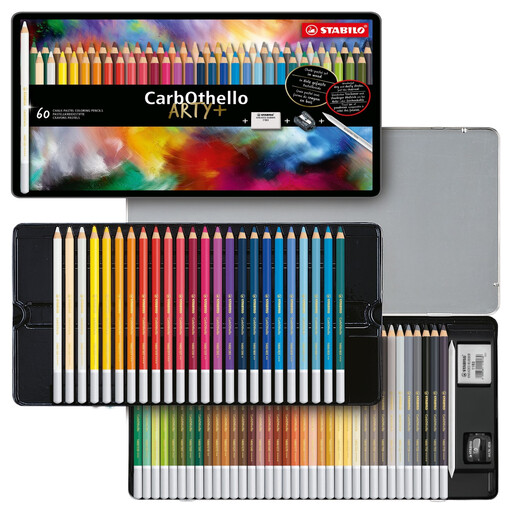
Why this choice suits this profile : This set of 60 pastel pencils is aimed at fans of artistic drawing who want to work on gradients, blending and contrasts on different types of paper.
The metal tin protects the pencils and makes it easy to identify all 60 shades, rather than leaving them scattered around.
Dry, powdery pastel core, can be blended dry or with a finger, made in Europe and PEFC-certified wood.
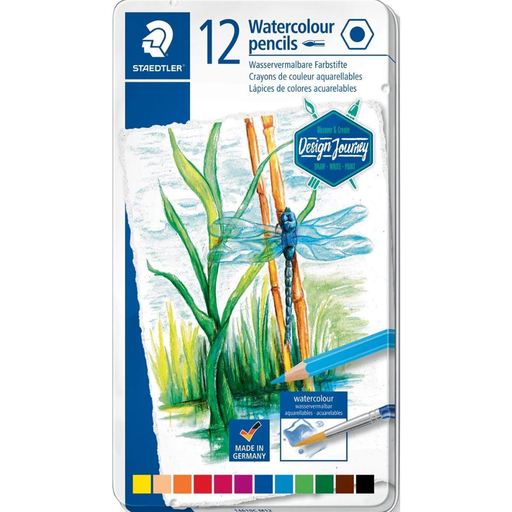
Why this choice suits this profile : These watercolour pencils let you switch from precise colouring to a diffused finish using a brush. Their metal tin is easy to carry.
It does not restrict the user to a single technique: the mark can remain dry or be activated with water.
Water-soluble core, stated break resistance, metal case and hexagonal barrel.
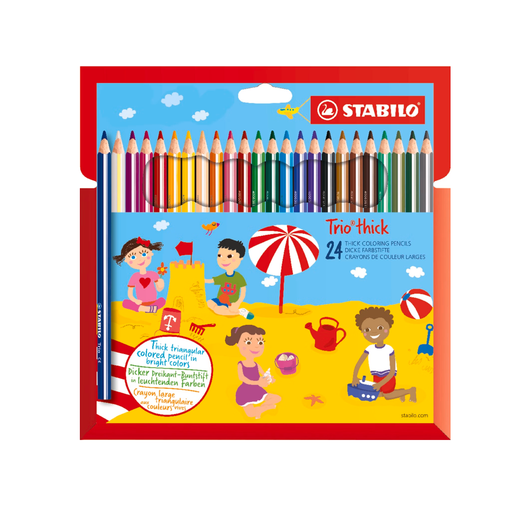
Why this choice suits this profile : Their triangular barrel and 4.2 mm core are designed for children colouring large areas at home or in the classroom.
The thick format reduces the pressure needed, while the reinforced core helps minimise interruptions caused by breakages.
24 pencils, triangular barrel, 4.2 mm core and certified wood sourced from sustainably managed forests.
We have put together a complete, real-time updated list of products that fully meet these strict selection criteria and European safety regulations.
Choose a triangular or jumbo barrel, a thick core and a clearly displayed age recommendation. Wax crayons and some multicoloured pencils can complement colouring activities, but safety instructions should remain easily accessible to responsible adults.
A 12-colour set is enough for school exercises and first drawings. A set of 18 to 24 colours offers more shades for gradients and colouring. Beyond that, the choice mainly depends on how often the pencils will be used and how much storage space is available.
They offer a complementary technique, but do not necessarily replace paint. Used dry, they behave like traditional pencils. With a damp brush, they create diffused effects, provided you use suitable paper and clean the brush between shades.