
Livraison le jour même ou le lendemain

Qualité garantie

Débloquez vos offres de bienvenue: Livraison GRATUITE | Jusqu'à -80 % | 30 jours d'essai gratuits à JoyPlus
Téléchargez l'application
Choosing a set of coloured pencils isn’t just about counting shades and comparing prices. The lead formulation, its diameter and the type of use directly affect comfort, precision and how long your pencils last. Whether you’re a child, a student, a colouring enthusiast or an illustrator, a poorly chosen set can quickly lead to broken leads, colours that are difficult to layer, or disappointing results on the paper you’re using.
Here are the criteria to consider before buying, along with a selection suited to different needs.
A box of 72 colours obviously offers more shades than a set of 12, but it isn’t necessarily the most sensible choice for a beginner child or for carrying pencils to class. Conversely, a small set can quickly show its limitations when it comes to gradients and blends for illustration.
The number of pencils should therefore match your project:
Watercolour pencils are used dry, then can be worked with a wet brush. On paper that’s too thin, adding water can cause buckling. To achieve smooth washes, it’s best to choose paper designed for wet techniques.
A brush included in the set is handy, but it doesn’t replace a suitable surface. Also remember to let your drawing dry flat, and avoid storing damp pencils or accessories in a metal tin.
A fine lead is ideal for outlines and details, while a jumbo pencil lets you cover large areas quickly. A larger diameter also withstands pressure better, but it needs a compatible sharpener.
For children, the shape of the pencil also matters. A triangular barrel with grip zones can help position fingers correctly. When the manufacturer offers versions for right-handed and left-handed users, make sure to choose the one that suits the child.
Drawing pencils are based on different formulations:
Mentions like “lightfast pigments”, “acid-free” or “reinforced lead” should always be checked against a sufficiently detailed product description. They don’t guarantee identical results on all papers or with all techniques.
A core of 2.9 to 3.8 mm is generally suitable for watercolour pencils and coloured pencils intended for detailed drawing. Models with 4 to 4.2 mm are more durable for intensive colouring. The STABILO Woody 3-in-1 stands out with its XXL core of 10 mm, designed for a wider grip and quick coverage.
Before ordering, check what type of sharpener you need. A standard model may not work with jumbo pencils or pencils with an especially thick core.
A metal tin protects the tips and makes storage easy in a bag or studio. A cardboard box is lighter, but doesn’t withstand repeated handling as well. A brush or sharpener included means you can start drawing straight away.
For school use, a space to write the child’s name can also help prevent losses. For artists, a compartmentalised box or a wooden case simplifies organising an extensive palette.
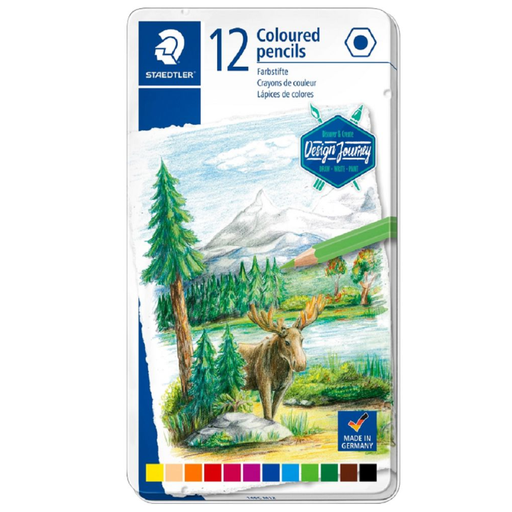
Why this choice suits this profile: With its 12 pencils, this set is ideal for students, school activities and first drawing projects. The hexagonal barrel ensures a stable grip during everyday colouring sessions.
This deliberately limited palette avoids paying for shades you’ll rarely use on a first purchase, while still offering enough freedom to create blends.
12 assorted shades, hexagonal barrel, soft lead and wood from certified sustainable forests, according to the product description.
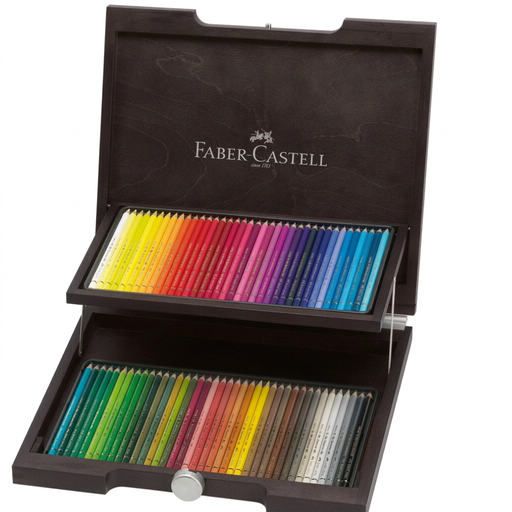
Why this choice suits this profile: With 72 colours, this set is aimed at illustrators and artists who work with layering, gradients and transitions between dry drawing and watercolour effects.
The large number of shades reduces the need for forced mixing. The wooden box protects the pencils and organises a palette designed for regular use.
72 colours, 3.8 mm core, pigments stated to be acid-free and lightfast, according to the product information.
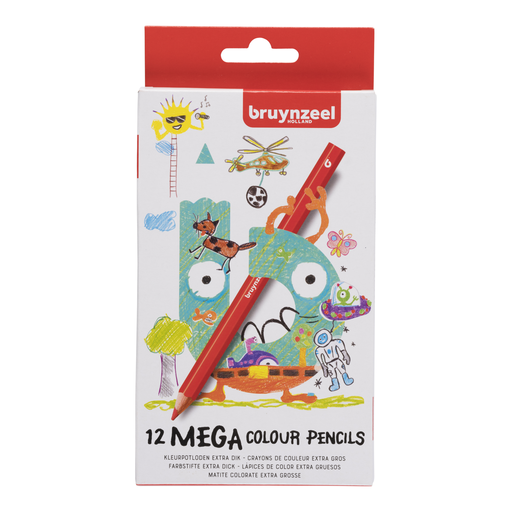
Why this choice suits this profile: The jumbo format is ideal for children, posters, large colouring projects and anyone who regularly fills in broad areas.
The 4 mm core withstands pressure better. However, do make sure you have a sharpener suitable for jumbo pencils.
12 pencils, extra-thick 4 mm core and a format designed to cover large areas with fewer strokes.
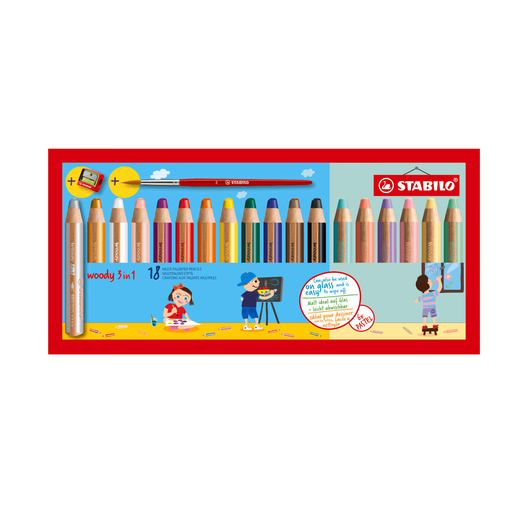
Why this choice suits this profile: This set combines a coloured pencil, a watercolour pencil and a wax crayon. It’s ideal for children who enjoy switching between different surfaces and creative effects.
One single product covers several uses, so you don’t need to buy multiple sets for early projects. On smooth surfaces, marks can be wiped away with a damp cloth.
18 pencils, XXL 10 mm core, six pastel shades, a brush and a sharpener included.
We’ve put together a comprehensive, real-time updated selection of products that meet these demanding criteria and European safety regulations.
To make a set of coloured pencils last longer:
Metallic pencils, such as the Bruynzeel Expression Metallic set, are mainly intended for accents, lettering and details on light or dark paper. They complement a standard set rather than replace it.
Go for a wide or triangular barrel, a durable lead and a palette of around 12 colours. Ergonomic or jumbo models are easier for small hands to hold. For young children, adult supervision is essential.
No. They offer two ways of using them – dry or with water – but they need suitable paper to achieve an even result. For everyday colouring without a brush, standard pencils are often more practical.
It all depends on how often you use them, the pressure applied and the storage conditions. A reinforced lead and a suitable sharpener help reduce waste. Stored dry, closed and away from strong temperature fluctuations, a set can remain usable for several years.