
Livraison le jour même ou le lendemain

Qualité garantie

Débloquez vos offres de bienvenue: Livraison GRATUITE | Jusqu'à -80 % | 30 jours d'essai gratuits à JoyPlus
Téléchargez l'application
A set of coloured felt-tip pens can be used for taking notes, decorating a bullet journal, colouring mandalas or creating illustrations. However, two boxes displaying a similar number of colours can offer very different experiences. The nib, ink and type of paper influence the result just as much as your choice of shades.
Before buying fine-tip felt pens or felt-tip pens, it is worth knowing the most common pitfalls.
A set of 60 colours is not necessarily more practical than an assortment of 18 or 20 shades. For taking notes or preparing revision cards, a more focused palette of clearly distinct colours will often be easier to organise. By contrast, drawing, detailed colouring and scrapbooking benefit from a wider choice.
Also check that the shades are genuinely different: some sets include many very similar colours that quickly become duplicates.
0.4 mm fibre-tip pens are suitable for annotations, outlines and precise details. A 0.7 mm to 1 mm nib produces a more pronounced line, which is useful for headings, colour coding or filling small areas. However, it may lack the precision needed in a planner or on squared paper.
The result depends on the paper’s weight and composition. Water-based ink can limit show-through on standard paper, but a very thin notebook may still reveal shadows or bleed-through. Test the pen on a less visible page, especially if you use a bullet journal or a notebook with writing on both sides.
A metal-clad nib will generally withstand being used alongside a ruler or stencil better. However, it is still sensitive to excessive pressure.
Washable felt-tip pens with water-based ink are popular for creative and school activities. However, “water-based” does not automatically mean that every mark will disappear from every textile. Check the product information and protect porous surfaces.
Quick-drying ink can be useful for left-handed users and for pages that will be handled immediately after writing. To create watercolour effects, use sufficiently thick paper and check that the manufacturer recommends this type of use.
A hexagonal barrel prevents the pen from rolling across your desk, while a cylindrical barrel offers a more traditional grip. A rigid case or metal tin makes it easier to carry the pens in a student’s bag or schoolbag.
Caps are small parts: the products shown are not suitable for children under 3 years of age. Do not ingest the ink, and replace each cap after use. Storing the pens away from heat and direct sunlight helps preserve the ink flow.
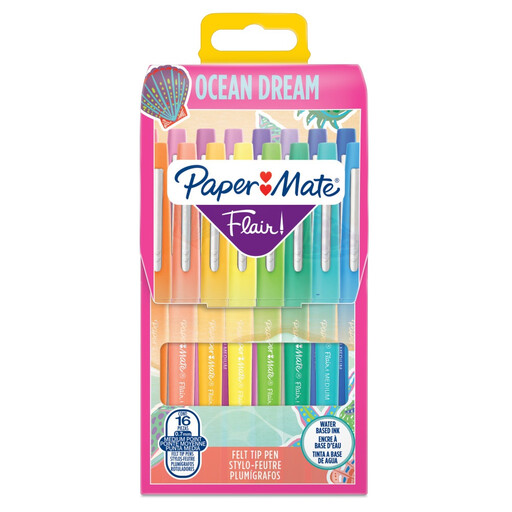
Why this choice suits this profile : The 16-colour set combines vivid shades and pastel tones, with a medium 0.7 mm nib suited to note-taking, creative journals and school projects.
The stated nib diameter prevents you from mistaking this model for a detail pen. According to the manufacturer, the water-based ink resists smudging when used as intended.
16 colours, 0.7 mm fibre tip, ambidextrous barrel and a cap to replace after every use.
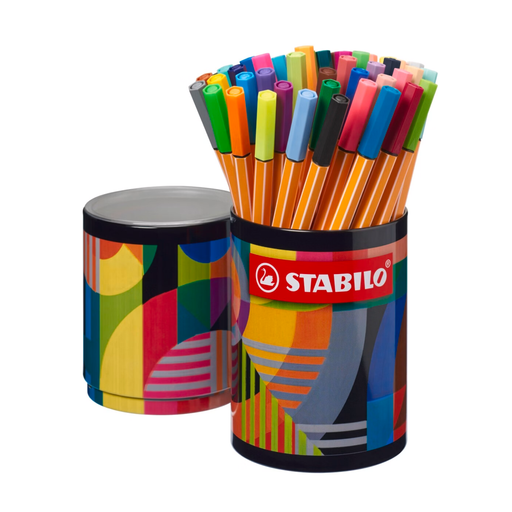
Why this choice suits this profile : Fans of drawing, mandalas and bullet journals have 45 shades in a practical metal tin that is easy to store and carry.
The 0.4 mm metal-clad fibre tip is designed for ruler-guided lines and details, rather than quickly filling large areas.
45 fine-tip pens, 0.4 mm line, metal tin and plastic stated to be ISCC Plus certified, with 96% bio-based material according to the product information.
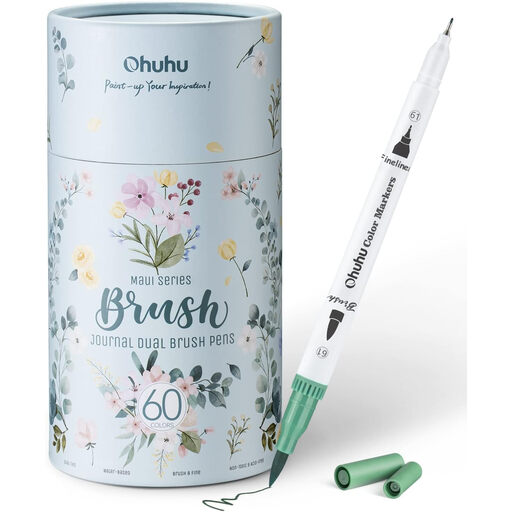
Why this choice suits this profile : Users who switch between calligraphy and drawing have a fine tip and a brush tip on every pen.
The dual-tip design makes each use clear: 0.4 mm for outlines and 1 to 6 mm for varied-width strokes. For water blending, however, you need to use thick paper.
60 colours, two tips, a colour chart and five replacement tips listed in the contents of the set.
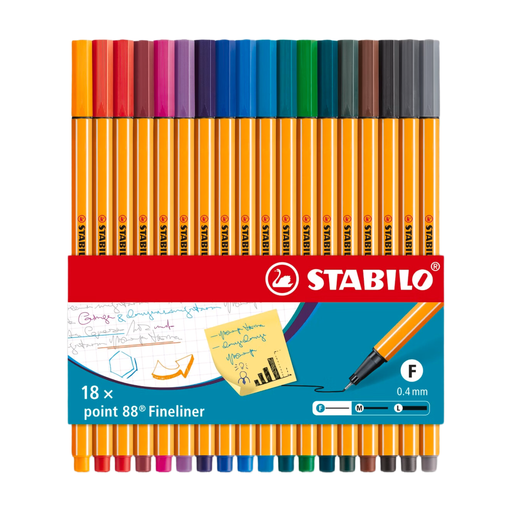
Why this choice suits this profile : The 18 colours and 0.4 mm line are ideal for visually organising lessons, revision cards and everyday diagrams.
The metal-clad tip is designed to remain stable when drawing along a ruler. The stated fine line prevents you from using a broad colouring pen to write in small boxes.
18 fine-tip pens, 0.4 mm line, hexagonal barrel and water-based ink, according to the manufacturer’s information.
We have put together a complete, real-time updated list of products that meet these demanding selection criteria and European safety regulations.
To extend the lifespan of your drawing and note-taking pens, a few simple habits can make all the difference:
STABILO point 88 pens are particularly well suited to fine lines and visual organisation. Paper Mate Flair pens offer a more visible medium nib for headings and annotations. Dual-tip brush pens are better suited to creative calligraphy and drawing with variable line widths.
Choose fine-tip pens with a 0.4 mm nib for writing, outlining and annotating boxes. To create decorative headings, a set combining a fine tip and a brush tip offers greater versatility. Always test the ink on your notebook paper to check that it does not bleed through the page.
A fibre-tip pen generally produces an even line, making it suitable for writing and precise drawing. A brush pen has a flexible tip whose width varies according to the pressure applied. It is suitable for thick and thin strokes, solid fills and calligraphy effects, but requires a more gradual movement.
Replace each cap firmly, avoid sunlight and heat, and follow the manufacturer’s storage recommendations. A metal tip or anti-drying technology may improve durability in certain conditions, but you should still replace the cap after every use.