
Livraison le jour même ou le lendemain

Qualité garantie

Débloquez vos offres de bienvenue: Livraison GRATUITE | Jusqu'à -80 % | 30 jours d'essai gratuits à JoyPlus
Téléchargez l'application
Making homemade juice seems simple… until the appliance takes over your countertop, leaves a significant amount of liquid in the pulp, or requires an extensive cleaning session after every use. For everyday use in France, choosing a cold-press juicer therefore involves more than comparing the stated power or taking performance claims at face value.
A slow juicer, also known as a masticating juicer or slow juicer, gradually presses fruit and vegetables instead of shredding them at high speed like a centrifugal juicer. This method can appeal to anyone looking for gentler extraction and a different texture. However, there are several essential criteria to check before buying.
The percentages shown in commercial specifications generally reflect the manufacturer’s test conditions. A figure such as “99%” or “99.5%” does not predict the result with every type of apple, carrot, citrus fruit, or fibrous leafy vegetable. Variety, ripeness, and cutting technique directly affect the amount of juice produced.
It is therefore also worth examining the auger design, filter type, pulp ejection system, and usage recommendations. Claims of “anti-oxidation” generally refer to low-speed operation: they do not guarantee better preservation or superior nutritional value.
A wide opening often reduces preparation time, but it does not mean that every ingredient can be inserted whole. Hard pits, sugar cane, ice cubes, frozen fruit, and certain highly fibrous foods may damage the appliance or cause it to jam.
Even with a whole-fruit and vegetable juicer, you should wash the ingredients, remove pits, and cut oversized pieces. The pusher is designed to guide ingredients: fingers and utensils must never enter the feed chute while the appliance is operating.
An appliance may be advertised as easy to clean while still containing several parts that need to be disassembled. For family use, check whether a cleaning brush is included, whether the parts are dishwasher-safe, and how long it actually takes to rinse the filter.
Continuous operating time also deserves your attention. The Bear model specifies a 15-minute limit, while the WOOX MX0289 recommends not exceeding 10 minutes before allowing the motor to cool. A large capacity does not mean that the appliance can run continuously without interruption.
A 1-litre bowl is sufficient for preparing a few glasses on demand. For several people, a large-capacity juicer with a 1.8-litre bowl avoids repeated refills. However, you should check both the actual juice container capacity and the pulp container capacity: these two volumes are not always identical.
If the juice is served immediately, a small container may be perfectly adequate. For preparing several portions, a separate receptacle and a stable outlet make it easier to fill a jug.
Openings ranging from 80 to 135 mm are common in this selection. An 80 mm feed chute already accommodates many medium-sized fruits, while a 130 or 135 mm opening further reduces the need for preliminary cutting. In every case, large ingredients must be sized to fit the chute and added gradually to avoid overloading the motor.
A quiet juicer is considerably more comfortable to use in an open-plan kitchen or when preparing juice in the morning. Be sure to compare measurements obtained using the same method, however: the WOOX specification states a noise level below 72 dB, while the information provided for the Bear and EUHOMY models mainly highlights quiet operation without giving a numerical value.
Power alone is not enough to assess an appliance. Also consider overheating protection, a reverse function for clearing blockages, the materials used in food-contact components, and the maintenance instructions. To minimise wear, always unplug the motor base before disassembly and never immerse it in water.
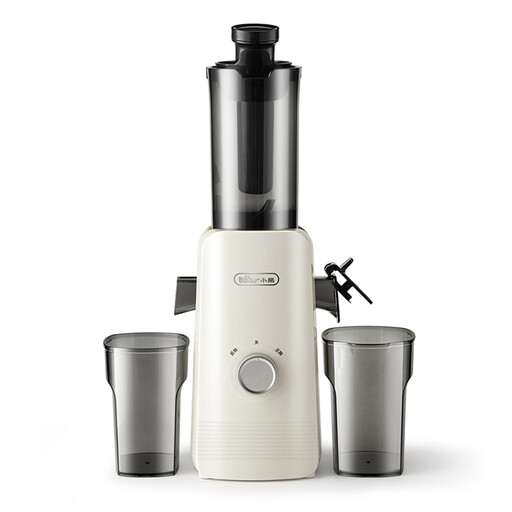
Why this model is a good fit: its 1-litre capacity is well suited to individual servings and smaller households. The 80 mm feed chute reduces the need to cut many fruits and vegetables into smaller pieces.
The specifications clearly state the usage limits, recommend immediate washing, and set the maximum continuous operating time at 15 minutes.
1-litre capacity, 80 mm opening, masticating operation, and removable parts that rinse clean quickly.
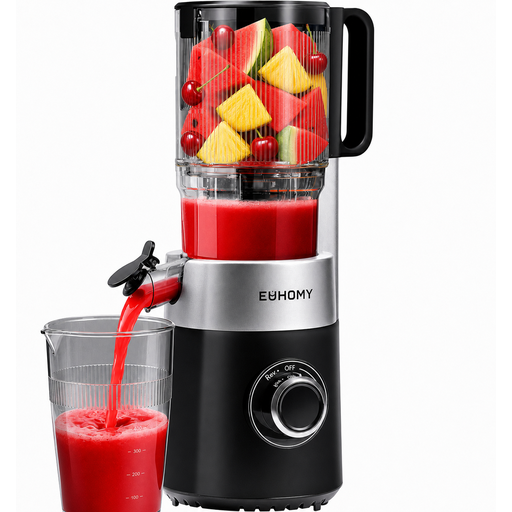
Why this model is a good fit: its stated 1.8-litre capacity and XXL 135 mm feed chute are designed for families preparing several servings at once.
The specifications describe a three-step assembly process and a three-stage filtration system. It is still best to rinse the parts immediately after extraction.
Stated 220 W motor, 1.8-litre bowl, twin augers, and a 135 mm opening. The 99% yield is a figure provided in the product specifications.
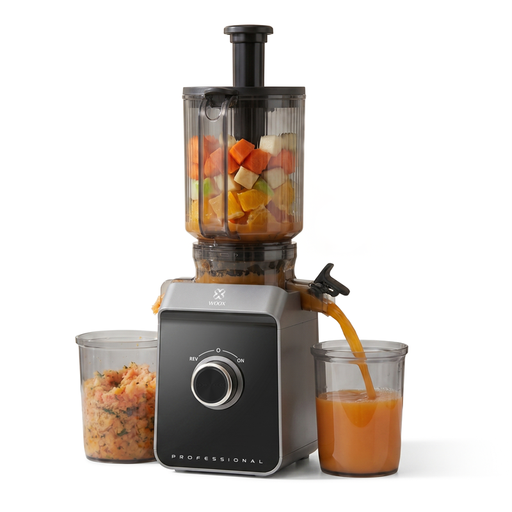
Why this model is a good fit: its 1.8-litre capacity, 130 mm opening, and 836 ml pulp container are well suited to regular household use.
Overheating protection and the reverse function can help clear blockages. The removable parts are also listed as dishwasher-safe.
Stated power of 150 W, noise level below 72 dB according to the specifications, 726 ml juice cup, and a DC motor with thermal protection.
We have brought together an updated selection of products that meet these purchasing criteria and the applicable safety requirements in the European Union.
Yes, provided it is placed on a stable, dry surface out of children’s reach. To prevent residue from drying, rinse the removable parts immediately after use, then allow them to dry completely before storing them. Clean the motor base with a damp cloth and never immerse it in water.
It depends on how frequently the appliance is used, whether the required motor breaks are observed, and how thoroughly it is cleaned. Adding ingredients gradually, removing pits, and avoiding prohibited foods reduces the risk of blockages. Always consult the manual for the recommended operating time: this varies from one model to another.
Consumption depends on the motor’s power and the operating time. A 150 to 220 W model can run at low speed, but its actual running cost depends primarily on the number of preparations and the duration of each cycle. For an accurate comparison, note the stated power, estimate your weekly usage time, and factor in your electricity tariff.