
Livraison le jour même ou le lendemain

Qualité garantie

Débloquez vos offres de bienvenue: Livraison GRATUITE | Jusqu'à -80 % | 30 jours d'essai gratuits à JoyPlus
Téléchargez l'application
Making fresh juice at home every morning sounds simple… until the preparation drags on, the pulp clogs the machine, or the cleaning routine puts you off. For British families looking for a durable appliance that’s easy to use and simple to fit into daily life, choosing a cold press juicer comes down to some very practical considerations.
Before you buy, take the time to check the feed chute width, the actual usable capacity, the time needed for cleaning, and the usage instructions. Claims of high yield or quiet operation are also worth taking with a pinch of salt: results vary depending on the fruits and vegetables you use, how you cut them, and the speed at which you feed them in.
The phrase “wide opening” doesn’t mean you can feed every ingredient in whole. An opening of 80 mm works well for many apples, oranges, carrots, or cucumbers, but larger items will still need to be cut. A wide chute reduces preparation time, but it doesn’t eliminate it entirely.
A juice yield of 99.5% might be a figure the manufacturer has measured under very specific conditions. It’s not a promise that applies to every recipe. Fibrous vegetables, citrus fruits, very ripe fruit, and soft ingredients all produce different amounts of liquid.
To compare two machines, look instead at the quality of the separation between juice and pulp, how easy it is to feed ingredients in, and whether you can reuse the pulp in other recipes.
A juicer that’s easy to clean is far more likely to be used regularly. Removable parts should be easy to access and rinse without hassle. If the manual says they’re dishwasher-safe, that’s a real time-saver. The motor base, however, should never be submerged.
Also check the maximum continuous running time. The Bear model, for example, shouldn’t run for more than 15 minutes at a time, while the WOOX MX0289 has a limit of 10 minutes, followed by a cooling period.
A slow juicer uses an auger that gradually presses ingredients. Unlike a traditional centrifugal juicer, it generally operates at a slower speed.
This technology is ideal for anyone who wants to make fruit and vegetable juices with a clean separation of pulp. The term “anti-oxidation” should be understood as a design feature highlighted by the brand, not a health claim. The freshness of your juice also depends on how you store it, the temperature, and how soon you drink it.
For family use, a wide-mouth slow juicer makes preparation much easier. The Bear model has an opening of 80 mm, while the WOOX MX0289 boasts a chute of 130 mm. In both cases, you still need to wash your ingredients and remove hard stones.
Never put peach, mango, or plum stones into the machine. Ice cubes, frozen fruit, sugar cane, and any very hard ingredients not mentioned in the manual should also be avoided.
A 1-litre slow juicer is ideal for a typical family batch, without taking up as much space as a model with a large reservoir. The Bear has a 1-litre capacity, enough to prepare several glasses in one go.
The WOOX MX0289 has a 1.8-litre chamber, with a 726 ml juice jug (the scale on it goes up to 600 ml), and an 836 ml pulp container. This difference between the chamber capacity and the jug capacity is worth noting: it doesn’t necessarily mean you’ll get that volume of ready-to-serve juice.
A quiet motor makes using the juicer much more pleasant, especially in an open-plan kitchen or early in the morning. The noise level can vary depending on how firm your ingredients are and how loaded the machine is. WOOX states a noise level of under 72 dB in its specifications. Bear, on the other hand, highlights a quiet motor without giving a specific figure.
To prevent blockages, alternate hard and soft ingredients, feed them in gradually, and use the pusher provided without forcing it. Rinsing the parts straight after use also stops fibres from drying onto the filter.
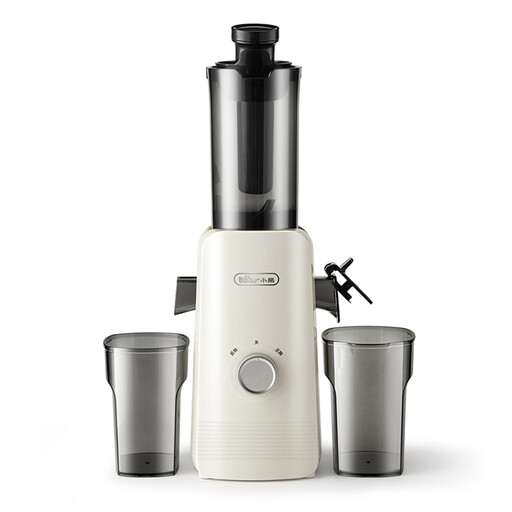
Why this choice suits this profile: Its 1-litre capacity and 80 mm chute make it ideal for first-time daily use, with less chopping needed for many common fruits and vegetables.
The clearly stated opening size stops you from choosing a small-chute model thinking you can always feed whole ingredients in.
1-litre capacity, advertised as quiet operation, rinse-clean design, and a stated yield of up to 99.5% under the manufacturer’s conditions.
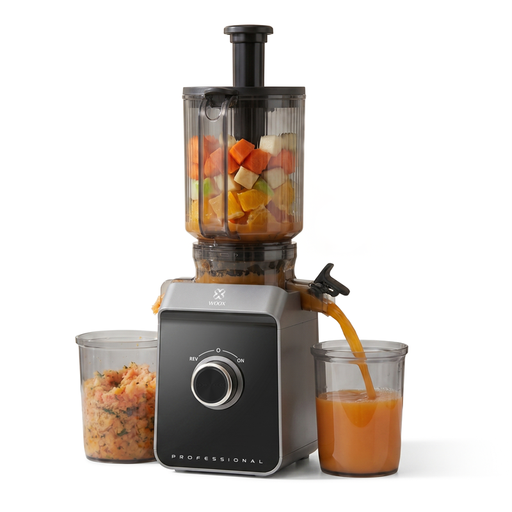
Why this choice suits this profile: Its 1.8-litre chamber and 130 mm chute are designed for households that make larger batches and want to spend less time chopping.
The specifications clearly distinguish the 1.8-litre chamber from the 726 ml juice jug, so you won’t confuse internal capacity with the actual volume you get.
150 W copper motor, removable parts stated as dishwasher-safe, and a noise level rated at under 72 dB.
Why this choice suits this profile: Its large format can work well for users who make several batches in a row, as long as you stick to the cooling breaks and maximum running time.
The manual clearly states not to exceed 10 minutes of continuous use and recommends a 20-minute break if it gets hot, which sets clear boundaries for heavy use.
Large 130 mm chute, overheat protection, and a reverse function to help clear blockages.
We’ve put together a comprehensive, real-time updated list of products that fully meet these strict selection criteria and European safety regulations.
A wide chute allows you to feed some whole fruits and vegetables in, but not all. Very large items still need to be cut. Hard stones, ice cubes, and frozen products are generally not allowed or not recommended, depending on the specific model’s instructions.
An immediate rinse can take just a few minutes when the parts are still damp. Dried-on fibres, on the other hand, need more scrubbing. Models with removable parts that are dishwasher-safe (where the manual allows it) can make daily maintenance much simpler.
It depends on how often you use it, whether you respect the rest periods, how well you clean it, and how you feed ingredients in. Never force the pusher, avoid overloading the machine, and always follow the manufacturer’s stated usage limits.