For repeated espressos, a bean-to-cup machine is worth considering if you are happy to accept its larger footprint, noise and regular maintenance. Capsules and pods prioritise immediate convenience, while a portafilter machine requires more hands-on preparation. A filter coffee machine is best suited to longer coffee prepared in larger quantities.
Which households is it for?
Households that enjoy several espressos a day
You prepare several short coffees every day and want to keep ongoing costs down while making each drink to order. An automatic bean-to-cup machine is worth considering if you are comfortable with the noise, footprint and regular maintenance. UFC-Que Choisir reports that the cost per cup of a bean-to-cup machine can be lower than that of a pod espresso machine.
Busy households looking for a simple cup
You prioritise quick preparation, a compact appliance and minimal daily handling. A capsule or pod machine could be a good choice, provided you check which consumable format it accepts and how readily available it is.
Households that mainly serve longer coffee
You mostly prepare longer coffee at breakfast or several portions at once, rather than individual espressos. In that case, a filter coffee machine remains an option worth comparing.
Buying priorities
Start by considering how often you prepare coffee, then check the maintenance routine and the coffee format you are prepared to use every day.
| Priority |
What to check |
Your needs |
| Frequency and capacity |
Check the capacity of the water tank and bean hopper, whether two cups can be prepared at once and how much handling is needed between several drinks. |
I want to be able to make coffees one after another without having to refill too often. In the OpinionWay study conducted in June 2025 among 1,042 adults in France, 39% said they drank 2 to 3 coffees a day and 21% between 4 and 10. |
| Running costs |
Compare the price of compatible beans, capsules or pods through the retailers you usually use. Separate the cost of consumables from the cost of the appliance. |
I make enough coffees for the cost of consumables to matter over time. UFC-Que Choisir found a lower cost per cup for bean-to-cup machines than for pods in its comparison by machine type. |
| Maintenance and noise |
Consult the instructions for rinsing, emptying the containers, descaling, access to the brew group and cleaning the steam wand or milk system. |
I prefer a maintenance routine that fits around my daily life and an appliance suited to an open-plan kitchen or early-morning preparation. UFC-Que Choisir states that a bean-to-cup machine is generally noisier and takes up more space than a capsule machine or filter coffee maker. |
| Compatible consumables |
Check the capsule format accepted, the range of pods or beans available and local packaging recycling instructions. |
I want to be able to buy the right coffee easily and switch beans if my preferences change. ADEME states that aluminium or plastic capsules are sorted with paper and packaging according to local instructions. |
Mistakes to avoid before buying
-
Comparing only the price of the machine
When several coffees are prepared every day, the budget for beans, capsules or pods can have a significant impact on your decision over time.
Calculate your situation using the household’s actual number of cups and the current price of compatible consumables. Do not apply a comparison between bean-to-cup and capsule machines to pods, portafilter machines or filter coffee makers without comparable data.
-
Choosing a bean-to-cup machine without planning for maintenance
Cleaning the containers and brew group, descaling and maintaining the milk system are all part of regular use. Poor maintenance can affect the appliance’s performance.
Before choosing a model, consult the instructions to find out how often it needs rinsing, emptying and descaling, and how easily you can access the parts that need cleaning.
-
Assuming all capsules are interchangeable
Some appliances are designed for a specific capsule format. Recycling rules may also vary depending on the material and the facilities available near you.
Check the exact format accepted, the range of consumables available from your usual shops and the applicable recycling instructions before buying the machine.
-
Overlooking the noise and footprint of a bean-to-cup machine
UFC-Que Choisir states that an automatic bean-to-cup machine generally takes up more space and produces more noise than a capsule system or filter coffee maker.
Measure the available space and check the model’s dimensions. If noise is a deciding factor, look for a measurement taken using a comparable testing procedure.
Brands to consider in this category
De’Longhi
According to its French catalogue, the brand offers several bean-to-cup espresso ranges in France, including Magnifica, Rivelia, Eletta, Dinamica and PrimaDonna.
- A broad range of bean-to-cup espresso series.
- Differences in noise, maintenance and operation need to be checked on a model-by-model basis.
Krups
Krups is a brand worth considering for bean-to-cup espresso machines: the Intuition Essential EA870810 was among the appliances recently tested by UFC-Que Choisir in France.
- A model featured in a recent independent comparison of bean-to-cup espresso machines.
- This does not mean that the features of one model apply to the brand as a whole.
Melitta
Melitta is also active in the bean-to-cup espresso segment, with the CI Touch Frosted F630-112 and Barista SE F830-003 among the appliances tested by UFC-Que Choisir.
- Several of the brand’s models appear in the segment studied.
- The detailed results needed to compare noise, maintenance or running costs do not apply to the entire brand.
Joybuy options for bean-to-cup espresso
These Joybuy options are automatic espresso machines with built-in grinders, suited to households that regularly prepare individual coffees at home.
 Image unavailable
Philips EP2230/10 Series 2200 LatteGo
Worth considering for preparing coffee and milk-based drinks at home with regular maintenance.
Advertised features include a 1.8 L tank, 275 g bean hopper and two-cup preparation. The brew group is removable and the LatteGo system can be dismantled; the AquaClean filter is compatible but not included.
Check the noise level in real-world use if the machine will be used early in the morning or in an open-plan kitchen.
Joybuy
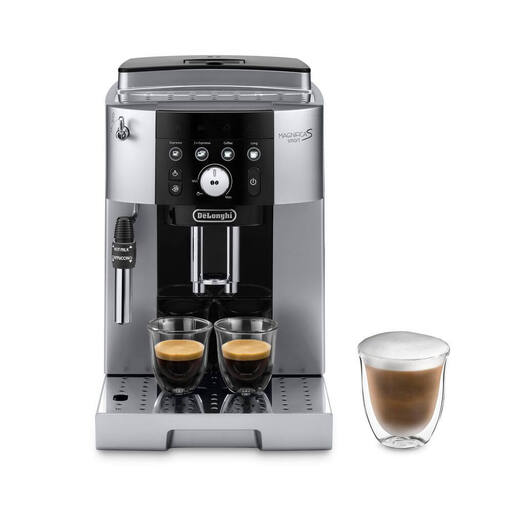 Image unavailable
De’Longhi Magnifica S Smart ECAM250.23.SB
This machine is designed for households that want to prepare espressos, double espressos, coffee or longer coffee from beans.
Advertised features include a 1.8 L tank, 250 g bean hopper, grounds container for 14 cups, four direct recipes and 13 grind settings. The steam wand requires rinsing after milk-based drinks.
Its dimensions of 240 × 440 × 360 mm should be compared with the depth available on your worktop.
Joybuy
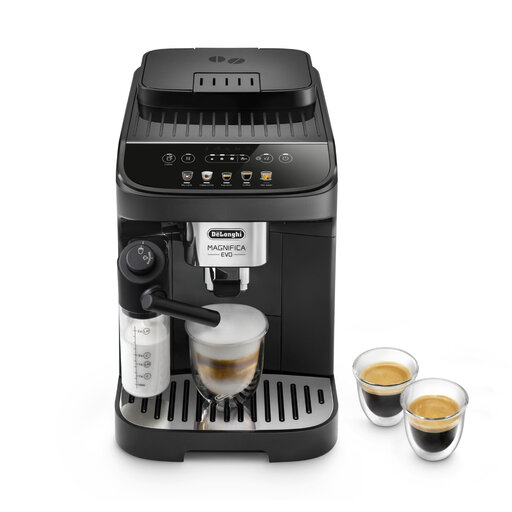 Image unavailable
De’Longhi Magnifica Evo ECAM290.61.B LatteCrema
It could suit a household that regularly prepares coffee and cappuccinos with fewer steps when adding milk.
Advertised features include a 1.8 L tank, 250 g bean hopper, 14-cup grounds container, LatteCrema system and dishwasher-safe carafe. Rinsing and descaling programmes are also listed.
Check the exact recipe configuration and allow time to clean the carafe and milk system.
Joybuy
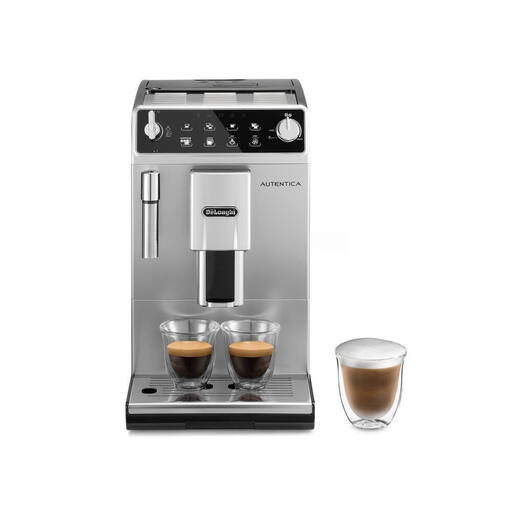 Image unavailable
De’Longhi Autentica ETAM29.510.SB
This model is aimed at households that alternate between short, double and longer coffees, with a manual steam wand for milk-based drinks.
Advertised features include a 1.4 L tank, 200 g bean hopper, 14-cup grounds container, one- or two-cup selection and the option to use pre-ground coffee.
Check whether these capacities match your daily consumption and consult the instructions for the full rinsing and descaling procedures.
Joybuy
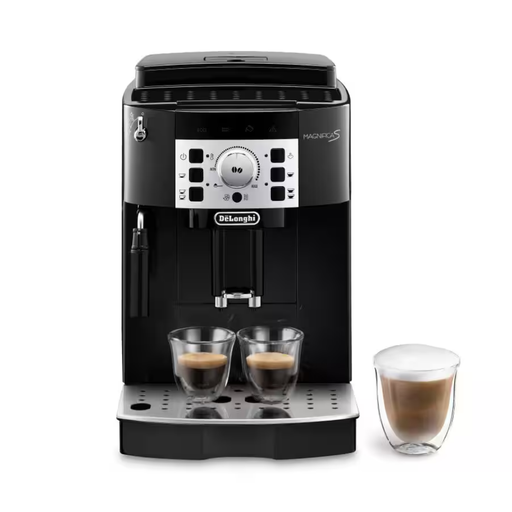 Image unavailable
De’Longhi Magnifica S ECAM22.140.B
It is suitable for households looking for an automatic machine for single or double espressos, using either beans or ground coffee.
Advertised features include a 1.8 L tank, integrated grinder, opening for pre-ground coffee, two-cup preparation and a descaling alert. An aroma selector is explicitly not included.
Check the actual footprint and noise level if space or noise are important criteria.
Joybuy
Frequently asked questions
Can coffee capsules be recycled in France?
Yes. ADEME states that aluminium or plastic capsules should go in the paper and packaging recycling bin, bag or container. Paper capsules can be composted where composting or food-waste collection services are available near your home.
Does a bean-to-cup espresso machine need more maintenance than a basic machine?
Yes. A bean-to-cup machine typically requires the containers to be rinsed, the brewing chamber to be cleaned periodically, the appliance to be descaled when prompted and the steam wand to be rinsed after milk-based drinks. UFC-Que Choisir recommends taking these tasks into account before choosing an automatic machine.
Are compatible capsules available beyond a single brand?
UFC-Que Choisir has tested capsules compatible with Nespresso systems and pods compatible with Senseo in supermarkets and organic shops. This does not guarantee universal compatibility: always check your machine’s exact system and the range available near you.


