What should you compare before buying?
Start with the feature that will have the biggest impact on your routine, then check the details of the model and its compatible consumables.
| What matters to you |
What to check before buying |
Who it matters most to |
| Ease and speed |
Check how many cups the machine can make, which sizes are available and what you need to do to remove used portions. |
If I want to make my coffee with minimal fuss before heading out, I look for a simple brewing process. Around 29% of consumers prioritise everyday convenience. |
| Cost per cup |
Compare the cost of the machine, capsules or pods, ground or whole-bean coffee, and cleaning products over the same period. |
When I make coffee often, I want to understand the ongoing costs, not just the price of the machine. Around 22% of consumers put cost per cup first. |
| Drinks and brewing options |
Check which drinks are listed for the exact model, what settings are available and whether it works with your chosen coffee or portions. |
If I have a particular type of coffee in mind or want to choose how it is made, I check the features rather than relying on the product name alone. Around 21% of consumers put drinks and their settings at the top of their list. |
| Space and capacity |
Measure the space available and check you can reach the water tank, then compare the machine’s full dimensions and tank capacity in litres. |
In a kitchen with limited worktop space, I want to avoid a machine that takes up too much room or needs refilling more often than suits my habits. Around 14% of consumers prioritise available space or useful capacity. |
| Maintenance and waste |
Check the manual for cleaning and descaling instructions, and find out how to dispose of the consumable you choose. |
If I want cleaning and disposing of used portions to fit into my routine, I look into these tasks before choosing. Around 14% of consumers make maintenance and waste their main priority. |
Coffee machines available on Joybuy
This selection includes capsule machines, a semi-automatic model and machines with grinders, so you can compare portion systems, manual brewing and whole-bean coffee. For an appliance covered by the European Low Voltage Directive, which applies subject to its exclusions to equipment rated from 50 to 1,000 V AC, check the model’s rated voltage and compliance information. The DGCCRF reminds consumers that CE marking is not an independent certification.
 No image available
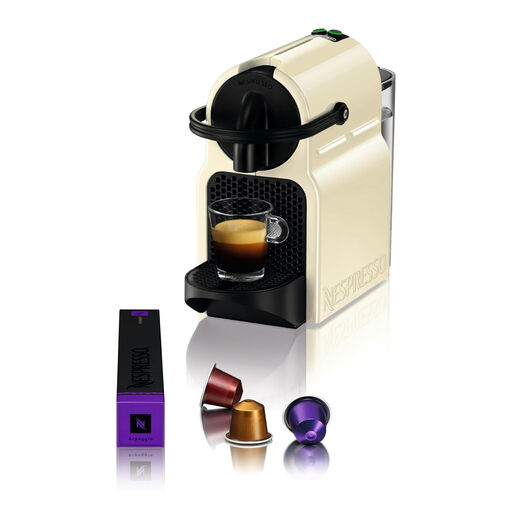
Nespresso EN80.CW Inissia, cream white
For espresso or lungo with minimal fuss, the listing says it has two programmable cup sizes and automatically ejects used capsules.
0.7 L tank; stated dimensions of 120 × 321 × 230 mm.
Joybuy
 No image available
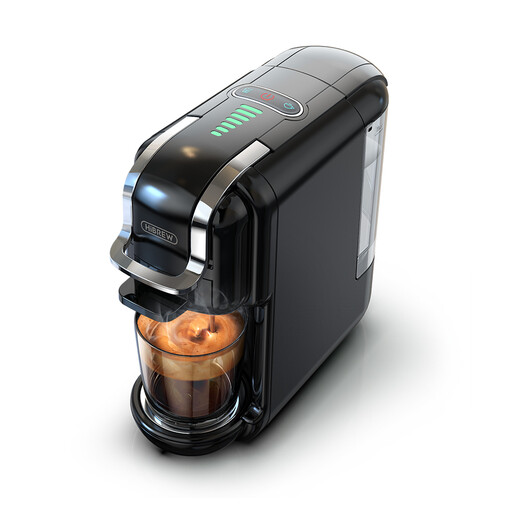
HiBREW H2B, 5-in-1 coffee machine
For more choice of portions, the listing says it comes with several capsule adapters and an option for ground coffee. Hot and cold modes are also listed.
Stated tank capacity of 600 ml. Formats listed include Dolce Gusto, Nespresso and E.S.E.; mugs over 3.8 inches tall are listed as incompatible.
Joybuy
 No image available
HiBREW H10B, semi-automatic espresso machine
For more control over brewing and to make milk-based drinks, the listing says it offers adjustable settings and a milk frother.
Removable 1.3 L tank and 51 mm portafilter. The stated adjustable volume is 35 to 300 ml, with temperature settings and a cold mode.
Joybuy
 No image available
Philips EP2230/10 Series 2200 LatteGo, glossy black
For making coffee from beans and milk-based drinks, the listing says it has an integrated grinder and the LatteGo system.
Listed with a grinder offering 12 settings and a 1.8 L tank. The two-cup function cannot make two milk-based drinks at the same time.
Joybuy
 No image available
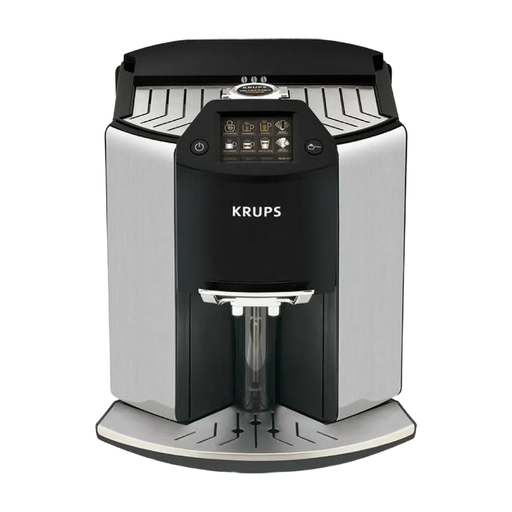
Krups EA907D10 Barista, 1.7 L, black and stainless steel
For a choice of bean-to-cup drinks, the listing says it offers 17 options, including espresso and cappuccino, with an integrated grinder and milk frother.
1.7 L tank and 1,450 W power stated in the product name. Rinse and descaling programmes are also listed.
Joybuy
Frequently asked questions
How can I compare the cost of two systems if I make coffee every day?
Compare the same number of cups over the same period, taking into account the price of the machine, consumables and maintenance. For portion-based systems, divide the pack price by the number of portions used. For ground or whole-bean coffee, work out the cost using the amount you actually use per cup. UFC-Que Choisir distinguishes between the initial cost and the cost of each coffee, so the result depends on how much you drink and which system you choose.
Can you use a SENSEO pod as an E.S.E. pod in a portafilter machine?
Don’t assume these formats are interchangeable. Philips describes the CSA210/50 as a SENSEO pod machine, while De’Longhi lists E.S.E. compatibility for the Dedica Style EC685.BK EX:4. Check which format the machine specifically accepts and whether it matches the consumable you want to use.
How often should you descale a SENSEO machine?
Philips recommends descaling its SENSEO machines every three months, more often if your water is very hard or the indicator light comes on. This is the manufacturer’s recommendation, so follow the instructions in the manual for your specific model.
What safety requirements should you check for an electrical machine sold in France?
For equipment covered by the European Low Voltage Directive, subject to its exclusions, the scope includes products designed to operate between 50 and 1,000 V AC, and CE marking is required. Check the rated voltage and compliance information for the exact model. The DGCCRF reminds consumers that CE marking is not an independent certification.
Where should you dispose of used capsules in France?
ADEME says aluminium or plastic capsules can go in the recycling bin, bag or container for paper and packaging. Paper capsules can be composted or put in a food-waste collection if this service is available near you. Check the material your capsules are made from and the local recycling options available.


