If your water seems hard, first check the results available for your local area or water supply. Then look for a machine whose instructions explain how to adjust the water hardness, if applicable, and how to descale it. Only factor in a filter if it’s compatible with the model you’re considering and you’re happy to replace it; having a filter doesn’t automatically mean you can skip descaling.
Who are these criteria useful for?
Water hardness, consumables and the time needed for maintenance don’t matter equally to everyone when choosing a coffee machine.
Households wondering about their local water
If your water seems hard, start by checking the results available for your local area or water supply from the government department responsible for health. You can then compare the adjustment options and maintenance instructions for the model you’re considering, rather than assuming that water has the same level of hardness everywhere in France.
Buyers considering a bean-to-cup espresso machine
If you’re considering a filter cartridge, check which one is suitable for the exact model and how you’ll be told when to replace it. Also think about descaler and, if the machine has a milk system, the cleaning products recommended for it.
People who want guided maintenance
A descaling alert and clear instructions may matter more to you than having a filter. Check the rinsing steps and recommended products in the manual: filtering and descaling are two separate tasks.
What should you compare before buying?
Start with the water supplied to your home, then check the manual for each model. A hardness setting, compatible filter and descaling programme each address different needs.
| What to check |
Points to consider |
Your needs |
| Water hardness |
Check the results for your local area or water supply from the government department responsible for health. Then see whether the manual explains how to test or adjust the hardness, and how to do so. |
I want to set up the machine based on the water I use, not just my impression that it’s hard. De’Longhi says that, on the relevant bean-to-cup models, the hardness setting determines how often you need to descale. |
| Compatible filter |
Check which cartridge is approved for the machine, when it should be replaced and its stated capacity under the conditions of use. JURA says the capacity of a CLARIS Smart+ cartridge depends on water hardness. |
If I choose a machine with a filter, I want to be able to get the right cartridges and be happy to replace them regularly. Simply stating that a machine has a filter doesn’t tell me when it needs changing. |
| Descaling |
Check whether there’s an alert, which programme to follow, which product to use and what rinsing steps are required. For the model you’re considering, check whether the filter needs to be removed before descaling. |
I’d prefer a process I can follow from start to finish. Philips says that machines using AquaClean still need descaling after eight filter cycles: a filter doesn’t remove this task. |
| Other consumables |
Check the instructions separately for the water system, brew group and, where applicable, milk system. Only use a descaler or cleaner if it’s recommended or approved for that model. |
Before buying, I want to know which products I’ll need for the maintenance I actually have to do, without confusing a water filter with descaler or milk-system cleaner. |
What pitfalls should you avoid?
-
Relying only on the assumption that your water is “hard”
A general impression isn’t enough to choose a hardness setting. The government department responsible for health makes water quality test results available by local area or water supply; De’Longhi says this setting affects how often you need to descale its relevant models.
Check the information for your water supply, then follow the testing or adjustment method in the manual for the model you choose.
-
Assuming you only need to buy a filter once
A compatible cartridge is a consumable that needs replacing. Its capacity can vary depending on the system and water hardness. Philips also says that machines using AquaClean still need descaling after eight filter cycles.
Before choosing a machine because of its filter, compare the cartridge model, replacement guidance and descaling process.
-
Choosing a “similar” cleaning product
A filter, descaler and milk-system cleaner all serve different purposes. Instructions for removing the filter, descaling and rinsing vary from machine to machine.
Look up the full model reference in its manual and use the consumables recommended or explicitly approved there.
-
Forgetting how long maintenance takes
Descaling involves more than responding to an alert: the process may include several steps and a rinse cycle that needs to be completed as instructed.
If you’d like a guided routine, check how the programme works and what alerts it gives before you buy. Then set aside time to complete the full cycle.
Which brands explain these features?
These examples show how different brands approach maintenance. Always check the features and consumables available for the specific machine you’re considering.
De’Longhi
The brand provides information about hardness settings and descaling for some of its bean-to-cup espresso machine ranges, including Magnifica Evo.
- De’Longhi says the hardness setting on its relevant models determines how often you need to descale.
- Check the filter and descaling instructions for the exact model. Instructions for a Magnifica Evo won’t necessarily apply to another machine.
Philips / Saeco
AquaClean is a filter system to consider if the Philips or Saeco machine you choose supports its installation and activation.
- Philips explains how to activate AquaClean with step-by-step guidance on compatible Saeco machines.
- Philips says that the relevant machines still need descaling after eight filter cycles. Check the alerts for your specific model.
JURA
The CLARIS Smart+ cartridge may interest buyers who want to consider filtration in relation to their water hardness.
- JURA says the capacity of this cartridge depends on the hardness of the water.
- Check that CLARIS Smart+ is compatible with the specific machine and follow the applicable replacement instructions.
Melitta
Melitta offers Pro Aqua cartridges for its automatic espresso machines, alongside descaling instructions.
- Melitta’s product information identifies Pro Aqua as a filter consumable to consider for a compatible machine.
- Having a cartridge doesn’t replace the regular descaling recommended by Melitta. Check the instructions for your model.
A machine to consider on Joybuy
This bean-to-cup espresso machine may be worth considering if you value a descaling alert and an easy-to-clean brew group. Before choosing it for hard water, check the manual for the exact model to find out how to adjust the hardness, whether a filter is compatible and which cleaning products are approved.
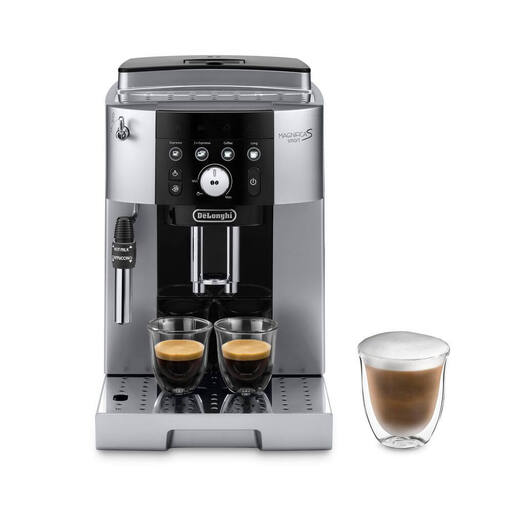 Image unavailable
De’Longhi Magnifica S Smart ECAM250.23.SB, silver
For a maintenance routine guided by alerts, the product description says to start the descaling programme when prompted by the machine. This automatic espresso machine has a grinder and a removable brew group that you can rinse. Before choosing your consumables, check the ECAM250.23.SB manual for any hardness settings, compatible filters and the full descaling process.
View on Joybuy
Frequently asked questions
How can I find out how hard the water is where I live?
Check the water quality test results available by local area or water supply from the government department responsible for health. If you’re setting up a machine, also follow the testing or adjustment method in your model’s manual. Don’t base the setting on a general impression of the water in your area.
Should I choose a coffee machine with a filter?
Not necessarily. Choose one with a filter if the manufacturer offers a compatible option for your model and you’re happy to replace the cartridge as instructed. Also compare any hardness settings and the descaling programme, as these tasks aren’t interchangeable.
Does an AquaClean filter eliminate the need to descale?
No. Philips says that machines using AquaClean still need descaling after eight filter cycles. Check the alerts and instructions for your model rather than assuming a filter means you’ll never need to descale.
How often should you descale a machine if the water is very hard?
ADEME recommends descaling at least once a year, and up to three or four times a year if the water is very hard. It also recommends following the manufacturer’s instructions and using its recommended product. For your machine, follow its alerts and descaling instructions first.


